

By using this site, you agree to the Privacy Policy and Disclaimer.
Accept
FinpearlsFinpearlsFinpearls
  • Home
  • Our Blogs
    • Personal Development
    • Economics
    • Finance
    • Technology
  • About Us
  • Privacy Policy
  • Contact Us
Reading: What Is Fractional Reserve Banking? How It Works and How It’s killing Economy in the 21st Century
Share
Sign In
Notification Show More
Font ResizerAa
Font ResizerAa
FinpearlsFinpearls
  • Finance
  • Economics
  • Personal Development
  • Technology
  • Home
  • Our Blogs
    • Personal Development
    • Economics
    • Finance
    • Technology
  • About Us
  • Privacy Policy
  • Contact Us
Create Your Account Sign In
Follow US
© 2023 Finpearls All Rights Reserved Created By Mustufa
Finpearls > Blog > Economics > What Is Fractional Reserve Banking? How It Works and How It’s killing Economy in the 21st Century
EconomicsBlog

What Is Fractional Reserve Banking? How It Works and How It’s killing Economy in the 21st Century

Finpearls
Last updated: 2026/03/09 at 2:53 AM
By Finpearls 8 Min Read
Share
Fractional Reserve Banking by Finpearls
Symbolic illustration of fractional reserve banking: A glass vault where deposits multiply into loans via the money multiplier effect, with only a small reserve portion locked, highlighting money creation in the modern banking system.
SHARE

In today’s complex financial landscape, fractional reserve banking stands as a cornerstone of the modern banking system, enabling commercial banks to create money and drive economic activity. This practice, often linked to money supply expansion, reserve requirements, and monetary policy, allows banks to lend out more than they hold in deposits, fueling growth but also raising concerns about inflation, currency devaluation, and economic inequality. While it empowers central banks and financial institutions to manage the economy, critics argue it disproportionately benefits the elite, perpetuating a debt-based economy through mechanisms like the money multiplier effect. Understanding how fractional reserve banking works reveals hidden realities in our financial world, from loan creation to potential recessions and hyperinflation.
Contents
How Fractional Reserve Banking Works: The Basics ExplainedHow Commercial Banks Lend Money: The Hidden Debt CycleDisastrous Effects of Fractional Reserve Lending on SocietyConclusion: Navigating the Flaws of Modern Banking
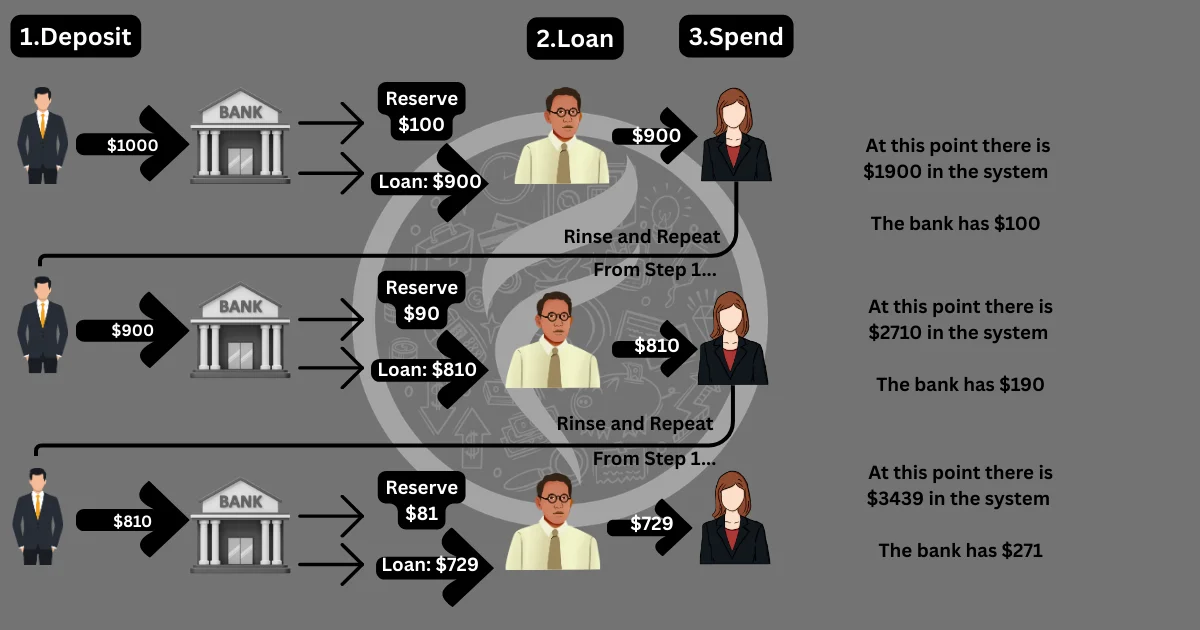
Fractional reserve banking diagram illustrating money creation, reserve requirements, and the bank lending process in a debt-based economy with the money multiplier effect.
Visual breakdown of the fractional reserve banking process, showing how deposits lead to loans and expanded money supply through reserve requirements.

How Fractional Reserve Banking Works: The Basics Explained

Fractional reserve banking is a system where commercial banks are required to hold only a fraction of customer deposits as reserves, typically around 10% in many jurisdictions, while lending out the rest. This reserve requirement is set by central banks like the Federal Reserve to ensure stability, but it also amplifies the money supply through repeated lending cycles.

Here’s a step-by-step breakdown of how banks create money under this model:

  • Deposits as the Foundation: When you deposit money into a savings or checking account, the bank records it as a liability but treats most of it as an asset for lending.
  • Reserve Rules in Action: If the reserve ratio is 10%, a $1,000 deposit means the bank must keep $100 in reserves and can lend out $900.
  • The Money Multiplier Effect: The loaned $900 becomes a new deposit elsewhere, allowing another bank to lend $810 (90% of $900), and so on. This chain reaction can theoretically expand the initial deposit up to 10 times, creating “money out of thin air.”
  • Role of Central Banks: Monetary policy tools, such as adjusting interest rates or reserve ratios, help control this process to prevent excessive money creation.

This mechanism supports economic growth by providing liquidity for businesses and individuals, but it relies on trust that not all depositors will withdraw funds simultaneously, a scenario known as a bank run.
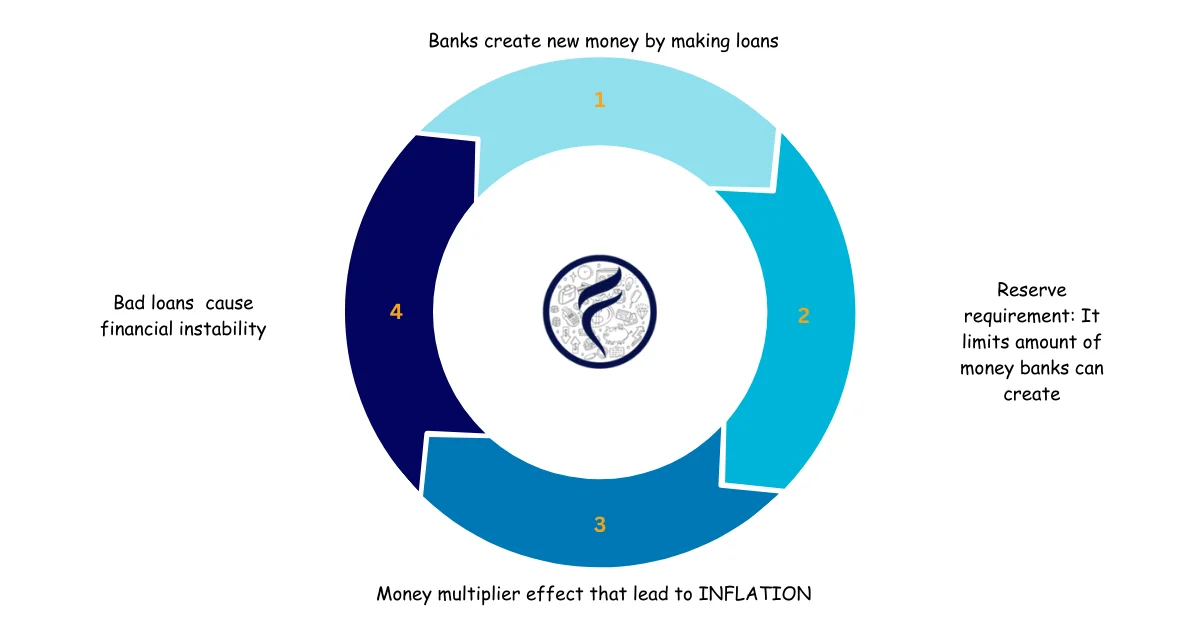
Money multiplier effect infographic in fractional reserve banking system, explaining reserve ratios, loan creation, and impacts on monetary policy and inflation risks
Infographic depicting the money multiplier effect in commercial banking, highlighting how central bank reserves and loans influence money supply and economic growth

How Commercial Banks Lend Money: The Hidden Debt Cycle

At first glance, commercial bank lending seems straightforward: Banks take deposits and issue loans to borrowers, earning interest income. However, under fractional reserve lending, the process is far more intricate, often leading to a debt-based economy where money is created through borrowing.

Consider this simple example to illustrate how banks create money:

  1. John deposits $1,000 in Bank A.
  2. Bank A keeps $100 (10% reserve) and lends $900 to Sarah.
  3. Sarah spends the $900, which ends up deposited in Bank B.
  4. Bank B keeps $90 and lends $810 to another borrower.
  5. This cycle continues, potentially adding up to $10,000 in new money from the original $1,000.

Banks may even lend before receiving deposits by borrowing from other institutions or the central bank, exacerbating money supply growth. While this boosts short-term buying power and stimulates demand, it sows seeds for long-term issues like inflation and recession. Borrowers, enticed by easy credit for mortgages, credit cards, or student loans, often find themselves trapped in debt, as seen in the U.S. where student loan debt has ballooned to over $1.6 trillion.
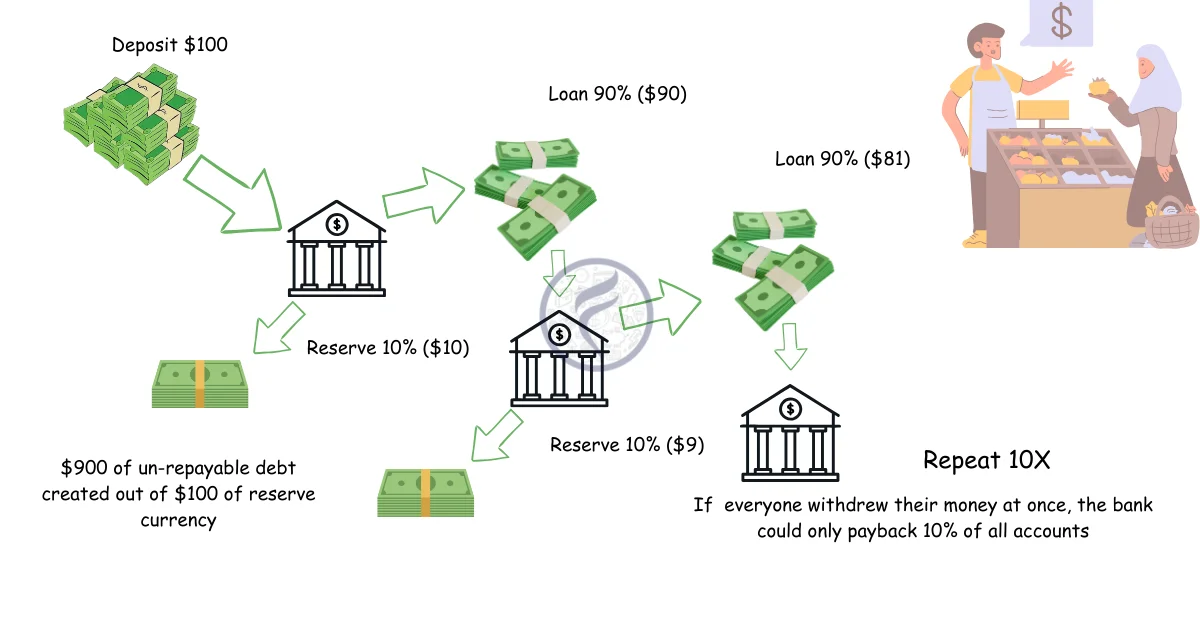
Debt cycle diagram in fractional reserve banking, demonstrating money creation out of thin air, currency devaluation, and boom-bust cycles in a debt-based economy.
Illustration of the debt cycle in fractional reserve lending, showing UNREPAYABLE debt creation from initial deposits and repeated bank loans.

Disastrous Effects of Fractional Reserve Lending on Society

While fractional reserve banking drives economic expansion, its downsides can be profound, contributing to currency devaluation, hyperinflation, and widening economic inequality. By injecting excess money into the economy, banks inflate demand without matching supply increases, leading to skyrocketing prices.

Key negative impacts include:

  • Inflation and Hyperinflation: Rapid money supply growth erodes purchasing power, as more dollars chase fewer goods. Historical examples, like post-World War I Germany, show how unchecked lending can spiral into economic chaos.
  • Boom-and-Bust Cycles: During booms, low interest rates encourage borrowing; but when bubbles burst, central banks implement contractionary monetary policy, raising rates and tightening lending. This triggers recessions, job losses, and reduced buying power for the average person.
  • Debt Burdens on the Masses: Everyday people face mounting debts from installment plans and credit card loans, while the elite capitalize on cheap assets during downturns. Governments often bail out debts (e.g., recent student loan forgiveness) using taxpayer money, shifting the burden.
  • Power Imbalance: Banks wield immense influence, often surpassing governments in controlling monetary policy. As Mayer Amschel Rothschild famously stated: “Permit me to control the money of a nation, and I care not who makes its laws.” This underscores how the system favors the 1%, perpetuating elite domination.

These effects highlight why fractional reserve banking is criticized as a tool for systemic inequality, turning economic stability into a privilege for the few.

The hidden reality of fractional reserve banking: A single deposit multiplies into loans and new money, but the bank only keeps a fraction in reserve. leaving ordinary people with devalued currency and growing debt burdens.
How fractional reserve banking works in simple terms: Deposits enter the bank, but through the money multiplier effect, banks lend far more than they hold, creating new money “out of thin air” while the system leaks value through inflation and debt cycles.

Conclusion: Navigating the Flaws of Modern Banking

The modern banking system, built on fractional reserve lending, offers undeniable benefits like credit access and growth but poses risks of widespread debt and instability. To mitigate these, authorities must carefully balance money supply through prudent monetary policy and reserve adjustments. Individuals can protect themselves by learning about finance, investments, and value creation—focusing on building wealth rather than relying on borrowed funds for unnecessary purchases.

If you’re concerned about economic inequality or want to explore alternatives like full reserve banking, consider educating yourself on personal finance strategies to avoid the debt trap. What are your thoughts on how banks create money? Share in the comments below! For more insights, check out our articles on inflation causes and investment tips for beginners.


You Might Also Like

2024, Breaking Ground: SEC Greenlights Bitcoin ETFs Amidst a Muddled Message – Untangling Regulatory Signals!

WHAT IS BRICS? ITS EXPANSION IN 2024, CHANGING GLOBAL DYNAMICS  

HOUTHI RED SEA ATTACKS: EMERGING GLOBAL TRADE CRISIS   

UNRAVELING THE RECESSION: CAUSES, CONSEQUENCES, AND ITS IMPACT ON NATIONS AND PEOPLE

MONETARY POLICY AND ITS EFFECTS: CENTRAL BANKS ARE THE REAL DEEP STATE

TAGGED: banking system, commercial banks, economic inequality, fractional reserve banking, inflation, Monetary policy, Money supply, recessions, reserve requirements
Share This Article
Facebook Twitter Pinterest Whatsapp Whatsapp LinkedIn Copy Link Print
Previous Article Approval of Bitcoin EFT's by SEC 2024, Breaking Ground: SEC Greenlights Bitcoin ETFs Amidst a Muddled Message – Untangling Regulatory Signals!
Next Article Rich vs poor mindset comparison showing how positive thinking and success habits lead to financial success and freedom 5 Proven Steps Rich People Use to Achieve Financial Success
2 Comments
  • fitspresso real reviews says:
    March 17, 2024 at 3:37 am

    Your blog has become my daily dose of positivity and inspiration It’s a space that I always look forward to visiting

    Reply
  • Purchase biolean says:
    March 27, 2024 at 2:38 am

    Usually I do not read article on blogs however I would like to say that this writeup very compelled me to take a look at and do it Your writing style has been amazed me Thank you very nice article.

    Reply

Leave a Reply Cancel reply

Your email address will not be published. Required fields are marked *

Stay Connected

Facebook Like
Pinterest Pin
Instagram Follow
- Advertisement -
Ad image

Latest News

Rich vs poor mindset comparison showing how positive thinking and success habits lead to financial success and freedom
5 Proven Steps Rich People Use to Achieve Financial Success
Personal Development
Approval of Bitcoin EFT's by SEC
2024, Breaking Ground: SEC Greenlights Bitcoin ETFs Amidst a Muddled Message – Untangling Regulatory Signals!
Technology Blog Economics Finance
BRICS; CHANGING WORLD DYNAMICS
WHAT IS BRICS? ITS EXPANSION IN 2024, CHANGING GLOBAL DYNAMICS  
Economics Blog Finance
Houthis attacks in Red Sea, emerging trade crisis
HOUTHI RED SEA ATTACKS: EMERGING GLOBAL TRADE CRISIS   
Economics Blog Finance

You Might Also Like

Approval of Bitcoin EFT's by SEC
TechnologyBlogEconomicsFinance

2024, Breaking Ground: SEC Greenlights Bitcoin ETFs Amidst a Muddled Message – Untangling Regulatory Signals!

January 19, 2024
BRICS; CHANGING WORLD DYNAMICS
EconomicsBlogFinance

WHAT IS BRICS? ITS EXPANSION IN 2024, CHANGING GLOBAL DYNAMICS  

January 14, 2024
Houthis attacks in Red Sea, emerging trade crisis
EconomicsBlogFinance

HOUTHI RED SEA ATTACKS: EMERGING GLOBAL TRADE CRISIS   

January 6, 2024
Recession
Economics

UNRAVELING THE RECESSION: CAUSES, CONSEQUENCES, AND ITS IMPACT ON NATIONS AND PEOPLE

November 4, 2023
Previous Next

Subscribe to our newsletter

Check your inbox or spam folder to confirm your subscription.

Finpearls is a financial blog with a central mission of combatting the widespread issue of financial illiteracy in society. Our primary goal is to deliver valuable content covering a range of topics, including corporate finance, economic analysis, self-improvement, and personal finance.

  • info@finpearls.com

Categories

  • Finance
  • Personal Development
  • Economics
  • Technology
  • Finance
  • Personal Development
  • Economics
  • Technology

Links

  • About Us
  • Privacy Policy
  • DISCLAIMER
  • My Bookmarks
  • About Us
  • Privacy Policy
  • DISCLAIMER
  • My Bookmarks

©2023 Finpearls, all rights reserved