
The Big Picture
Elon Musk has promised to give one SpaceX share to every child in America next year. Based on a reported share price of $146.03 and an estimated 73 million children under 18, the proposed giveaway could represent roughly $10.6 billion in stock. But how the shares will be distributed, and what they could eventually be worth, remains unclear.
Imagine your child receiving an investment worth around $146 without you having to buy it. It might not sound life-changing today, but what if that investment grows over the next 10 or 15 years?
That is the idea behind Elon Musk’s latest pledge. Instead of giving children cash, he says he will give them a share in SpaceX, the company associated with rockets, space exploration and Starlink satellite internet.
It is an extraordinary promise. Yet the important questions go beyond the headline: Can Musk deliver it? How would millions of children receive their shares? And could a single share genuinely make a difference to a child’s financial future?
By the end of this article, you’ll understand:
- What Musk actually promised and when he intends to deliver it.
- Why the estimated giveaway could be worth $10.6 billion.
- How the shares might reach millions of children.
- What one share could mean financially, and what it cannot guarantee.
- Whether this could become a meaningful starting point for children’s wealth.
What Exactly Did Elon Musk Promise?
On October 19, 2026, Musk posted on X:
“Next year, I will give one of my SpaceX shares to every kid in America. This will be the first of many.”
The statement is straightforward: Musk intends to distribute one of his SpaceX shares to every child in America in 2027.
But there is an important distinction between announcing a plan and completing it.
Musk has not publicly provided a complete distribution plan explaining who will qualify, how children will be identified, when the transfers will happen, or what restrictions might apply to the shares.
For example, does “every kid in America” mean every person under 18 living in the United States, only American citizens, or children who meet certain eligibility requirements? His announcement did not settle these questions.
The proposal concerns SpaceX shares, not Tesla shares. And until the distribution details are confirmed and the shares are transferred, families should treat it as a pledge rather than money or stock they can already claim.
Why Could the Giveaway Be Worth $10.6 Billion?
The estimated scale becomes easier to understand with a simple calculation.
Reports put the number of children under 18 in the United States at roughly 73 million. A reported SpaceX share price of $146.03 provides a basis for estimating the value of one share.
| Calculation | Estimate |
| Children under 18 in the United States | 73 million |
| Reported value of one SpaceX share | $146.03 |
| Estimated value per child | $146.03 |
| Approximate total market value | $10.6 billion |
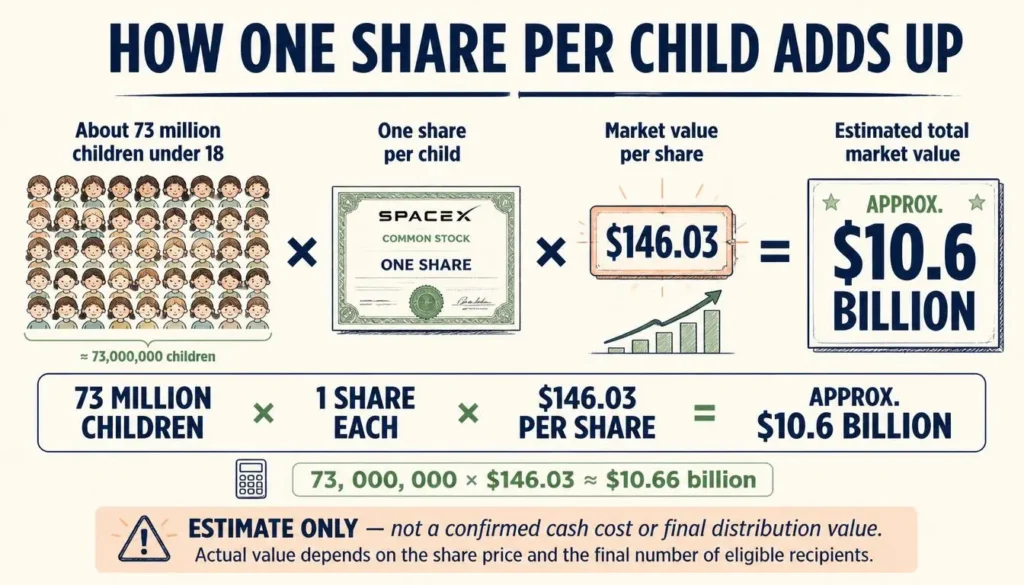
The total is calculated by multiplying the estimated number of children by the reported price of one share. The figures are estimates, not a confirmed budget or final cost.
There is another important point: $10.6 billion in stock is not the same as $10.6 billion in cash.
Musk would be transferring ownership in a company, rather than handing every child cash of equivalent value. The final market value could change before the distribution, and the value of the shares could rise or fall afterward.
Still, the estimate gives the public a sense of the scale of the promise. Even if each gift appears modest compared with the value of a major company, distributing shares to millions of people adds up to an enormous commitment.
Can Musk Actually Give Away That Many Shares?
The estimated total sounds enormous, but the relevant question is not simply how much the shares are worth. It is whether Musk can transfer enough shares and arrange the distribution legally and practically.
Musk is SpaceX’s founder and largest individual shareholder, according to reporting on the company. That gives him a substantial ownership stake from which a large transfer could potentially be made.
However, a shareholder cannot make a large-scale giveaway happen merely by announcing it. The transfer would need a workable process, clear eligibility rules and arrangements for holding shares on behalf of children.
There are also questions about the type of shares recipients would receive and the rights attached to them. Owning a share does not necessarily mean having the same voting power as every other shareholder, particularly where a company has different classes of stock.
These details matter because the value of a gift is only part of what determines what a recipient actually receives.
So, is the pledge financially possible? The available reporting suggests Musk has substantial shareholdings. But the precise number of shares to be distributed, the structure of the transfers and the final eligibility rules have not been fully established publicly.
How Could Millions of Children Receive Their Shares?
Giving stock to millions of children is more complicated than sending a cash payment. Children generally cannot manage investment accounts in the same way adults can, so a distribution on this scale would need an appropriate legal and administrative structure.
One possible route is the US government’s Trump Accounts, investment accounts designed for eligible children. In July 2026, the US Treasury said certain donations of readily tradable public-company stock could be accepted into eligible Trump Accounts.
That makes these accounts a possible mechanism for a stock giveaway. However, Musk has not confirmed a complete distribution plan, so it would be premature to say that every child will receive a share through these accounts.
If such accounts were used, parents or guardians would need to understand the account rules, including restrictions on access and withdrawals. A share held in a child’s investment account is not necessarily equivalent to cash that the family can spend immediately.
The practical questions remain significant: Who will qualify? How will the accounts be funded or identified? What happens to children who do not have an eligible account? And when will the shares actually arrive?
Until those questions are answered, the method of distribution remains uncertain.
What Would One SpaceX Share Actually Give a Child?
At the reported price of $146.03, one share would represent an investment of around $146 at that point in time. But it would not guarantee that the child could immediately withdraw that amount as cash, nor would it promise a particular future return.
The difference is important. A share represents ownership in a company, and its market value can change as the company’s prospects and investor expectations change.
Consider three simple examples using a rounded starting value of $150:
| If the share price… | Investment value | Gain or loss |
| Rises to $300 | $300 | $150 gain |
| Stays at $150 | $150 | No gain or loss |
| Falls to $90 | $90 | $60 loss |
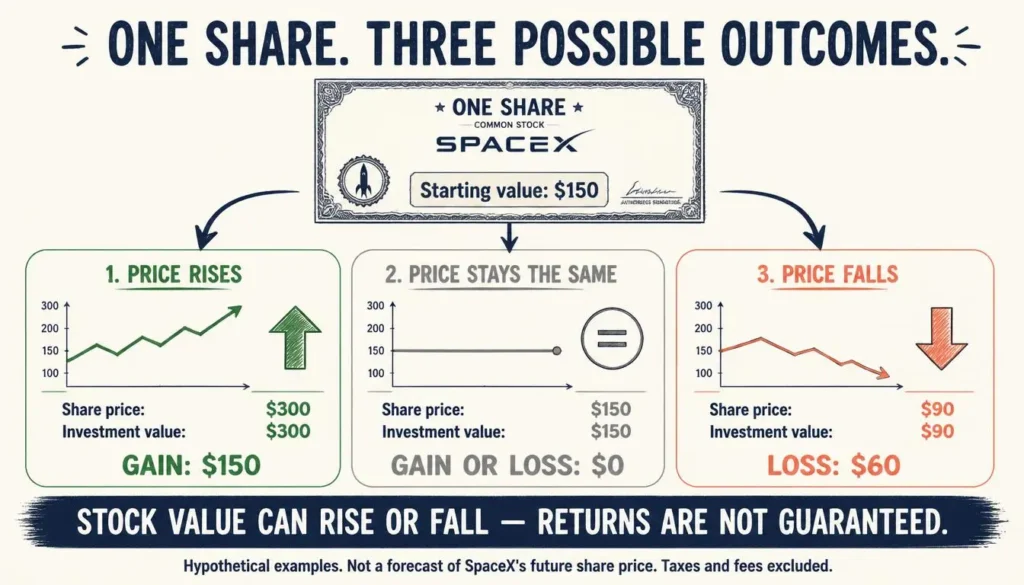
These examples are illustrations, not predictions about SpaceX. They also exclude taxes, fees and any restrictions affecting the sale or transfer of the shares.
This is the central lesson: receiving a share is not the same as receiving guaranteed wealth. Its eventual value depends on what happens to the business, how the market values it and whether the child can access or sell the investment under the applicable rules.
Could One Share Become Meaningful by the Time a Child Turns 18?
Potentially, but there is no guarantee.
Imagine a child receives a share worth around $146 and holds it for 10 years. If the share price rises substantially over that period, the investment could become worth considerably more. If the company struggles or investors become less optimistic, the value could fall instead.
For perspective, if an investment worth $146 grew at a hypothetical annual rate of 8% for 10 years, it would be worth about $315 before taxes and fees. That is a mathematical illustration of compound growth, not a forecast for SpaceX. A single share’s actual return would depend on its changing market price and any distributions or corporate actions.
Even if the value grows, one share alone is unlikely to guarantee financial independence or cover major expenses such as university, housing, or starting a business.
Its significance could be different: it might give a young person an early experience of ownership. They could learn how a company creates value, why prices fluctuate, and why long-term investing involves uncertainty.
That lesson is more useful when it is paired with financial education. A child who understands investing may be better prepared to make decisions about saving, risk and diversification later in life.
Is This a New Way to Share Wealth?
Musk’s proposal raises a bigger question: should people benefit from economic growth through direct ownership of companies, rather than receiving money through traditional donations or government support?
The announcement followed a move by Anthropic to establish a public-benefit fund involving company shares. Musk had advocated giving shares directly to the public before announcing his own plan for children.
The approaches are different. A fund can use its resources to support selected public-benefit goals, while giving shares directly to individuals would give recipients a personal financial interest in a company.
Direct ownership has potential advantages. If the investment grows, the recipient may benefit from that growth. But it also transfers investment risk to the recipient: the value can fall, and the benefits may be unevenly distributed.
A company share is not a substitute for every form of support a child might need. Nor does one gift automatically solve broader issues such as unequal access to education, housing or financial opportunities.
The real test will be how the proposal is implemented, what recipients actually receive and whether the gift provides lasting benefits beyond the announcement itself.
The Bottom Line: A Big Promise, With Important Questions Still Open
Elon Musk’s pledge to give one SpaceX share to every American child could represent roughly $10.6 billion in stock, based on reported figures available around the announcement. If delivered, it would introduce millions of children to company ownership through an investment they did not have to purchase themselves.
But the estimated value is only the starting point. The eligibility rules, distribution method, timing and rights attached to the shares all matter. So does the future performance of SpaceX: the value of the gift could rise, stagnate or fall.
For parents, the sensible response is to follow the confirmed details rather than count the proposed share as part of a child’s finances today.
And for children who do receive one, the lasting value may depend on more than the share price. Understanding what ownership means, and how to make informed financial decisions, could be one of the most useful lessons the gift offers.
Frequently Asked Questions
Did Elon Musk promise to give a SpaceX share to every American child?
Yes. On October 19, 2026, Musk posted on X that he would give one of his SpaceX shares to every child in America the following year. He described the proposal as the first of many such gifts. However, he has not yet publicly explained all eligibility requirements or distribution arrangements.
When are children expected to receive the SpaceX shares?
Musk said he intended to make the distribution in 2027. He has not announced a confirmed distribution date or published a complete process explaining how recipients will be identified and how the shares will be transferred.
How much could each child’s SpaceX share be worth?
Reports cited a share price of $146.03 around the announcement, which would put the initial estimated value of one share at roughly $146. That value can change with the market, so it should not be treated as a guaranteed payment or a forecast of future returns.
Can Musk afford to give every child a share?
Musk holds a substantial stake in SpaceX, making a large share transfer potentially feasible. But the final number of shares, the eligibility rules and the transfer arrangements have not been fully detailed publicly. The estimated total market value alone does not establish how the distribution will be carried out.
Will the shares be distributed through Trump Accounts?
Trump Accounts are one possible route because US Treasury guidance allows certain donations of readily tradable public-company stock into eligible accounts. However, Musk has not confirmed a final distribution mechanism, so it is not yet established that every recipient will receive a share through these accounts.
Could one SpaceX share make a child rich?
One share could increase in value, but it could also lose value. Even a substantial gain would not automatically make a child wealthy. The outcome would depend on SpaceX’s future performance, the market price and any applicable taxes, fees or account restrictions.
Can a child sell the share immediately?
That depends on how the shares are transferred and whether they are held in an account with restrictions. If the gift is placed in a child-focused investment account, access and withdrawal rules may apply. The final arrangements for Musk’s proposal have not been confirmed.