The Big Picture
If you have used ChatGPT, Gemini, Claude, or another AI tool recently, you have probably experienced something strange: AI can sometimes solve a difficult problem in seconds, and then make a surprisingly simple mistake.
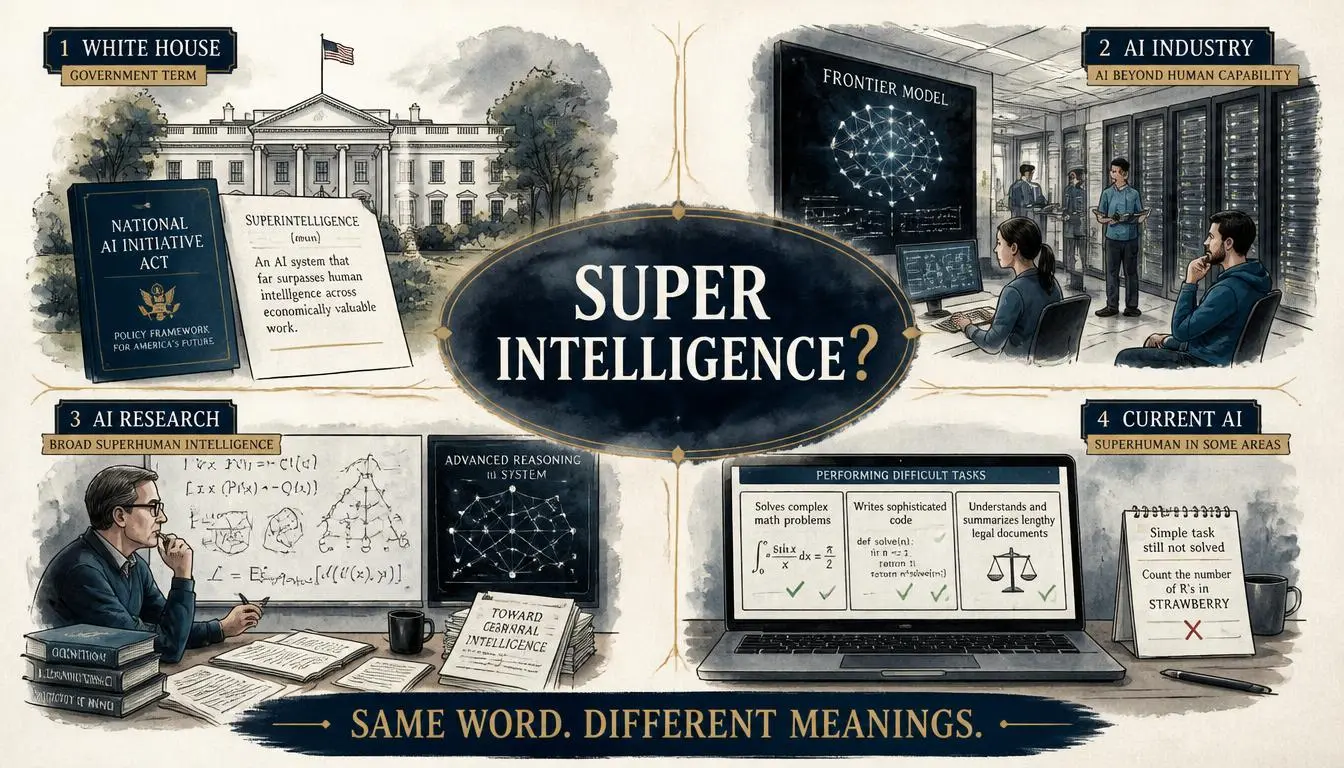
Now President Donald Trump is calling the technology “Super Intelligence,” or “SI.” A September 29, 2026 executive order directs the U.S. executive branch to use “Super Intelligence” instead of “Artificial Intelligence” in applicable official communications. But there is an important catch: the order currently uses the existing federal definition of AI for SI while asking officials to develop a separate definition of superintelligence.
So, has AI actually become superintelligent?
That depends on what you mean by “superintelligence.”
And that is where things get interesting.
Before We Go Further, Think About Your Own Experience With AI
You ask AI to explain a complicated financial concept.
It does.
You ask it to write some code.
It does.
You give it a long document and ask for the key points.
It can do that in seconds.
Then, occasionally, you ask something that seems almost embarrassingly simple, and it gets it wrong.
Maybe it misunderstands an instruction.
Maybe it confidently gives you a wrong answer.
Maybe it struggles with something you could solve without thinking twice.
So, what exactly are we looking at?
A very powerful tool?
Human-level intelligence?
Something beyond human intelligence?
Or, as President Trump now calls it, “Super Intelligence”?
Let’s take the hype out of the word and look at what the technology can actually do.
By the End of This Article, You’ll Know:
- Why is President Trump calling AI “Super Intelligence”?
- What does artificial intelligence actually mean?
- What does superintelligence actually mean?
- How close is today’s AI to that idea?
- Why can AI be better than humans at some things and still fail at simple tasks?
- What do the people building AI actually think about superintelligence?
- Does today’s AI really deserve the name “Super Intelligence”?
1. Why Is President Trump Calling AI “Super Intelligence”?
Let’s start with the headline that caused all of this.
On September 29, 2026, President Trump signed an executive order titled “Inaugurating the Era of Super Intelligence.”
The order directs executive departments and agencies to use “Super Intelligence” and “SI” instead of “Artificial Intelligence” and “AI” in official correspondence, public communications, websites, reports, policy documents and other non-statutory documents, to the maximum extent permitted by law.
Trump’s administration says the new terminology better reflects how far today’s frontier systems have advanced.
But there is an interesting wrinkle.
For the purposes of the order, SI currently uses the existing statutory definition of AI. At the same time, the order tells the Assistant to the President for Science and Technology to propose a federal definition of “Super Intelligence” within 60 days and consider whether that definition should expand or replace the existing AI definition.
In other words:
The government has changed the label before it has finished defining the new label.
That doesn’t tell us whether today’s technology is technically superintelligent.
To answer that, we need to understand what the words actually mean.
2. What Does Artificial Intelligence Actually Mean?
Here’s something that can make the whole debate easier:
AI does not mean “a machine smarter than a human.”
Artificial intelligence is a broad category.
It includes systems designed to perform tasks that we associate with intelligence, such as recognizing patterns, generating language, making predictions, solving problems, writing code or controlling machines.
That means an AI system can be extremely good at one particular job without being generally intelligent.
Think about a calculator.
A calculator can perform arithmetic vastly faster and more accurately than you can.
But you wouldn’t say:
“My calculator is more intelligent than me.”
Why?
Because being better at one task isn’t the same as being better at thinking generally.
That distinction becomes extremely important when we start talking about superintelligence.
3. What Does “Superintelligence” Actually Mean?
Now we get to the word that has caused all the confusion.
In technical discussions, superintelligence generally refers to an artificial system whose intellectual abilities substantially exceed those of humans across a broad range of cognitive tasks.
That is a much bigger claim than:
“AI beat humans on a difficult test.”
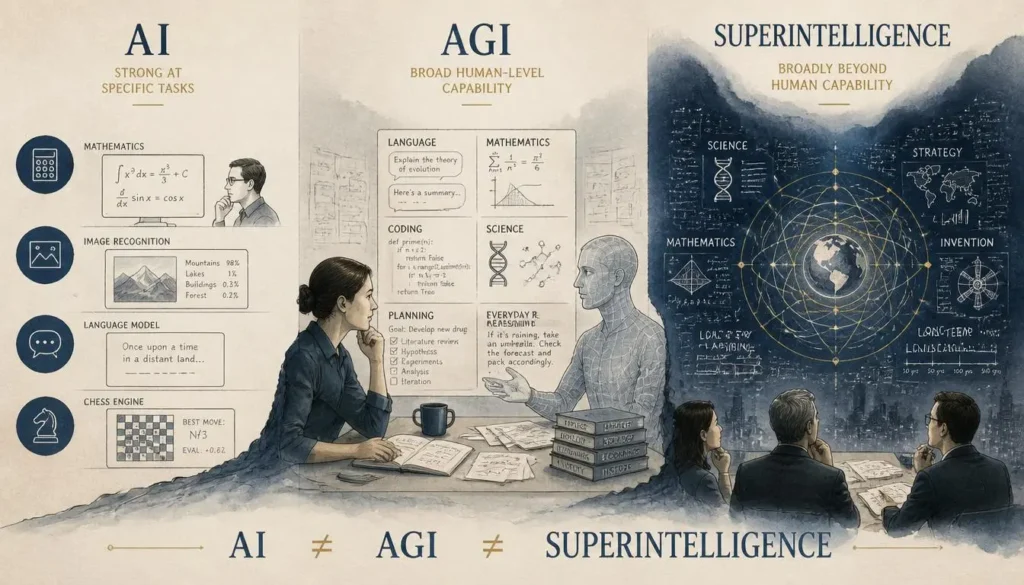
A useful way to picture the terms is:
AI: machines that perform tasks associated with intelligence.
AGI: a hypothetical form of AI with broad, general-purpose intelligence comparable to humans.
Superintelligence: a hypothetical form of AI whose broad intellectual capabilities substantially exceed those of humans.
And notice the word that matters most: Broad
A chess engine can be superhuman at chess.
An AI system can be superhuman at mathematics.
A coding model can outperform many human programmers on particular tasks.
But superintelligence implies something much bigger: superior intellectual ability across many different kinds of work.
That’s why the question isn’t simply whether AI can beat humans.
It already can.
The question is how broadly and reliably it can do so?
4. How Close Is Today’s AI to Superintelligence?
This is where things become genuinely fascinating.
Because the answer isn’t:
“AI is nowhere close.”
Nor is it:
“AI has already surpassed humanity.”
The evidence is much more complicated.
Stanford’s 2026 AI Index reports that frontier AI systems now meet or exceed human performance on several challenging benchmarks, including PhD-level science questions, multimodal reasoning and competition mathematics.
And some results are remarkable.
One frontier model achieved a gold-medal-level result at the International Mathematical Olympiad.
But then comes the part that sounds almost ridiculous.
The same generation of AI systems can still struggle with something as ordinary as reading an analog clock.
Stanford reports that the top model on its cited ClockBench evaluation correctly read analog clocks only about 50% of the time, compared with about 90% for humans.
Think about that for a moment.
An AI system can tackle mathematics at a level that would be extraordinary for most humans.
Yet it can still look at a clock and get confused.
That’s not a contradiction in the data.
It’s one of the defining features of modern AI.
5. Why Can AI Be Superhuman and Still Make Simple Mistakes?
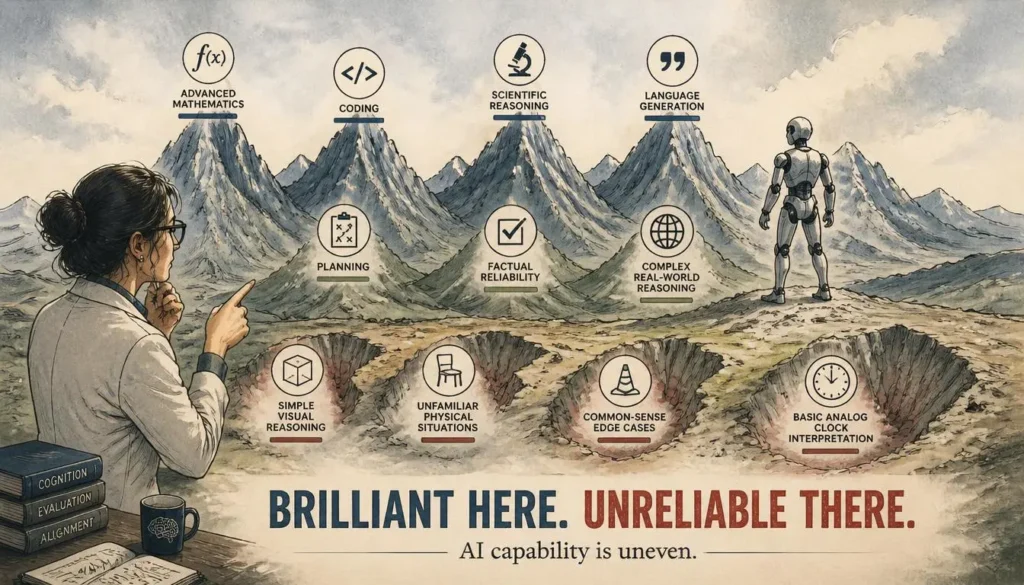
Researchers sometimes describe this uneven capability pattern as a “jagged frontier.”
But you don’t need the technical phrase to understand the idea.
Imagine a student who is brilliant at advanced mathematics, knows an enormous amount of science, and can write computer programs – but occasionally makes a very basic mistake that a child wouldn’t make.
That’s roughly the intuition.
AI’s abilities don’t rise evenly.
It can be:
Amazing at one task → ordinary at another → unreliable at a third.
Stanford’s 2026 AI Index finds that AI agents have made major progress on real computer tasks, but still fail a substantial share of attempts on structured evaluations. It also reports that robots remain far less reliable in unpredictable household environments than in controlled settings.
So, here’s the distinction worth remembering:
Superhuman performance is not automatically superintelligence.
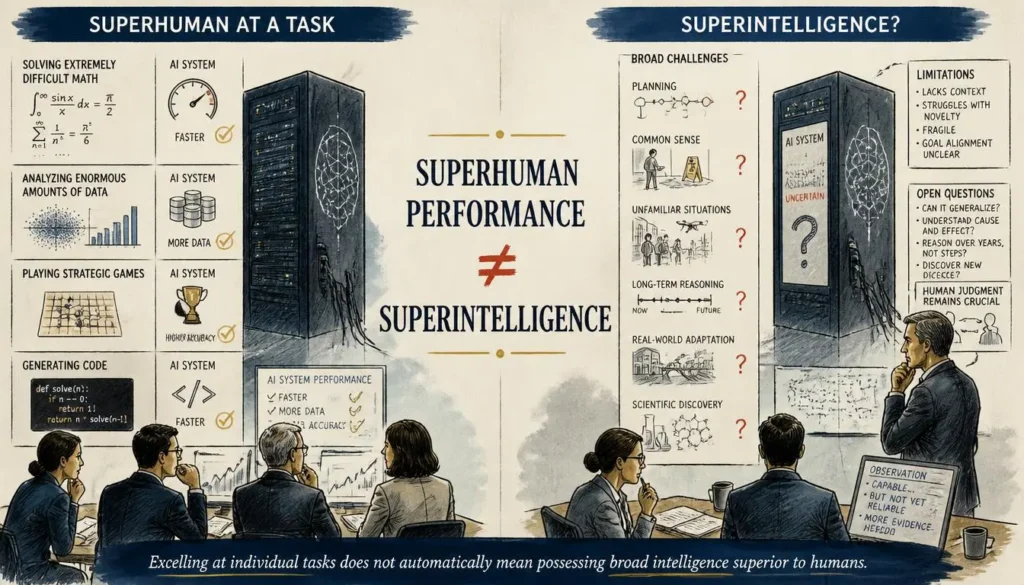
A machine can be better than you at something without being broadly more intelligent than you.
And that is probably the single most important idea in this entire article.
6. What Do the People Building AI Actually Think?
Now let’s step away from the benchmarks for a moment.
What do the people actually building these systems think about superintelligence?
Interestingly, they don’t all talk about it in the same way.
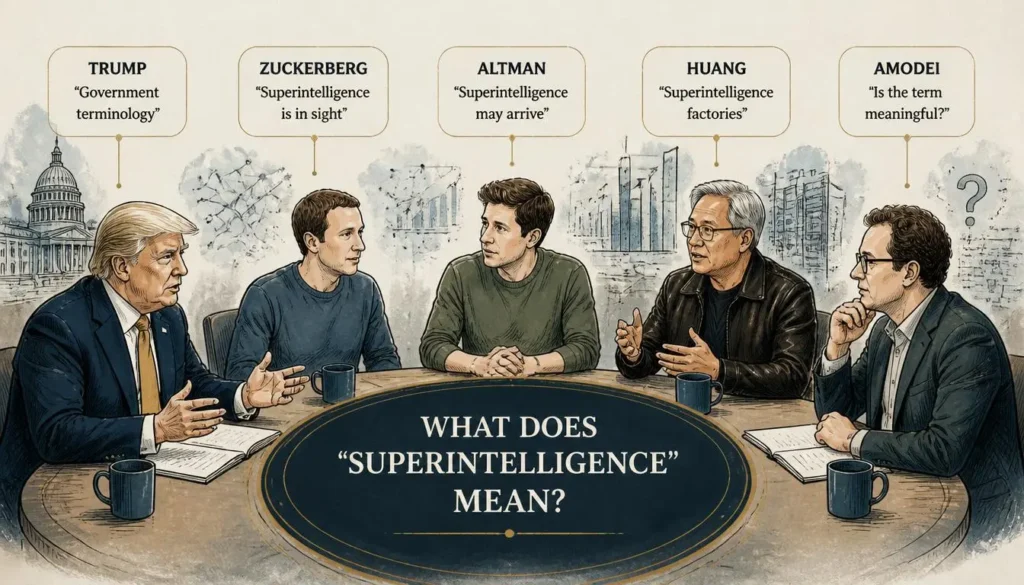
Mark Zuckerberg: “It is now in sight”
Meta CEO Mark Zuckerberg has openly embraced the term.
In his discussion of Meta’s AI strategy, he wrote:
“Developing superintelligence is now in sight.”
He also said Meta had begun seeing glimpses of AI systems improving themselves, while describing that improvement as slow for now.
That’s a strong statement about where he believes the technology is heading.
But it is a prediction, not evidence that superintelligence already exists.
Sam Altman: “Almost certain” within ten years
OpenAI CEO Sam Altman has also made a long-term prediction.
Writing about the future of AI, he said:
“In ten more years, I believe we are almost certain to build superintelligence.”
Again, notice the wording.
Build.
He’s talking about the future, not saying today’s AI has already crossed that line.
Jensen Huang: Superintelligence factories
Nvidia CEO Jensen Huang has used the term from an infrastructure perspective, describing modern AI data centers as “super intelligence factories.”
The idea is straightforward: enormous amounts of computing power, electricity, networking and cooling are being assembled to produce increasingly capable AI systems.
But then comes one of the most interesting counterpoints.
Dario Amodei: “What does superintelligence even mean?”
Anthropic CEO Dario Amodei has been much more skeptical about the terminology itself.
In a 2026 interview, he said:
“I don’t know what AGI is. I don’t know what superintelligence is.”
He described the terms as sounding like marketing language, while at the same time arguing that AI capabilities are improving very rapidly.
That is a fascinating distinction.
Amodei isn’t saying:
“AI isn’t improving.”
He’s saying, essentially:
“The improvement is real. The label may not be.”
And suddenly the whole debate looks different.
Trump is talking about what to call the technology.
Zuckerberg and Altman are talking about where the technology may go.
Huang is talking about the infrastructure being built around it.
Amodei is asking whether the terminology itself tells us anything useful.
So what does the evidence say?
7. Does Today’s AI Really Deserve the Name “Superintelligence”?
Let’s make this simpler than the headlines make it.
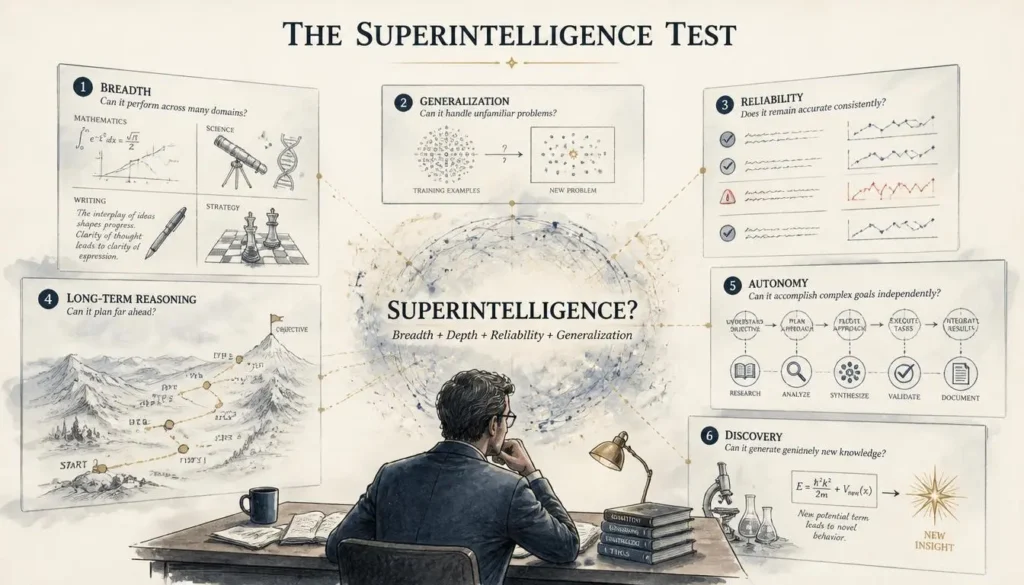
Imagine we created a test for superintelligence.
We wouldn’t ask only:
Can AI solve a difficult mathematics problem?
We’d ask:
Can it outperform humans across many different fields?
Not just mathematics or coding, but science, planning, research, communication and other intellectual work.
Can it handle problems it has never seen before?
Being excellent at familiar benchmarks isn’t enough. A genuinely general system should be able to transfer its abilities to unfamiliar situations.
Can it do the work reliably?
If it produces an extraordinary answer nine times and a bizarre answer on the tenth, that matters.
Can it work toward difficult goals over long periods?
Answering one question is different from independently managing a complicated project for days, weeks or longer.
Can it discover things humans haven’t?
A truly extraordinary system wouldn’t simply reproduce human knowledge. It could potentially contribute to new scientific discoveries, technologies and ideas.
And most importantly: is the advantage broad?
That’s the real test.
Because today’s evidence already shows something remarkable:
AI can be superhuman.
But the evidence also shows that its abilities remain uneven.
Stanford’s research describes frontier AI as surpassing human performance on several difficult benchmarks while still falling short in other areas, including some forms of autonomous computer use and real-world physical tasks.
So, based on today’s evidence, there is a meaningful difference between saying:
“AI is becoming extraordinarily capable.”
and saying:
“AI has become broadly superintelligent.”
The first is strongly supported by current evidence.
The second is a much bigger claim.
The Part That Could Change Everything
There is one reason this debate may become even more complicated.
What happens if AI starts helping researchers build better AI?
That’s no longer purely science fiction.
Researchers are actively examining whether increasing automation of AI research could accelerate AI progress itself – potentially creating a feedback loop in which better AI helps develop even better AI.
If that happens at sufficient scale, progress could potentially move much faster than traditional technology cycles.
But there’s an important word here:
potentially.
A possible future pathway is not the same thing as evidence that superintelligence has already arrived.
And that distinction matters.
What Does All This Mean for You – and Especially for Investors?
You don’t have to be an AI researcher to care about this.
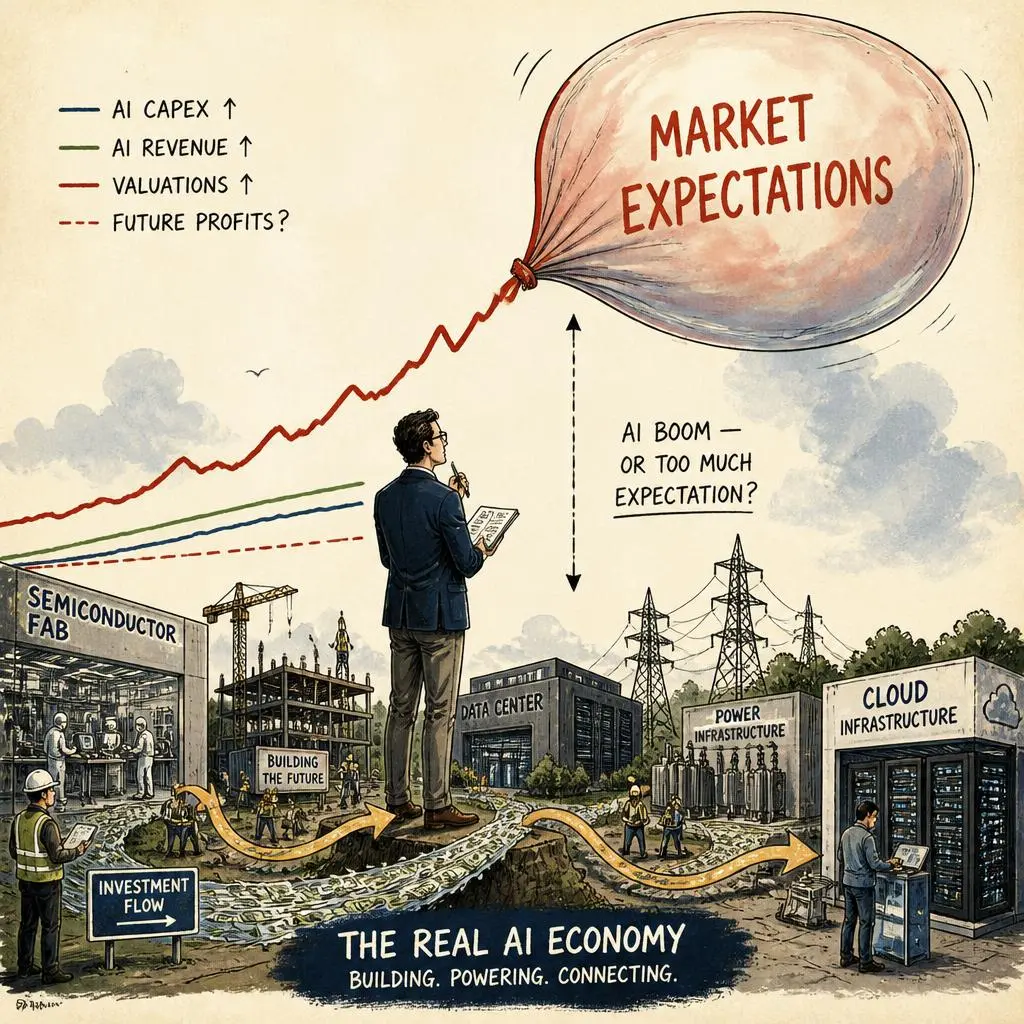
If you’ve watched the AI boom from the sidelines – or invested in companies connected to it – you’ve probably already seen how much expectations matter.
A company can benefit from better AI without possessing superintelligence.
A chipmaker can benefit from increasing AI computing demand.
A data-center operator can benefit from expanding infrastructure.
A software company can become more productive through AI.
And a company can even be technologically impressive while its financial results fail to justify the expectations surrounding it.
That’s why it’s useful to keep four questions separate:
What can the technology do?
What economic value can it create?
Which companies can capture that value?
What expectations are already reflected in their prices?
Those are four different questions.
Calling AI “Super Intelligence” may change the language around the technology.
It doesn’t automatically answer any of them.
The Bottom Line
So, is today’s AI really “Super Intelligence”?
There are two different answers.
As a U.S. government label: the White House is now officially using “Super Intelligence” and “SI” in place of “AI” in applicable executive-branch communications.
As a technical description: today’s AI is clearly capable of superhuman performance in some areas, but its abilities remain uneven. Current evidence does not establish a universally accepted threshold showing that today’s systems have achieved broad superintelligence.
And perhaps that’s the most interesting part.
The technology is moving fast enough that superintelligence no longer sounds like pure science fiction.
But the name may still be running ahead of the evidence.
Maybe the real question isn’t:
“Should we call AI Super Intelligence?”
It’s:
“When will the technology actually deserve the name?”
That answer won’t come from a presidential order, a CEO prediction or a marketing slogan.
It will come from what these systems can actually do.
Frequently Asked Questions
What does “Super Intelligence” mean?
The White House now uses “Super Intelligence” or “SI” as its preferred term for AI in applicable executive-branch communications. In technical discussions, however, superintelligence generally refers to a hypothetical system whose intellectual capabilities substantially exceed human abilities across a broad range of tasks.
Why is President Trump calling AI “Super Intelligence”?
The September 29, 2026 executive order says the capabilities of modern frontier systems increasingly represent a new era of Super Intelligence and directs federal agencies to use the term instead of AI in applicable communications.
Did the White House officially rename AI?
For applicable executive-branch communications, yes. The order directs federal agencies to use “Super Intelligence” and “SI” instead of “Artificial Intelligence” and “AI.” However, the order currently uses the existing statutory AI definition for SI and calls for a future federal definition.
What is the difference between AI and superintelligence?
AI is a broad category of technologies that perform tasks associated with intelligence. Superintelligence is a much stronger concept: an artificial system whose intellectual capabilities substantially exceed those of humans across a broad range of cognitive tasks.
Is AGI the same as superintelligence?
No. AGI generally describes a hypothetical AI with broad, general-purpose intelligence comparable to humans. Superintelligence goes further, referring to intelligence that substantially exceeds human capabilities across a broad range of intellectual tasks.
Is today’s AI actually superintelligent?
Today’s frontier AI has achieved or exceeded human performance on several difficult benchmarks, but its capabilities remain uneven. Current evidence therefore demonstrates substantial superhuman performance in specific areas rather than an established, universally accepted threshold of broad superintelligence.
Can AI be smarter than humans at some tasks but not be superintelligent?
Yes. An AI system can outperform humans at mathematics, coding or other specialized tasks while remaining unreliable at different tasks. Stanford’s 2026 AI Index describes this uneven pattern as the “jagged frontier” of AI capability.
What is jagged intelligence?
“Jagged intelligence” describes the uneven way AI capabilities can develop. A system may perform at an extraordinary level on one task while struggling with another task that appears much simpler to humans. That is one reason individual benchmark victories do not automatically establish general superintelligence.
What would true superintelligence need to do?
A meaningful test would likely require broad and reliable superiority across many intellectual domains, strong ability to handle unfamiliar problems, long-term planning, adaptability, and, potentially, the ability to make discoveries beyond current human knowledge.
What do AI leaders think about superintelligence?
Views differ. Mark Zuckerberg has said developing superintelligence is now in sight, while Sam Altman has predicted that OpenAI is almost certain to build it within ten years. Anthropic CEO Dario Amodei, meanwhile, has questioned whether terms such as AGI and superintelligence are precise enough to be useful.
Why does the AI vs. superintelligence distinction matter to investors?
Because technological capability, economic value and investment valuation are different things. More capable AI could affect productivity, chips, data centers, software and many industries, but the technology alone does not determine which companies capture that value or whether current market expectations already reflect it.