
Imagine investing in a company whose revenue is growing at an extraordinary pace, whose AI products are attracting businesses worldwide, and whose technology could change how millions of people work. Now imagine being asked to value that company at $1.5 trillion, even though it has reported billions of dollars in operating losses and faces enormous computing costs.
Would you invest?
That is the question facing investors as Anthropic, the company behind Claude AI, moves towards a potential initial public offering (IPO).
The excitement is understandable. Businesses are using AI to write software, analyse documents, automate tasks and improve productivity. If demand continues to grow, Anthropic could become one of the most important technology companies of the coming decade.
But there is a catch: growing quickly is not the same as making sustainable profits, and even a great company can be a poor investment if its shares are overpriced.
Reuters reported in October 2026 that Anthropic was preparing for a possible November IPO, although the timing remained subject to change. Some investors were discussing a valuation of around $1.5 trillion, down from expectations of approximately $2 trillion. These were reported valuation expectations, not a confirmed IPO price.
The debate goes beyond one company. It raises a bigger question about the entire AI boom: how much should investors pay today for profits that may take years to arrive?
Let’s explore the seven questions that matter most.
THE 7: Seven questions investors should ask about the Anthropic IPO
1. Why is the Anthropic IPO attracting so much attention?
Anthropic is not simply selling access to a chatbot. Its Claude AI models are used for tasks such as software development, business research, document analysis, and other work that companies may be willing to pay for regularly.
That recurring demand is attractive to investors. When customers rely on a product for essential daily work, the company selling it may be able to generate revenue repeatedly rather than depending on one-time sales.
Think about accounting software used by thousands of businesses. If customers depend on it every day, they have a reason to keep paying. AI companies are trying to build similar relationships, although their customers’ bills can vary depending on how much computing power they use.
Anthropic’s financial growth has been striking. According to figures reported by Reuters, revenue increased from approximately $386 million in 2024 to $4.6 billion in 2025. The company then reported revenue of $11.6 billion in the second quarter of 2026 and $16.8 billion in the third quarter. The latest quarterly figure represented a 45% increase from the previous quarter.
Michael Field, chief equity strategist at Morningstar, described the twelvefold revenue growth in 2025 as “truly remarkable.” He also cautioned that the company’s losses remained a concern relative to its current revenue.
That is what makes Anthropic so interesting. Its growth is not merely a promise about what AI might become; the reported revenue shows that businesses are already paying substantial sums for its products.
However, investors are not buying last year’s growth. They are paying for what they believe the company can achieve next.
And that brings us to the $1.5 trillion question.
2. What does a $1.5 trillion valuation actually mean?
A company’s valuation is the price investors place on the business as a whole. It is not its annual revenue, the amount of money in its bank account, or a guarantee of what its shares will be worth in the future.
To understand why valuation matters, consider a simple example.
Suppose a business earns PKR 100 million in annual profit. A buyer offers PKR 2 billion to purchase it. The buyer is effectively paying 20 times the company’s current annual profit.
That might be a reasonable price if profits are expected to grow rapidly. But if profits remain flat or decline, the buyer could end up paying far too much.
Anthropic presents a more complicated case because investors are looking at its potential future revenue and profits rather than simply valuing it on the basis of mature, established earnings.
In August 2026, Reuters reported that Anthropic was projecting revenue of approximately $190 billion to $200 billion for 2028, according to people familiar with its financials. This is a forecast, not revenue already earned by the company.
Why are investors willing to consider such an ambitious valuation?
Michael Field offered one explanation when discussing the earlier $2 trillion valuation expectation. He argued that although the figure initially sounded “outlandish,” it looked more reasonable when compared with projected sales. That was his assessment of the valuation at the time, not proof that the price was justified.
Newton Jones, a wealth manager at Steward Partners, expressed a more cautious view:
“There are a lot of question marks around these valuations.”
He pointed to the combination of substantial losses, massive capital spending and extremely high proposed equity values.
Both arguments deserve attention. Investors may reasonably pay more for a company expected to grow much faster than an established business. But a high valuation also leaves less room for disappointment.
If Anthropic grows faster than expected and eventually generates substantial profits, the valuation could look reasonable in hindsight. If revenue growth slows or costs remain too high, investors may reconsider how much the company is worth.
The lesson is simple: a great business is not automatically a great investment at every price.
3. Is Anthropic making money, or losing it?
Here is where the story gets complicated. Anthropic is bringing in more money, but developing and operating advanced AI systems costs a fortune.
According to Reuters’ reporting on the company’s draft IPO prospectus, Anthropic’s 2025 financial figures included:
- Revenue: approximately $4.6 billion.
- Operating loss: approximately $8.06 billion.
- Net loss: approximately $42 billion, including substantial accounting charges.
Those numbers look alarming, but they need context.
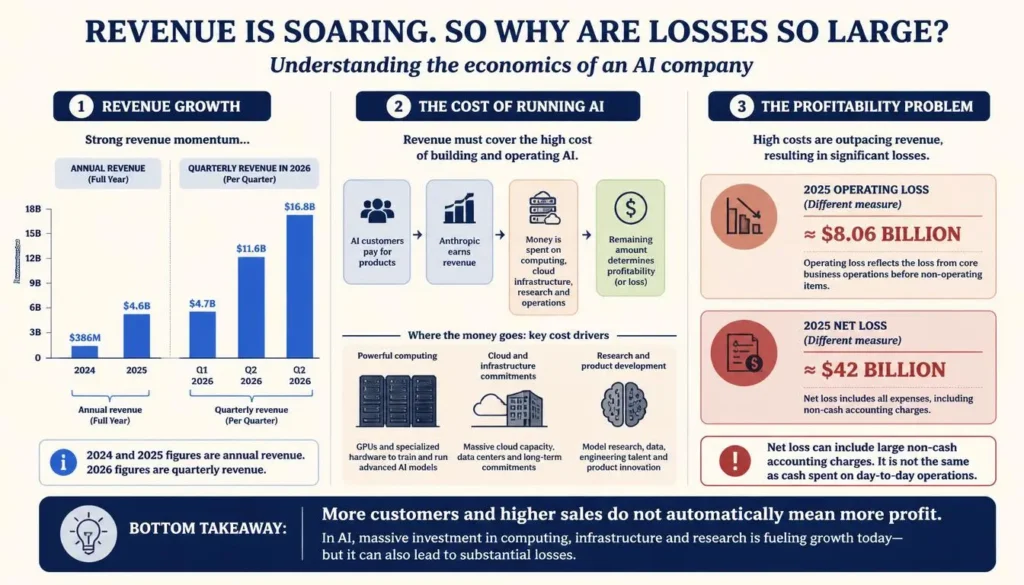
The operating loss reflects the gap between revenue and the costs associated with running the business. Anthropic also spent approximately $7.33 billion on computing and infrastructure in 2025, according to the reported prospectus figures.
The net loss is more complicated. A substantial portion included accounting charges connected to financing instruments that could eventually convert into shares. Such charges can increase a reported accounting loss without representing an equivalent amount of cash paid out to operate the business.
The distinction matters: an accounting loss is not always the same as cash burned, but a non-cash charge does not make a company’s real operating costs disappear.
The company’s more recent results have offered some encouragement. Anthropic reportedly told prospective investors that it was profitable on an adjusted basis in the third quarter of 2026, when revenue reached $16.8 billion. However, adjusted profitability does not automatically mean the company was profitable under every accounting measure or generated positive cash flow after all spending.
This debate is part of a much wider challenge facing AI developers. In his October 7 Reuters commentary, investment strategist Joachim Klement opened with a blunt assessment: “AI has a math problem.” His argument focused on the difficulty of making AI businesses sustainably profitable when computing costs are high, and prices for AI services are falling.
Consider the basic economics. If an AI company charges less for each task, it needs enough additional usage or lower costs to compensate for the reduced price. More customers do not automatically solve the problem if serving them becomes expensive.
For Anthropic, the crucial question is whether revenue can continue growing faster than the full cost of developing, delivering and improving its AI systems.
4. What must go right for a $1.5 trillion valuation to make sense?
Anthropic does not need to become consistently profitable overnight to justify a high valuation. But investors paying a premium need a convincing reason to believe that today’s growth will eventually translate into durable profits and cash flow.
Three things must happen.
First, businesses must keep paying for AI.
Companies need to see enough value in Claude to justify their bills. If AI helps them save time, reduce costs, or produce better work, they may increase their spending. If cheaper alternatives deliver similar results, they may switch or negotiate lower prices.
Second, Anthropic must improve its profit margins.
Revenue can rise rapidly while profits remain weak if computing, research, infrastructure and customer-serving costs rise just as quickly. The long-term opportunity depends on Anthropic retaining more from each dollar of revenue as the business scales.
Third, growth must support the expectations already built into the valuation.
The reported 2028 revenue forecast of $190 billion to $200 billion shows how ambitious those expectations are. Even if Anthropic achieves that revenue target, investors would still need to consider its profit margins, future investment requirements and cash flow.
There is also an opportunity beyond Anthropic itself.
Kathleen Brooks, research director at XTB, argued that the company’s planned spending was positive for the broader AI investment theme because it suggested that demand for semiconductors and AI infrastructure could remain strong.
In other words, Anthropic’s expansion could create opportunities for chipmakers, cloud providers and data-centre operators as well.
But there is an important distinction here: the AI industry can grow successfully without every AI company becoming a successful investment. Investors still need to evaluate each company’s price, competitive position, and ability to earn a return on the money it spends.
5. What are the biggest risks of investing in Anthropic?
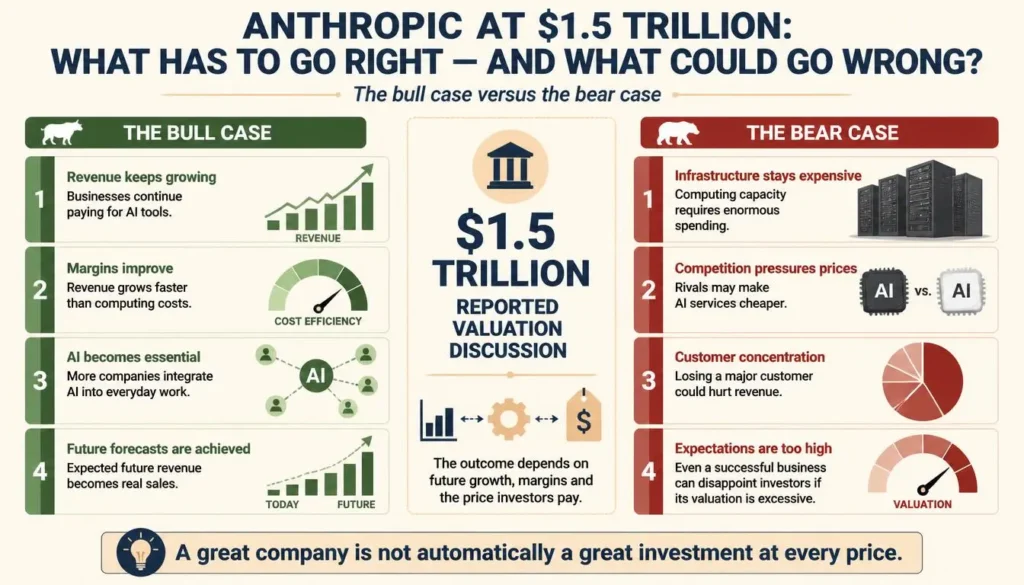
Anthropic’s growth story is compelling, but investors must look beyond revenue headlines. Several risks could affect the company’s future performance and valuation.
High computing and infrastructure costs
Advanced AI models require substantial computing power. Developing more capable systems and serving more users can require continued investment in chips, data centres and cloud services.
Reuters reported in September that Anthropic’s draft IPO prospectus described approximately $518 billion in planned cloud, computing and infrastructure obligations over the coming years. These commitments could support expansion, but they also represent a significant financial undertaking.
Intense competition and pricing pressure
Anthropic competes in a fast-moving market where rivals can improve their models, offer cheaper alternatives, or bundle AI into products customers already use.
If businesses can get comparable results for less money, Anthropic may find it harder to maintain its pricing or profit margins.
Dependence on major customers and technology partners
Reuters reported that two customers each accounted for 12% of Anthropic’s 2025 revenue. It also reported that Amazon and Google accounted for 47% of the company’s sales through their cloud marketplaces. Both companies are important investors, computing suppliers and distribution partners, while also competing in AI.
Dan Coatsworth, head of markets at AJ Bell, highlighted the customer-concentration issue. He noted that nearly a quarter of Anthropic’s previous-year revenue reportedly came from two customers and said investors would hope the company could broaden its client base quickly.
This does not mean those relationships are necessarily bad. Large partners can help Anthropic reach more customers and access computing resources. The risk is that reliance on a small number of customers and suppliers could make the company more vulnerable if commercial relationships change.
A cooling AI investment market
Investor enthusiasm can push valuations higher before businesses demonstrate sustainable profitability. If expectations change, high-valuation technology shares can fall sharply even when the underlying company continues to grow.
Regulation and AI safety
Changes in AI regulation, restrictions on particular uses or new safety requirements could affect development costs, product availability and customer demand.
None of these risks proves that Anthropic is overvalued. Together, however, they explain why investors need to look beyond the headline growth rate before deciding what a share is worth.
6. If you buy Anthropic shares, how much say would you have?
Buying shares generally gives investors ownership rights, but not every share structure gives all shareholders equal voting power.
Reuters reported in September that Anthropic was considering a structure under which its seven co-founders would collectively hold 50.1% of voting power over key corporate matters through a special class of shares. The final arrangements would need to be checked against the official IPO prospectus and share documents.
Why should ordinary investors care?
Imagine owning shares in a company but having limited influence over major decisions because the founders control most of the votes. Your investment could still rise in value if the business performs well, but you might have little influence if you disagree with its leadership or strategy.
This type of structure is not unique to Anthropic. Some public companies give founders greater voting power to preserve their control over long-term decisions.
The important point is to understand what you are buying. Before investing, examine the voting rights, board structure, related-party arrangements, and shareholder protections. A promising business can still carry governance risks that deserve careful consideration.
7. Should ordinary investors be excited or cautious?
The answer does not have to be one or the other. Investors can be excited about AI’s long-term potential while remaining cautious about Anthropic’s valuation.
Gil Luria, head of technology research at D.A. Davidson, offered a particularly clear warning in an October 19 interview with CNBC, reported by Business Insider:
“Anthropic will end up being a very speculative investment. They may do well, they may not.”
Luria argued that investors should also consider the established technology companies and infrastructure providers that support the AI industry, rather than focusing exclusively on which AI model developer ultimately wins.
His point is worth considering. AI adoption could continue growing, but investors may still struggle to identify which individual companies will capture the greatest share of the resulting profits.
Before investing in Anthropic’s IPO, ask yourself:
- Valuation: What price is being offered, and what growth and profitability assumptions does it require?
- Profitability: Is the company generating sustainable profits, or does its adjusted performance exclude significant costs?
- Cash and commitments: How much cash does it have, how much is it spending, and what future infrastructure obligations has it accepted?
- Customer strength: Is revenue diversified, or does the company depend heavily on a few customers and partners?
- Competition: Can Anthropic maintain its pricing and product advantage as rivals improve?
- Governance: Do the voting rights and shareholder protections meet your expectations?
- Personal risk: Could you withstand a substantial fall in the share price if investor expectations change?
There is no requirement to buy an IPO simply because it is generating headlines. Waiting for the official prospectus, final price range and clearer financial disclosures can be a sensible investment decision.
The goal is not to predict the first day’s share-price movement. It is to decide whether the business offers an attractive return relative to the price and risks involved.
The bottom line: A great AI business is not automatically a great investment
Anthropic has a remarkable growth story. Its revenue has surged, businesses are paying to use Claude, and its technology is part of a market that could reshape industries around the world.
But a valuation of around $1.5 trillion would require investors to place enormous confidence in the company’s future. Anthropic must turn demand into sustainable profits, manage substantial infrastructure costs, retain customers and defend its position against competitors.
The expert views capture the tension. Michael Field sees extraordinary revenue growth. Kathleen Brooks sees continued opportunities for AI infrastructure companies. Newton Jones questions whether valuations can be justified by businesses with large losses and spending needs. Joachim Klement highlights the challenge of making the economics work, while Gil Luria warns that investing in an individual AI model maker remains speculative.
Taken together, their perspectives point to a more useful question than whether the IPO will be popular: Can Anthropic generate enough future profit to justify the price investors are being asked to pay?
AI may change the world. That does not mean every AI stock will make its investors’ money.
Growth creates opportunity, but valuation, competition, costs, and execution determine whether that opportunity becomes a worthwhile investment.
When is Anthropic expected to go public?
As of October 25, , reporting indicated that Anthropic was preparing for a possible November 2026IPO. The timing remained subject to change, so investors should check for official announcements.
Is Anthropic worth $1.5 trillion?
The $1.5 trillion figure is a valuation expectation discussed by investors, not a confirmed IPO price. Whether it is justified depends on future revenue, sustainable profits, cash flow, competition and the risks involved.
Is Anthropic profitable?
Anthropic reportedly told prospective investors that it was profitable on an adjusted basis in the third quarter of 2026. Adjusted profitability does not necessarily mean the company was profitable under every accounting measure or generated positive free cash flow.
Why has Anthropic reported such large losses?
Its reported losses include substantial operating costs and accounting charges linked to financing instruments. Some accounting charges do not represent equivalent cash spending, but Anthropic also faces significant real costs for research, computing and infrastructure.
What are the biggest risks of investing in Anthropic?
The main risks include high computing costs, intense competition, dependence on major customers and cloud partners, uncertain long-term profitability, governance considerations and a valuation that may already assume exceptional growth.
Will ordinary investors be able to buy Anthropic shares?
If the IPO proceeds, eligible investors may be able to buy shares through participating brokers, subject to the offering terms, local regulations and broker access. Availability and allocation are not guaranteed.
How does Anthropic compare with OpenAI?
Both companies develop advanced AI systems and face questions about competition, infrastructure costs and long-term profitability. Investors should compare their financial disclosures, business models, valuations and governance structures rather than relying only on headline valuations.