
At a Glance
Can you trust AI financial advice? Yes, but only with caution. AI tools like ChatGPT and Google Gemini can help you understand investments, manage a budget, compare financial options, and make complicated money topics easier to understand. But they can also give incorrect information, overlook important details, or make recommendations that don’t fit your financial situation. The safest approach is to use AI as a financial research assistant, verify important claims, and make your own informed decisions.
By the End, You’ll Know
Why AI financial advice sometimes goes wrong, whether ChatGPT can help you choose investments, how to protect your financial information, how to recognize AI investment scams, and three simple questions to ask before following any AI-generated recommendation.
Would You Trust ChatGPT With Your Money?
You have $10,000 sitting in your savings account.
You’ve been thinking about doing something smarter with it. Maybe investing in stocks, paying off your credit card, or moving the money into a high-yield savings account.
But which option makes the most sense?
You could spend hours researching, comparing financial products, and trying to understand complicated investment terms.
Or you could open ChatGPT and ask:
“I have $10,000. What’s the smartest thing I can do with it?”
Within seconds, you receive a detailed answer. It explains your options, compares potential returns, and perhaps even recommends what you should do.
It sounds reasonable. The calculations look convincing. And the explanation is easier to understand than most financial websites.
So why not follow it?
Well, there’s something the AI might not know.
What if your credit card charges 24% interest? What if you have no emergency savings? Or what if you’re planning to buy a house in six months?
Suddenly, that seemingly intelligent recommendation might not be so intelligent after all.
And this isn’t just a hypothetical concern.
A 2026 NerdWallet survey found that 26% of Americans had used AI chatbots to ask personal finance questions. Among respondents who acted on AI financial advice, 39% said it helped their finances, while 29% said it hurt them.
These are people’s reported experiences, not proof that AI directly caused every outcome. But they reveal an important reality: Americans are already turning to AI for money decisions, and their experiences are mixed.
Here’s the interesting part.
AI isn’t necessarily giving bad financial advice. Sometimes it provides genuinely useful guidance.
The bigger problem is that a convincing answer and the right financial decision aren’t always the same thing.
So, can you trust AI financial advice?
To answer that, we first need to understand what AI is actually good at and the seven mistakes that could turn a helpful tool into an expensive one.
What Can AI Actually Help You Do With Your Money?
Let’s give AI some credit.
For someone without a financial background, understanding money can feel unnecessarily complicated.
You open an article about investing and encounter terms like asset allocation, expense ratios, compound interest, and tax-advantaged accounts.
Before you’ve even reached the useful part, you’re wondering whether you need a finance degree to understand your own savings.
This is where AI can be genuinely valuable.
You can ask ChatGPT to explain compound interest using a simple savings account. You can ask Gemini to explain why mortgage rates change. Or you can use an AI assistant to understand the difference between a Roth IRA and a traditional IRA.
And if the explanation still feels complicated?
You can simply say, “Explain it again, but make it easier.”
That’s a meaningful advantage.
AI makes financial education more accessible, especially for people who feel uncomfortable asking basic money questions.
Lucy Castledine, Director of Consumer Investments at the UK’s Financial Conduct Authority, explained the opportunity in August 2026:
“AI can help you research companies, understand jargon or explore options before you make a decision.”
That’s exactly how AI can be most useful.
It can explain the choices in front of you, help you understand unfamiliar concepts, and show you which questions deserve more attention.
But there’s a difference between understanding how a retirement account works and knowing whether it’s the right account for your particular circumstances.
AI can help you understand money. That doesn’t automatically mean it understands your money.
And that’s where our first mistake begins.
1. Can AI Give You Wrong Financial Advice?
The mistake: Believing an AI answer simply because it sounds confident.
Here’s something unusual about AI.
It can explain something incorrectly while sounding completely certain.
Imagine asking ChatGPT:
“Which bank offers the best high-yield savings account right now?”
You receive a neat comparison showing banks, interest rates, and account features.
Everything looks professional.
But what if one of those rates changed last week? What if the account requires a minimum deposit? Or what if the AI confused a promotional rate with the bank’s regular rate?
You might end up choosing an account based on information that isn’t accurate.
The problem becomes even more serious with tax rules, retirement contributions, insurance, or investments.
AI sometimes generates incorrect or invented information that sounds believable. This is often called an AI hallucination.
And even when the information was once correct, it may no longer be current.
The Financial Conduct Authority’s guidance on AI investment research specifically warns that AI can provide incorrect or outdated information and recommends checking its claims against trusted sources.
How to Avoid This Mistake
Instead of asking AI only for an answer, ask it to explain where the information comes from.
For example, rather than asking:
“What’s the current Roth IRA contribution limit?”
Try:
“Explain the Roth IRA contribution limits for the current tax year. Include the relevant IRS source and tell me which details I should verify.”
Then check the IRS website yourself.
The same principle applies to savings rates, investment fees, tax brackets, and financial regulations.
And don’t assume that an answer becomes trustworthy just because AI includes a link. Open the source and check whether it actually supports the claim.
Remember: Confidence is how AI presents an answer. Accuracy is something you still need to establish.
2. Does ChatGPT Really Understand Your Financial Situation?
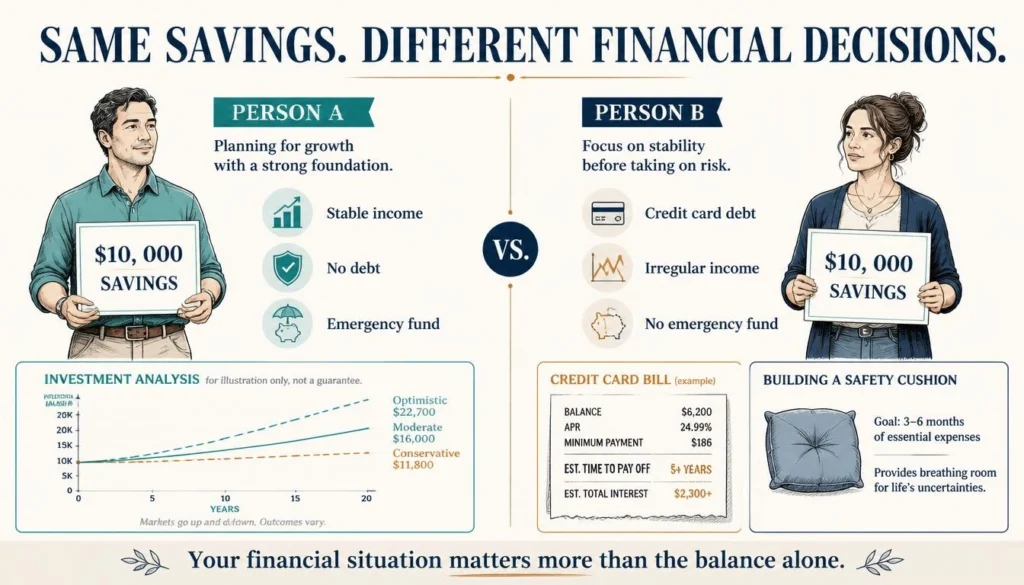
The mistake: Following advice that doesn’t consider your personal circumstances.
Let’s return to that $10,000 in savings.
Imagine two people with exactly the same amount of money.
One has a stable income, no debt, and enough emergency savings to cover several months of expenses.
The other has expensive credit card debt, irregular income, and almost no money set aside for emergencies.
Should they both invest their $10,000 in the stock market?
Probably not.
Their bank balances might look identical, but their financial priorities could be completely different.
That’s why personalized financial advice requires more than knowing how much money someone has.
It requires understanding their income, expenses, responsibilities, financial goals, and ability to handle unexpected losses.
AI doesn’t automatically know any of those things.
Kimberly Palmer, a personal finance expert at NerdWallet, explained this limitation in the organization’s 2026 research:
“They fall short when it comes to customized advice on complex topics that require layers of context.”
And that’s an important distinction.
An AI assistant might explain why investing early can help build long-term wealth.
That’s useful information.
But if you’re struggling with high-interest debt and have no emergency fund, investing may not be your most urgent priority.
How to Get More Useful Advice Without Sharing Too Much
Rather than asking AI to make the decision for you, explain the general situation and ask what factors matter.
For example:
“I have some savings, credit card debt, and an unpredictable monthly income. I’m trying to decide whether to invest or pay down debt. What should I consider before choosing?”
Notice that you haven’t shared your full name, bank account number, employer, or any other identifying information.
Yet AI has enough general context to explain why interest costs, emergency savings, and financial stability matter.
You can then ask it to identify what information is missing before comparing your options.
This doesn’t guarantee personalized advice will be correct, but it makes the conversation more useful.
The lesson is simple: A financial strategy isn’t good just because it works in theory. It needs to work for your life.
3. Can ChatGPT Predict Stocks or Tell You What to Invest In?
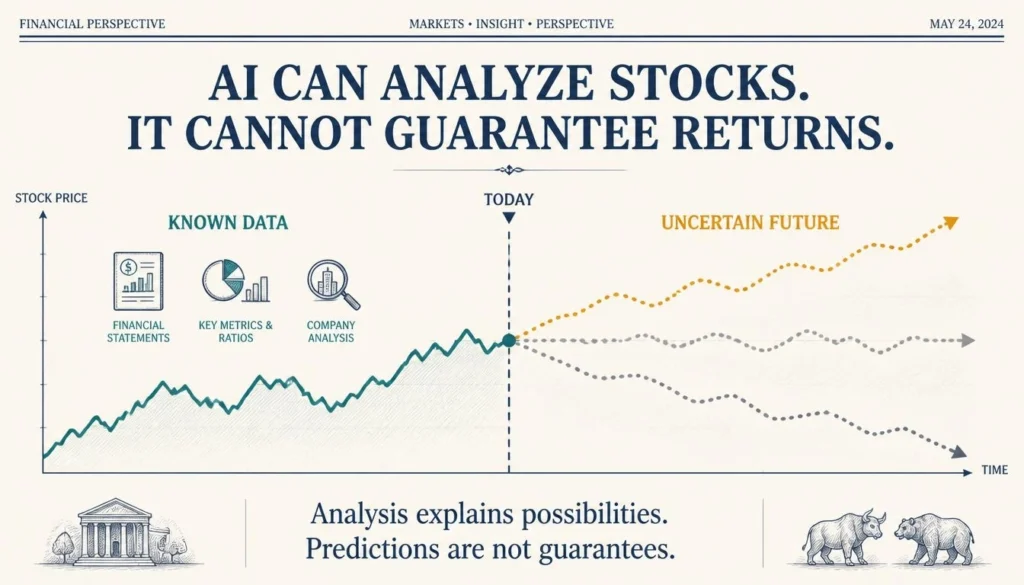
The mistake: Treating AI stock predictions as reliable forecasts.
This is where things get particularly tempting.
You’ve been hearing about a technology company that’s growing rapidly.
Its products are popular. Its business is expanding. And investors seem excited about its future.
So you ask ChatGPT:
“Is this a good stock to buy?”
AI responds with an impressive analysis of the company’s business, financial performance, competitors, and potential growth.
It might even estimate where the stock price could go.
Suddenly, you feel like you’ve discovered your own personal Wall Street analyst.
But here’s something important.
A great company isn’t always a great investment.
Think about buying a house.
You find a beautiful property in an excellent neighborhood. It’s well maintained, has everything you need, and looks like a wonderful place to live.
Would you buy it at absolutely any price?
Of course not.
Even the best house can be a bad purchase if you pay far more than it’s reasonably worth.
Stocks work in a similar way.
A company might have an exciting future, but if investors have already pushed its share price too high, its stock could still perform poorly.
And no AI assistant can guarantee what the market will do next.
Unexpected economic developments, disappointing earnings, interest-rate changes, or changing investor expectations can all affect stock prices.
The SEC, FINRA, and state securities regulators have warned investors not to rely solely on AI-generated information when making investment decisions.
So, Should You Avoid Using AI for Investing?
Not at all.
The trick is to use it for understanding investments rather than predicting guaranteed winners.
Instead of asking:
“Which stock will make me the most money next year?”
Ask:
“Explain this company’s business, financial strengths, major competitors, valuation risks, and the reasons its stock might perform better or worse than expected. Separate verified facts from assumptions.”
That’s a much better question.
AI can help you understand the business behind a stock and identify risks worth investigating.
But the decision to invest should still depend on reliable information, your financial circumstances, and the possibility of losing money.
Use AI to understand why an investment might succeed or fail. Not to pretend the future is certain.
4. Can AI Financial Advice Overlook Taxes, Fees, and Hidden Risks?
The mistake: Focusing on attractive returns while ignoring what they actually cost.
Imagine you’re comparing two investment funds.
Both seem to offer similar opportunities.
But one charges considerably more in annual management fees.
At first, that might not sound like a big deal.
After all, what’s a small percentage here or there?
The problem is that investment fees don’t usually disappear after one year.
They can reduce your returns year after year, leaving less money invested and potentially less growth over time.
Now imagine AI recommends the more expensive fund because it focuses on historical performance without properly considering the fees.
The recommendation might sound reasonable, but it could overlook something that matters to your long-term results.
Taxes can create similar problems.
Suppose AI suggests selling an investment and moving the money somewhere else.
It might explain the potential benefits of the new investment without considering whether selling the existing one could trigger capital gains taxes.
Or perhaps it recommends a retirement strategy without adequately considering when you’ll need access to the money.
None of these details necessarily makes the original recommendation completely wrong.
But they can make it incomplete.
And incomplete financial advice can be expensive.
Ask AI to Look Beyond the Headline Return
A useful follow-up question is:
“What fees, taxes, restrictions, and risks could change this recommendation? What assumptions are you making, and what happens if those assumptions are wrong?”
This encourages AI to explain the less attractive side of a financial decision.
For investments, you might also ask it to describe favorable and unfavorable outcomes rather than presenting only one expected result.
You don’t need complicated calculations to understand the principle.
The best-looking return isn’t always the best financial outcome. What matters is what you keep, what you risk, and whether the strategy fits your needs.
5. Is It Safe to Share Your Financial Information With AI?
The mistake: Sharing sensitive financial details when a simple summary would do.
Let’s say you want ChatGPT to help you understand where your money goes every month.
You could manually describe your expenses.
Or you could upload a bank statement and ask AI to categorize everything.
The second option sounds easier.
But before uploading anything, consider what your bank statement might contain.
Your name, address, account information, transaction history, and details about where you spend your money.
Does AI really need all that information to help you build a budget?
Usually, it doesn’t.
A 2026 NerdWallet survey found that among Americans who had used AI chatbots for personal finance questions, some reported sharing highly sensitive information, including Social Security numbers and financial account numbers.
That’s concerning because financial information deserves careful handling.
Different AI services have different privacy policies, data-retention practices, and security controls. Connected tools and third-party services may introduce additional considerations.
What Should You Share Instead?
Suppose your monthly take-home income is approximately $4,000.
You spend around $1,400 on housing, $500 on groceries, and $350 on transportation.
You can share those approximate figures and ask AI to help you identify spending patterns or build a budget.
There’s no need to include your bank account number, Social Security number, password, or full transaction history.
If you need to analyze a document, remove unnecessary identifying details first and check the service’s privacy settings.
Be especially careful when connecting AI tools to financial accounts or granting them permission to take actions.
A useful rule: Give AI the financial context it needs, not the personal information it doesn’t.
6. How Can You Spot AI Investment Scams?
The mistake: Assuming an investment is trustworthy because it claims to use artificial intelligence.
Imagine seeing an advertisement that says:
“Our advanced AI trading system identifies winning stocks automatically. No experience required. Consistent profits with almost no risk.”
It sounds impressive.
After all, AI can process large amounts of information and identify patterns much faster than most people.
So maybe the system really has discovered a way to beat the market?
Here’s the problem.
Calling something “AI-powered” doesn’t prove that it works or that it’s legitimate.
Fraudsters know AI sounds sophisticated, and they can use that excitement to make old investment scams look new.
In a January 2024 investor alert, the SEC, FINRA, and NASAA warned about fraudulent investment platforms promoting supposed AI trading systems and unrealistic promises of guaranteed profits.
Some scammers also use AI-generated voices, images, and videos to impersonate recognizable people or create convincing endorsements.
That makes the advertisements harder to distinguish from legitimate promotions.
But the underlying warning signs haven’t changed.
If someone promises extraordinary returns with little or no risk, pressures you to act immediately, or refuses to provide clear information about who operates the investment platform, you should be extremely cautious.
How Do You Know Whether an AI Investment Platform Is Legitimate?
Start by investigating the company independently.
In the United States, Investor.gov provides resources for checking investment professionals and identifying common fraud warning signs.
Don’t rely on a link provided by an advertisement or an unsolicited message. Find the official source yourself.
And remember that even a legitimate company using sophisticated AI technology cannot guarantee investment profits.
AI can improve investment analysis. It cannot eliminate the possibility of losing money.
7. How Can You Verify AI Financial Advice Before Acting on It?
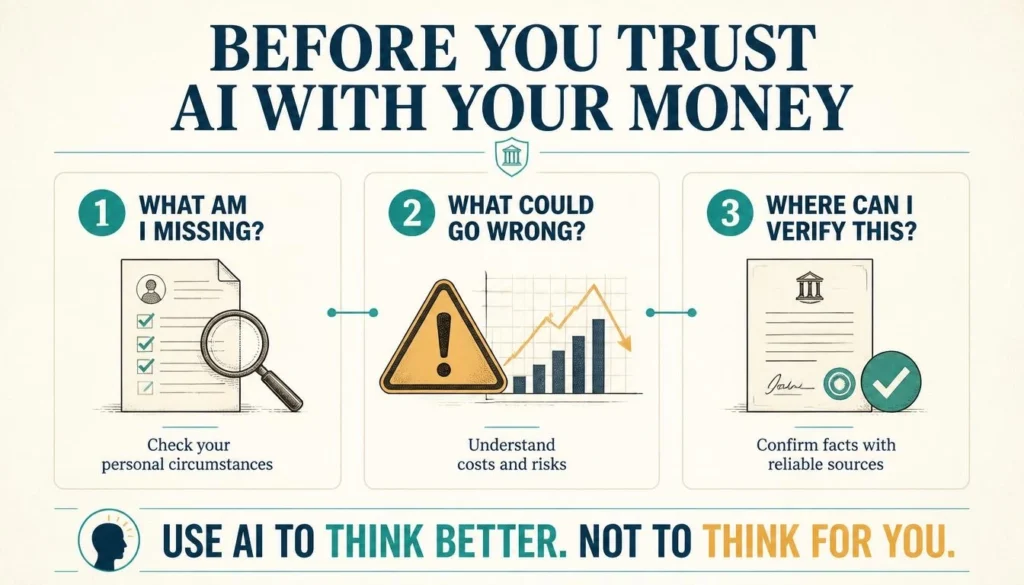
The mistake: Letting AI make the final decision instead of helping you make a better one.
By now, you might be wondering whether it’s worth asking AI about money at all.
It absolutely can be.
You just need to change the way you use it.
Think of AI as a research assistant that helps you understand your choices, rather than someone who gets the final say over your savings.
Let’s return to the $10,000 from the beginning.
You want to know whether to invest it, save it, or pay off debt.
Instead of accepting AI’s first recommendation, ask it to compare the options and explain which details could change the answer.
Then verify the important facts.
If it discusses credit card interest, check your actual interest rate.
If it recommends a savings account, confirm the current rate, terms, and deposit insurance.
If it suggests investing, think about how soon you might need the money and whether you could handle a market decline.
And if the decision is complicated or financially significant, consider speaking with an appropriately qualified professional.
You don’t need to become a financial expert overnight.
You simply need to avoid treating a quick answer as a final decision.
The AI Financial Advice Reality Check
Before following any AI financial recommendation, ask three questions:
1. What am I missing?
Has AI overlooked important information about my income, debt, financial goals, or personal circumstances?
2. What could go wrong?
What are the risks, hidden costs, and possible consequences if the recommendation doesn’t work as expected?
3. Where can I verify this?
Are the important facts supported by reliable, current sources? Should I consult a qualified professional?
These three questions won’t eliminate every financial risk.
But they can help you recognize when an AI-generated answer deserves a closer look.
And here’s a particularly useful question to ask the chatbot itself:
“What are the strongest reasons your recommendation might be wrong for someone in my situation?”
That one follow-up can turn an overly confident answer into a more thoughtful discussion.
A Better Way to Ask AI for Financial Advice
The quality of an AI response often depends on the question you ask.
A vague question like “What should I do with my money?” leaves too much room for assumptions.
A more useful approach is to ask AI to help you understand your choices before recommending anything.
Here’s a prompt you can adapt:
I’m trying to understand a financial decision involving [TOPIC].
My goal is [GOAL], and my general financial situation is [NON-SENSITIVE CONTEXT].
Before suggesting an approach, explain what information is missing and which factors matter most.
Compare my options in simple language, including the benefits, drawbacks, fees, taxes, and possible risks.
Use reliable, current sources where available. Clearly separate verified information from assumptions and tell me what you cannot confirm.
Explain what could go wrong with each option and what I should verify independently before making a decision.
If this decision requires personalized professional advice, explain why.
This won’t make AI perfectly accurate.
But it encourages the kind of careful explanation that can help you make a better-informed decision.
And it keeps the responsibility for the final choice where it belongs: with you.
The Bottom Line: AI Can Explain Money. But Should It Decide for You?
Not long ago, understanding investments, retirement accounts, or complicated financial products could mean spending hours searching for explanations.
Today, you can ask a chatbot a question and get a clear answer in seconds.
That’s a meaningful improvement.
AI can make financial knowledge easier to access, particularly for people who have never felt comfortable discussing money or asking basic financial questions.
But there’s something worth remembering.
A chatbot doesn’t have to pay your bills.
It doesn’t have to live with the consequences if an investment loses value. And it doesn’t automatically understand how much financial uncertainty you can afford.
You do.
So ask AI questions. Use it to understand unfamiliar financial concepts. Let it help you compare options and recognize risks you might otherwise overlook.
But don’t confuse a convincing answer with a decision that’s right for your life.
Before acting, remember those three questions:
What am I missing? What could go wrong? Where can I verify this?
Because the smartest way to use AI for financial advice isn’t to let it make decisions for you.
It’s to use AI to become a more informed, confident, and independent financial decision-maker.
Frequently Asked Questions
Can ChatGPT Give Financial Advice?
ChatGPT can explain financial concepts, compare options, and help with budgeting, saving, and investment research. However, general-purpose AI responses should not be treated as a substitute for personalized advice from an appropriately qualified financial professional.
Is AI Financial Advice Reliable?
AI financial advice can be useful, but it isn’t always accurate or suitable for your circumstances. Chatbots may provide outdated information, make incorrect assumptions, or overlook important risks. Verify consequential financial information before acting.
Can AI Replace a Human Financial Advisor?
AI can support financial education and research, but it doesn’t automatically provide the personalized assessment, professional accountability, or regulatory protections associated with an appropriately qualified financial advisor. Some specialized AI-based financial services operate under different regulatory arrangements.
Is ChatGPT Good for Investment Advice?
ChatGPT can help you understand companies, investment products, diversification, and financial risks. However, it cannot guarantee stock price predictions or investment returns. Use it for research rather than blindly following stock recommendations.
Is It Safe to Share Financial Information With ChatGPT?
You can discuss general financial questions and approximate figures, but avoid sharing unnecessary sensitive information such as passwords, Social Security numbers, or full bank account details. Review privacy settings and data-handling practices before uploading financial documents.
What Is the Safest Way to Use AI for Financial Planning?
Use AI to understand your options, identify missing information, and prepare questions. Verify important facts with reliable sources, consider your personal circumstances, and seek professional guidance for complicated or high-stakes financial decisions.