
At a Glance
The AI boom is generating billions in revenue, but the companies spending the most aren’t necessarily the ones making the most money.
NVIDIA and other semiconductor suppliers are selling the powerful chips needed to build AI systems. Data-center equipment manufacturers, networking companies, and electricity providers are benefiting from the infrastructure race. Meanwhile, Microsoft, Amazon, Google, and Meta are investing heavily to develop AI products and services that they hope will generate even greater returns.
Here’s the important distinction: AI spending is already producing revenue for suppliers, but not every company has demonstrated that its AI investments will generate attractive long-term profits.
To understand who’s winning, we need to follow the money, from the companies writing the checks to the businesses collecting them.
By the End of This Article, You’ll Know:
- Where the billions being invested in AI actually go.
- Why NVIDIA and other chipmakers are among the first to benefit.
- How data centers, cooling systems, and electricity providers make money from AI.
- Whether Microsoft, Google, Amazon, and Meta are profiting from artificial intelligence.
- Why AI revenue and AI profits are two different things.
- Which industries could capture the next wave of AI spending.
- How to identify genuine AI investment opportunities without getting caught up in the hype.
The AI Gold Rush: Who’s Getting Rich Before Anyone Finds the Gold?
Imagine two people arriving in California during the famous gold rush.
One spends his savings buying land, hiring workers, and digging for gold.
The other opens a shop selling shovels, equipment, and supplies.
A year later, the miner may or may not have discovered anything valuable.
But the shopkeeper has already sold equipment to hundreds of hopeful miners.
Now imagine the same story happening with artificial intelligence.
Companies like Microsoft, Amazon, Google, and Meta are spending enormous sums building AI infrastructure.
They’re buying processors, constructing data centers, installing cooling systems, and securing electricity supplies.
Why?
Because they believe AI could transform how people work, search, shop, communicate, and run businesses.
But while these companies compete to develop the next generation of AI products, other businesses are already collecting billions from the equipment they sell.
Welcome to the AI gold rush, where selling the tools can generate revenue long before the miners know how much gold they’ll find.
And this isn’t just a story for Wall Street.
If you own an S&P 500 index fund, have retirement savings invested in technology stocks, pay an electricity bill, or use AI-powered products, the outcome of this investment race could affect you.
So, let’s follow the money.
THE 7: Following the Money Through the AI Economy
1. Where Are Big Tech’s Billions Actually Going?
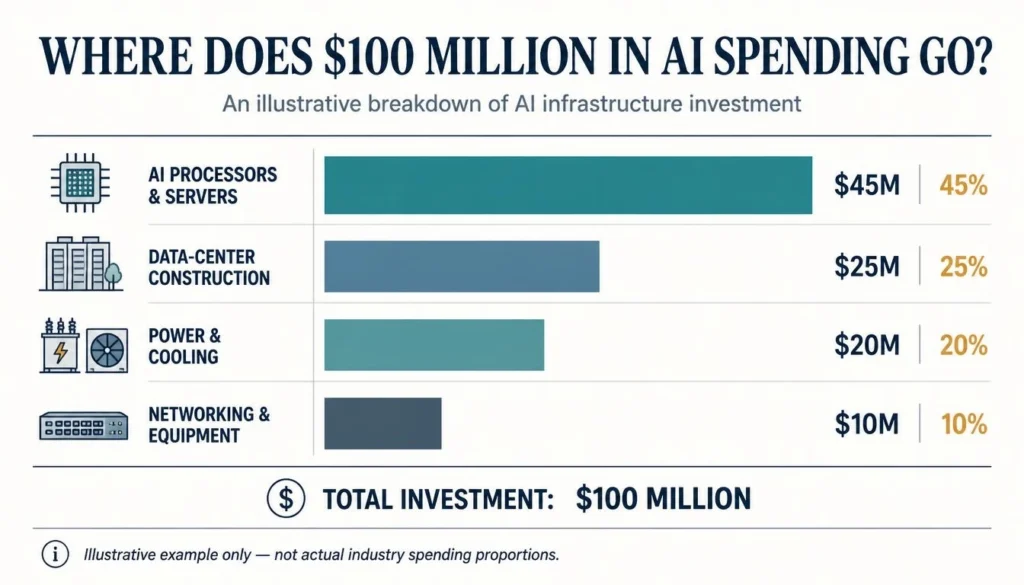
Imagine Amazon decides to spend $100 million expanding its AI computing infrastructure.
It doesn’t simply hand $100 million to an AI scientist and ask for a smarter chatbot.
That money must be divided among many suppliers.
For illustration, imagine the investment is distributed like this:
| Where the money goes | Hypothetical amount |
| AI processors and servers | $45 million |
| Data-center construction | $25 million |
| Electricity and cooling equipment | $20 million |
| Networking and supporting equipment | $10 million |
| Total | $100 million |
These figures are illustrative, not actual industry spending proportions or Amazon’s spending breakdown.
Notice something interesting.
Before Amazon earns a single dollar from the new computing capacity, suppliers may already have received substantial orders.
That’s how capital expenditure works.
Capital expenditure, or CapEx, is money a company spends buying or building assets it expects to use for several years.
Think of a restaurant owner buying ovens, refrigerators, and furniture before opening.
The investment may help the restaurant earn money later, but buying equipment doesn’t guarantee customers will arrive.
How Big Is the Real AI Spending Boom?
The scale is enormous.
In its 2026 financial outlook, Amazon discussed capital expenditures of approximately $200 billion, driven substantially by AWS and AI infrastructure demand.
Amazon CEO Andy Jassy defended the spending with a pointed statement:
“We’re not investing approximately $200 billion in capex in 2026 on a hunch.”
– Andy Jassy, CEO of Amazon, 2026
In simple terms, Jassy is saying Amazon believes there is genuine customer demand behind its investment plans.
But there’s a difference between having customers interested in computing capacity and earning enough profit from that capacity to justify the investment.
Consider our imaginary $100 million project.
If it eventually generates $30 million in annual revenue, that sounds promising.
But how much does it cost to operate?
How quickly will the equipment become outdated?
Will customers keep paying?
Those questions determine whether the investment becomes a financial success.
The first lesson: AI investment creates revenue for suppliers immediately, while the companies funding the infrastructure may have to wait years to recover their money.
And the first major recipients are the companies selling AI’s most essential equipment.
2. Why Is NVIDIA Making So Much Money From AI?
Let’s return to our gold rush.
If thousands of miners need powerful drilling machines, the manufacturer of those machines suddenly has an enormous market.
That’s roughly the position NVIDIA occupies in today’s AI economy.
AI systems require powerful processors capable of performing huge numbers of calculations.
These processors help AI models learn patterns, analyze information, generate images, and respond to questions.
NVIDIA designs many of the advanced chips and computing systems used for these tasks.
What Makes AI Chips So Valuable?
Imagine asking 10,000 people to solve different mathematical problems simultaneously.
A powerful AI processor can handle many calculations in parallel, making it especially useful for large AI workloads.
Companies developing advanced AI models need enormous amounts of this computing capacity.
And that demand has produced remarkable financial results.
In August 2026, NVIDIA reported quarterly revenue of approximately $96.2 billion, including about $89 billion from its Data Center business.
It also reported substantial net income.
These figures are important because they demonstrate something beyond excitement about AI.
NVIDIA is not merely promising future revenue. It is already reporting enormous sales and profits.
NVIDIA founder and CEO Jensen Huang described the changing role of computing power in a short statement:
“Now, compute is revenue.”
– Jensen Huang, NVIDIA CEO, August 2026
What does he mean?
Computing power is no longer just an internal tool that technology companies use.
It has become something businesses can sell to customers—much like electricity, storage space, or internet access.
Companies can rent access to computing systems, and customers pay to use them.
The more computing power businesses need, the greater the potential demand for the equipment behind it.
But NVIDIA Isn’t Working Alone
The semiconductor industry resembles a car-manufacturing supply chain.
One company designs the engine.
Another manufactures it.
Others provide essential components.
NVIDIA designs advanced computing chips and systems. AMD competes in parts of the processor market. TSMC manufactures chips for semiconductor designers, while memory suppliers provide components needed for high-performance computing.
All can participate in the AI investment cycle.
Does That Make Every Chipmaker a Good Investment?
Not necessarily.
Imagine the shovel manufacturer becomes so popular that investors push its stock price to an extraordinary level.
Even if the company continues selling shovels, the stock could disappoint if profits grow more slowly than investors expect.
Competition, changing technology, and future demand all matter.
The lesson: NVIDIA demonstrates that substantial AI-related profits are already being earned. But a profitable company and an attractively priced stock are not automatically the same thing.
Now let’s follow the chips to their next destination.
3. Who Makes Money Building the Giant Data Centers Behind AI?
Imagine buying the world’s most powerful restaurant oven.
There’s just one problem.
You don’t have a kitchen.
No electricity.
No ventilation.
No building.
The oven is impressive, but it’s practically useless on its own.
AI chips face a similar problem.
They need enormous supporting infrastructure.
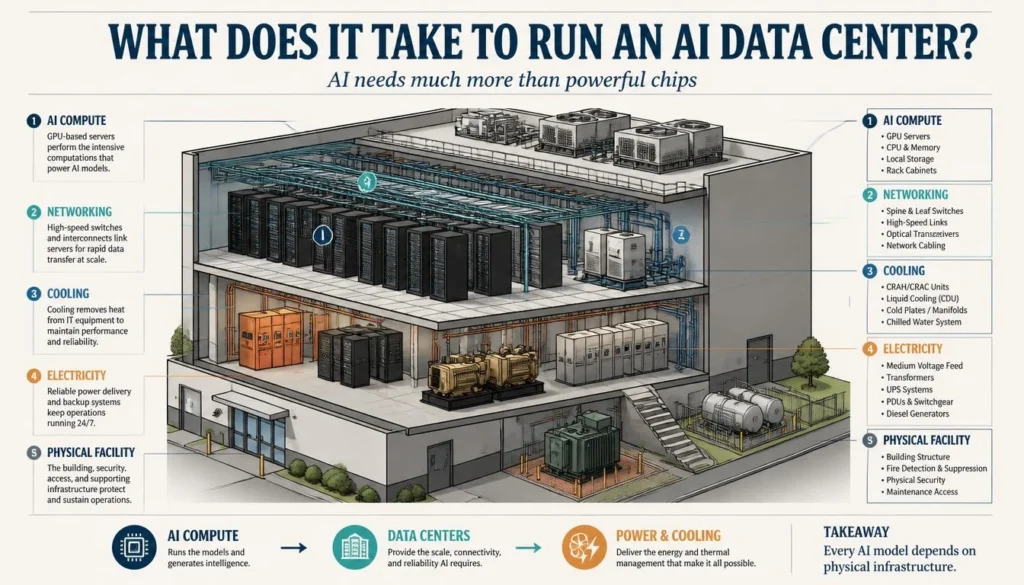
Thousands of processors must operate together inside specialized facilities, supported by networking equipment, cooling systems, power distribution, and maintenance.
These facilities are called data centers.
And building them creates an entire economy of suppliers.
The Businesses Most People Never Hear About
Consider a few examples.
Vertiv supplies equipment used to power and cool data centers.
Arista Networks provides networking technology that helps computing systems communicate.
Dell Technologies sells servers and related computing infrastructure.
Equinix operates data-center facilities and provides infrastructure services.
These companies play different roles, but they have something in common.
They can benefit when businesses expand their computing capacity.
Microsoft’s fiscal 2026 disclosures described significant data-center expansion, including the addition of dozens of facilities.
That’s a reminder that the AI boom isn’t happening only inside computer screens.
It’s also happening on construction sites, in equipment factories, and across electrical networks.
Who Earns the Money First?
Remember our hypothetical $100 million AI project?
Suppose $25 million goes toward constructing a facility and another $20 million toward power and cooling equipment.
The companies receiving those orders can record revenue as they fulfill their contracts under applicable accounting rules.
But the owner of the data center still has to attract enough paying customers to recover its investment.
That’s an important difference.
The supplier earns revenue from selling equipment.
The operator earns revenue from providing services over time.
Both can be profitable, but their financial risks are different.
A supplier might struggle with rising production costs.
A data-center operator might struggle if its facility remains underused.
The lesson: The AI boom is creating business opportunities for companies that build the physical infrastructure, but the size of their orders doesn’t tell us how much profit they ultimately keep.
And all those data centers need something else.
Something you use every day.
Electricity.
4. Why Is AI Turning Electricity Into a Major Business Opportunity?
Think about the last time you asked ChatGPT a question.
You typed a few words.
Seconds later, you received an answer.
It felt almost effortless.
But somewhere, powerful computers were performing calculations, consuming electricity, and generating heat.
Multiply that by millions of users and businesses running AI systems around the world.
Suddenly, electricity becomes a major part of the story.
Fatih Birol, Executive Director of the International Energy Agency, summarized the relationship:
“There is no AI without energy”
– Fatih Birol, International Energy Agency, 2026
It’s a simple statement with enormous economic implications.
How Much Electricity Could AI Need?
The International Energy Agency has projected that global data-center electricity consumption could rise from roughly 485 terawatt-hours in 2025 to 950 terawatt-hours by 2030.
That would represent nearly a doubling.
And supplying that additional electricity requires more than simply generating power.
Data centers need reliable connections to the grid, transformers, transmission equipment, backup systems, and cooling infrastructure.
That’s where companies such as GE Vernova, Eaton, and Constellation Energy enter the picture.
They operate in different parts of the energy and power-equipment industries.
Some may benefit from growing demand for electricity generation.
Others may benefit from equipment orders or infrastructure upgrades.
Could the AI Boom Affect Your Electricity Bill?
Potentially, yes.
Imagine a large data center opening near your town.
It requires a substantial amount of electricity.
The local utility may need to invest in transformers, substations, power lines, or additional generating capacity.
Who pays for those upgrades?
That depends on utility contracts, local regulations, and how infrastructure costs are allocated.
In some cases, technology companies may bear substantial costs.
In others, portions of the investment could eventually influence electricity rates.
So the AI spending boom isn’t just about stock prices.
It can affect real infrastructure decisions and potentially household expenses.
But More Electricity Demand Doesn’t Guarantee More Profit
A utility may face strict regulations.
A power project might take years to complete.
And expensive infrastructure doesn’t automatically generate attractive financial returns.
The lesson: AI is becoming an energy and infrastructure story. But investors need to distinguish growing demand from actual profitability.
We’ve now followed the money through chips, buildings, and electricity.
But there’s one question we haven’t answered.
What happens when the companies paying for all this infrastructure finally try to earn their money back?
5. Are Microsoft, Google, Amazon, and Meta Actually Making Money From AI?
Imagine you’ve spent millions building a luxury hotel.
The construction company has been paid.
The furniture suppliers have been paid.
The electricity company is receiving monthly payments.
But you still need guests.
Without paying customers, your expensive hotel is just an expensive building.
That’s the challenge facing companies investing in AI infrastructure.
They need to turn computing capacity into products and services people are willing to pay for.
Four Companies, Four Different Approaches
| Company | How AI can generate financial value |
| Microsoft | Azure AI computing services, Copilot subscriptions, business software |
| Amazon | AWS computing services, AI tools, automation |
| Google Cloud, search, advertising, productivity tools | |
| Meta | Advertising performance, recommendations, engagement, AI products |
Notice that not every company needs to sell an AI chatbot subscription.
Google can benefit if AI improves its advertising business.
Meta can benefit if AI helps advertisers reach customers more effectively.
Amazon can benefit if businesses pay to rent computing power through AWS.
And Microsoft can earn revenue from AI services integrated into products customers already use.
What Does the Financial Evidence Show?
Google’s parent company, Alphabet, has reported strong Google Cloud growth alongside rising demand for AI infrastructure and services.
Alphabet CEO Sundar Pichai has emphasized the role of AI investment across Google’s businesses.
In July 2026, he stated:
“Our AI investments are redefining what’s possible across every part of our business.”
– Sundar Pichai, CEO of Alphabet and Google, July 2026
That’s encouraging for Google.
But here’s a question a careful investor should ask:
How much of Google’s profit comes specifically from AI?
That’s harder to answer.
Google Cloud serves customers with both AI and non-AI workloads.
Google Search earns advertising revenue from many activities, not just AI-related features.
And companies don’t always disclose the precise profits generated by individual AI investments.
A Profitable Company Can Still Make an Unprofitable Investment
Let’s return to our hotel.
Suppose you already own five profitable hotels.
You decide to build a sixth.
Your company remains profitable because the first five hotels are doing well.
But that doesn’t prove the sixth hotel will earn enough money to justify its construction cost.
The same principle applies to Big Tech.
Microsoft, Amazon, Google, and Meta operate profitable businesses.
That does not automatically prove that every new AI data center, model, or product will produce an attractive return.
The lesson: Big Tech is earning meaningful revenue from AI-related activities, but its total profitability and the profitability of individual AI investments are different questions.
And that brings us to the most important financial test of all.
6. Is the AI Boom Actually Generating Enough Profit to Justify the Spending?
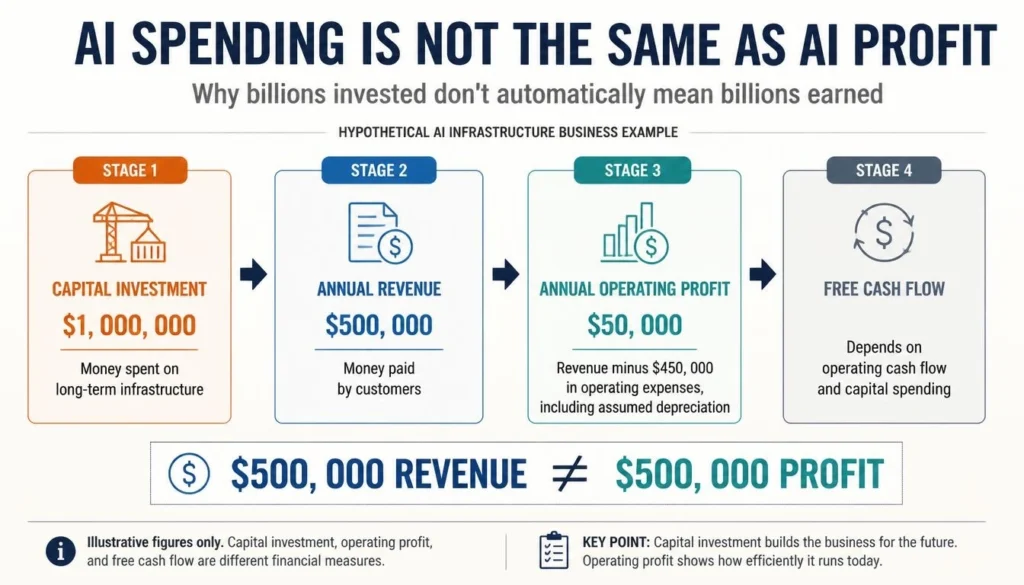
Let’s say you invest $1 million in a business.
A year later, it generates $500,000 in revenue.
Sounds impressive, right?
But wait.
What if running the business costs $450,000?
You have only $50,000 in operating profit before considering any additional financing or tax effects not already included.
And what if the equipment needs replacing in a few years?
Suddenly, the investment doesn’t look quite as extraordinary.
This is the difference between money coming in and money actually being earned.
Four Numbers That Tell the Real Story
1. Revenue: How much customers pay the company.
2. Operating profit: What remains after the costs of operating the business, including depreciation where applicable.
3. Free cash flow: Cash remaining after operating activities and capital expenditure.
4. Return on invested capital: How efficiently the business turns its invested capital into operating returns.
For a beginner, think of a bakery.
Revenue is all the money customers pay for bread.
Operating profit reflects what remains after running the bakery.
Free cash flow considers the cash generated after operating expenses and investments such as buying new ovens.
And return on invested capital helps evaluate whether the money tied up in the bakery is earning a worthwhile return.
These are the kinds of questions investors need to ask about AI.
Why Some Analysts Are Worried
Jim Covello, an analyst at Goldman Sachs Research, has questioned whether the enormous sums being invested in AI will generate sufficient financial returns.
In a June 2026 discussion, he put the issue bluntly:
“At some point you got to make money.”
– Jim Covello, Goldman Sachs Research, June 2026
His point is straightforward.
A company cannot justify unlimited investment simply by arguing that the technology is exciting.
Eventually, customers must pay enough to cover the costs and produce worthwhile profits.
But What If AI Creates Entirely New Businesses?
There’s another side to the argument.
George Lee, also speaking in a Goldman Sachs discussion, emphasized the possibility that AI could create new markets and economic activities.
Think about smartphones.
When smartphones first appeared, most people thought about calling, texting, and browsing the internet.
Few fully anticipated how much business would eventually develop around ride-hailing, food delivery, mobile banking, and app-based services.
AI could create opportunities that are difficult to imagine today.
That possibility helps explain why companies are willing to invest so aggressively.
But here’s the balance investors need to maintain.
A technology can change the world without every company investing in it becoming a financial winner.
The internet changed nearly everything.
Yet many companies that attracted huge investments during the dot-com boom eventually disappeared.
The technology succeeded.
Not every investment did.
The Question That Matters Most
Instead of asking, Will AI become important?
Ask:
Will this particular company earn enough money from AI to justify what it has invested, and what investors are paying for its stock?
That’s a much more useful question.
And it leads directly to our final stop.
7. Which AI Industries Could Make Money Next and How Can You Spot the Winners?
We’ve followed the money from Big Tech’s investment budgets to the companies selling chips, building data centers, supplying electricity, and operating cloud platforms.
But the story doesn’t end there.
What happens when AI becomes useful enough that businesses across the economy begin paying for it?
Imagine a delivery company using AI to plan better routes.
Its drivers travel fewer miles.
Fuel costs fall.
Deliveries become faster.
Customers are happier.
The company hasn’t invented a new AI model.
It has simply used AI to improve an existing business.
And that may be where some of the next opportunities emerge.
Goldman Sachs Research has identified industries such as software, advertising, cybersecurity, and transportation as potential areas where AI could create or reshape business value.
The important question is whether companies can convert those improvements into sustainable profits.
The AI Opportunity Map
| Industry | Where the money comes from | Main risk |
| Semiconductors | Selling advanced processors and memory | Competition, changing demand |
| Data-center equipment | Servers, networking, power and cooling systems | Project delays, margins |
| Electricity infrastructure | Generation, equipment and grid upgrades | Regulation, high costs |
| Cloud computing | Renting computing capacity and AI services | Expensive infrastructure |
| AI software | Subscriptions, automation and business applications | Competition, weak customer retention |
So how should an everyday investor approach this?
You don’t need to predict the next revolutionary AI breakthrough.
Start with three practical questions.
Question 1: Is the Company Actually Making Money?
Look beyond exciting announcements.
Are customers paying for its products?
Is revenue growing?
Is the company reporting profits?
And if it isn’t profitable yet, is there a credible path toward profitability?
Question 2: How Much Does It Cost to Keep Growing?
Some businesses can sell additional software subscriptions without building another billion-dollar facility.
Others need to keep buying expensive processors, constructing data centers, and securing electricity.
Both business models can succeed.
But they require different amounts of investment and carry different risks.
Question 3: Is the Stock Already Too Expensive?
Imagine two restaurants.
Both are excellent.
Both earn the same profit.
But one is available to buy for $1 million, while the other costs $5 million.
Which is the better investment?
You’d probably want to understand why the second costs five times as much.
Stocks work similarly.
A company can have an outstanding business and still be a poor investment if its share price already assumes extraordinary future success.
That’s why valuation, the price investors pay relative to a company’s earnings, cash flow, and prospects, matters just as much as the technology itself.
What About Your Retirement Savings?
Even if you never buy an individual AI stock, you may already have exposure to the AI boom.
Major technology companies represent substantial portions of broad US stock indexes.
That means their performance can influence index funds, retirement accounts, and other diversified investments.
You don’t need to become an AI expert overnight.
But understanding the difference between genuine profits and optimistic expectations can help you make more informed decisions.
The Bottom Line: Follow the Money, Not Just the Hype
Let’s return to our two gold-rush entrepreneurs.
One is digging for gold.
The other is selling the equipment.
The equipment seller may earn money first.
But that doesn’t mean the miner will never discover something far more valuable.
And it doesn’t guarantee that the equipment seller will remain profitable forever.
The AI economy works in much the same way.
Chipmakers and infrastructure suppliers are already receiving substantial revenue from the investment boom.
Cloud providers and technology companies are developing ways to turn AI into recurring business income.
Other industries may eventually benefit by using AI to improve productivity, reduce costs, or create entirely new products.
But the ultimate winners are not yet fully known.
The real question isn’t simply who’s spending the most on AI. It’s who’s turning that spending into lasting profits, and whether investors are paying a sensible price for those profits.
That’s the difference between investing in a promising technological revolution and getting carried away by the excitement surrounding it.
Frequently Asked Questions
How much money is Big Tech spending on AI?
Major technology companies are investing hundreds of billions of dollars in computing infrastructure, data centers, chips, and related assets. However, reported capital expenditure figures often include non-AI investments, so they shouldn’t automatically be treated as AI-only spending.
Which companies are making the most money from AI?
NVIDIA is a prominent example of a company reporting substantial revenue and profits from AI-related computing demand. Cloud providers, networking suppliers, and data-center equipment manufacturers also benefit, although their AI-specific profits are not always disclosed separately.
Why is NVIDIA benefiting so much from the AI boom?
NVIDIA designs advanced processors and computing systems widely used to develop and operate AI models. Demand for this infrastructure has generated substantial revenue and profits for the company.
How do AI data centers make money?
Data-center businesses can earn revenue by providing computing capacity, leasing facilities, or selling related infrastructure services. Their profitability depends on customer demand, operating costs, equipment depreciation, and the investment required to build and maintain facilities
Why does AI need so much electricity?
Advanced AI systems operate on powerful processors that consume electricity and produce heat. Large data centers also need electricity for cooling, networking, and other supporting equipment
Are Microsoft, Google, Amazon, and Meta making profits from AI?
These companies have profitable businesses and generate AI-related commercial value through cloud services, software, advertising, and operational improvements. However, their financial statements don’t always reveal the precise profit or return attributable to AI investments alone.
Is investing in AI stocks still worth it?
AI may create substantial long-term opportunities, but not every AI-related company will generate attractive shareholder returns. Investors should consider profitability, cash flow, competition, capital requirements, and stock valuation rather than relying on AI-related excitement.