
Nvidia Stock Crashes 35%: Jensen Huang Controversy 7 Things Investors Need to Know
At a Glance
Nvidia stock has reportedly fallen nearly 35% from its October peak, amid uncertainty surrounding Jensen Huang, concerns about AI stock valuations, and questions about future growth. The controversy has brought leadership and corporate governance into focus, but investors should distinguish unverified allegations from developments that could genuinely affect Nvidia’s business. The central question is whether the decline reflects a temporary loss of confidence or a lasting change in the company’s earnings potential. A falling share price alone doesn’t mean Nvidia’s AI business is failing or that its stock is now a bargain.
Key Takeaways
Nvidia’s reported 35% decline has raised questions about its valuation, leadership, and future growth. The company’s technological advantages and demand for AI computing remain important strengths, but investors also face risks from competition, export restrictions, and potentially excessive AI spending. Whether the stock offers value depends on its future earnings and the price investors are paying for them.
Introduction: When Confidence in an AI Giant Starts to Crack
Imagine investing in a company that seems to be shaping the future. Its technology is everywhere, its profits are growing, and its founder has become one of the most recognizable figures in the business world.
Then a controversy erupts, investors become nervous, and the stock starts falling.
That’s the story surrounding Nvidia, the company at the center of the artificial intelligence boom.
For more than three decades, Jensen Huang helped transform Nvidia from a graphics-chip manufacturer into a leading supplier of the powerful computing technology behind modern AI. His leadership became closely associated with the company’s success.
But the recent controversy surrounding Huang has raised uncomfortable questions about leadership, governance, and investor confidence.
Meanwhile, Nvidia’s stock has reportedly lost approximately 35% from its October high. For someone who invested $10,000 at that peak, a decline of that magnitude would leave roughly $6,500.
Yet Nvidia hasn’t suddenly stopped selling AI chips. Its technology hasn’t become obsolete, and companies around the world are still investing heavily in artificial intelligence.
So what’s really happening?
Is Wall Street overreacting to bad headlines, or are investors beginning to recognize risks they previously overlooked?
1. What Is the Jensen Huang Controversy, and Why Does It Matter?
Jensen Huang isn’t an ordinary corporate executive. He co-founded Nvidia in 1993 and helped build the company into one of the most influential businesses in technology.
That makes any serious controversy surrounding him particularly sensitive for shareholders.
Recent allegations involving Huang’s personal conduct have attracted attention and prompted questions about corporate governance. However, claims about potential security implications must be treated cautiously unless supported by verified investigative findings.
For investors, the important distinction is between a personal controversy and a problem that could materially affect Nvidia’s operations.
A personal scandal can damage confidence in leadership. But confirmed failures involving confidential information, regulatory compliance, or corporate oversight could have more serious business consequences.
The concern is therefore not simply what happened in Huang’s personal life. It’s whether the controversy could weaken investor trust, disrupt management, or affect Nvidia’s ability to execute its strategy.
And that leads to a much bigger question: why can uncertainty about one person have such a powerful effect on a company’s stock?
2. Why Can Nvidia Stock Fall Even When Its Business Is Growing?
Here’s something that often surprises people who are new to investing: a company’s stock price can fall even when its sales and profits are increasing.
That’s because investors aren’t simply paying for what a company earns today. They’re paying for what they believe it will earn tomorrow.
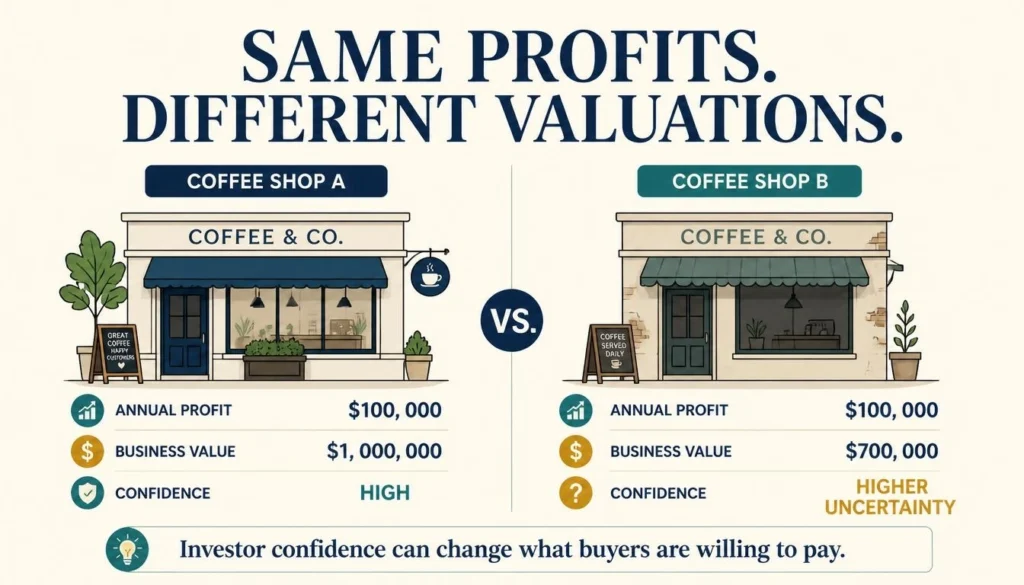
Imagine two coffee shops, each earning $100,000 annually. The first has experienced management, loyal customers, and a clear expansion plan. The second earns the same amount, but its founder is caught in a controversy and nobody knows who will lead the business next.
Would you pay the same price for both?
Probably not.
You might offer $1 million for the first shop but only $700,000 for the second. Their current earnings are identical, yet the uncertainty makes one feel riskier.
The stock market works similarly.
Investors may become unwilling to pay the same premium for Nvidia if they’re less confident about its future. Analysts call this a valuation reset, but the idea is simple: a business can remain profitable while its stock becomes less valuable because expectations have changed.
However, the Jensen Huang controversy isn’t the only issue affecting Nvidia.
Investors have also been questioning whether technology companies can continue spending enormous amounts on AI infrastructure and whether those investments will eventually produce sufficient profits.
Export restrictions, competition, and concerns about expensive technology-stock valuations have added to the pressure.
The controversy may have intensified those worries, but it would be misleading to attribute the entire stock decline to one headline.
3. Can Nvidia Continue Growing Without Jensen Huang?
Think about Apple after Steve Jobs.
Jobs was closely associated with Apple’s identity and innovation. When he died in 2011, investors naturally wondered whether Apple could maintain its success.
Yet the company continued growing under new leadership.
Nvidia faces a similar underlying question: how much of its success depends on Huang personally, and how much belongs to the business he helped build?
Huang shaped Nvidia’s strategy, developed important industry relationships, and helped establish its position in advanced computing. Losing that influence, whether through a leadership transition or reputational damage, would create uncertainty.
But Nvidia is much more than one executive.
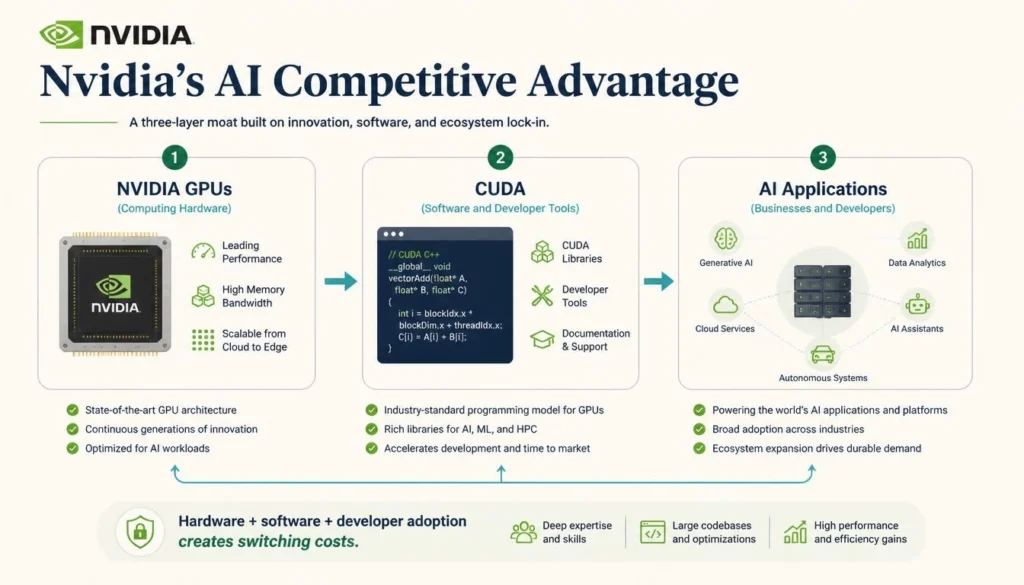
It has experienced engineers, valuable technology, major customers, and an established software ecosystem. Its CUDA platform, for example, is deeply integrated into the way many developers build AI applications.
Think of a business that has spent years using one software system. Switching to another might be possible, but it would involve retraining employees, changing processes, and potentially rebuilding important tools.
That’s part of Nvidia’s competitive advantage.
Customers don’t necessarily abandon its technology because of uncertainty surrounding its leadership.
The real test is whether Nvidia can preserve its innovation, customer relationships, and long-term strategy through whatever management and governance challenges lie ahead.
4. Could the Controversy Actually Hurt Nvidia’s AI Business?
This is where investors need to separate dramatic headlines from genuine business risks.
Nvidia’s advanced chips are important to AI development, cloud computing, and other technologies with strategic significance. That means the company operates in an environment where national security and international trade regulations matter.
If a controversy produces verified findings of serious compliance failures, it could create regulatory or operational consequences.
But an allegation alone doesn’t establish that a security breach occurred.
Investors should pay attention to confirmed findings, official disclosures, and any measurable effect on Nvidia’s business rather than treating speculation as fact.
There is also a separate challenge involving China.
The United States restricts exports of certain advanced computing technologies because of national-security concerns. For Nvidia, these rules can limit access to potential customers even when demand for its products remains strong.
Imagine running a successful business whose products are popular worldwide, only to discover that government rules prevent you from selling your most advanced products in certain markets.
Your technology might still be excellent, but your growth opportunities become more complicated.
That’s the situation Nvidia must navigate.
Ultimately, the company’s future depends less on how sensational the controversy becomes and more on whether it can keep developing, manufacturing, and selling its technology profitably.
5. Is Nvidia’s Stock Decline a Warning for the Entire AI Market?
Even if you don’t own Nvidia shares directly, its performance may affect your investments.
Nvidia has substantial influence on major US stock indexes, including the S&P 500 and Nasdaq-100. When such a large company declines, index funds can feel the impact.
There’s another issue investors sometimes overlook: owning several different investments doesn’t always mean you’re properly diversified.
Imagine someone holding Nvidia shares, an AI-focused ETF, and a technology-heavy index fund. Those investments may have different names, but all three could depend heavily on the same AI growth story.
If enthusiasm for AI stocks weakens, several parts of that portfolio might decline together.
Could Nvidia’s competitors’ benefit?
Possibly. Companies such as AMD and Broadcom may find opportunities if customers want to diversify their semiconductor suppliers. However, replacing Nvidia’s established technology and software ecosystem isn’t something customers can accomplish overnight.
The larger concern is whether the AI investment boom can justify the enormous amounts being spent.
Microsoft, Amazon, Alphabet, Meta, and other technology companies are investing heavily in data centers and computing infrastructure. Those investments could create substantial future value, but businesses eventually need to earn a return on their spending.
Imagine opening a restaurant for $100,000. If it earns $30,000 annually, the investment could be attractive. If it earns only $3,000, you might reconsider expanding.
The same principle applies to AI infrastructure, although the numbers are vastly larger.
If major technology companies eventually slow their AI spending, Nvidia’s growth could be affected.
That’s why investors should remember that AI can transform the world without every AI-related stock delivering exceptional returns.
6. Is Nvidia Stock Cheap After a 35% Crash?
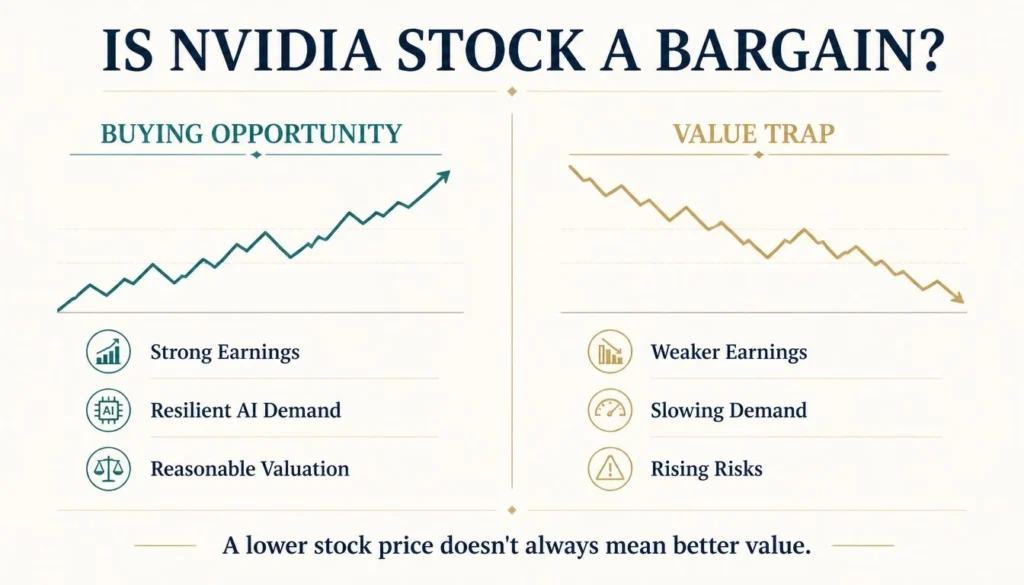
A sharp decline can make a stock look attractive.
After all, buying something for $156 that recently cost $239 sounds like getting a substantial discount.
But investing isn’t quite that simple.
Imagine a house that was listed for $500,000 last month. Today, the owner is asking $350,000.
You might think you’ve found an incredible bargain.
But what if the property has serious structural problems?
Suddenly, the lower price doesn’t tell you whether it’s a good investment.
The same applies to Nvidia.
Its share price may be considerably lower, but investors still need to determine what the underlying business is worth.
Nvidia’s growth has been driven by extraordinary demand for AI computing. Its software ecosystem, technology, and relationships with major customers provide meaningful advantages.
However, investors must consider whether future earnings can continue growing fast enough to justify the stock’s valuation.
One commonly used measure is the price-to-earnings ratio, or P/E ratio. It simply compares what investors pay for a company’s shares with the profits the company generates.
A lower P/E ratio can make a stock more attractive, but only if those profits are sustainable.
For Nvidia, the important questions are whether AI chip demand remains strong, whether profit margins hold up, and whether competition or export restrictions could weaken future growth.
A stock becomes a bargain when its price falls below what the business is reasonably worth, not merely because it has fallen from a previous high.
That’s the distinction investors need to make before rushing to buy the dip.
7. Should Investors Buy, Hold, or Sell Nvidia Stock?
Imagine three investors watching Nvidia’s decline.
One bought shares several years ago and still has substantial gains. Another purchased near the peak and is now facing a painful loss. The third has never owned Nvidia but wonders whether this is the perfect time to buy.
They’re looking at the same company, but their decisions shouldn’t necessarily be identical.
For someone who already owns Nvidia, the first question is whether the original reason for investing still makes sense. If the investment was based on long-term AI demand and Nvidia’s competitive advantages, those factors deserve more attention than daily price movements.
However, the size of the investment also matters. Even a strong company can create substantial portfolio risk if it represents too much of someone’s savings.
For someone who bought near the peak, the temptation may be to sell immediately or purchase more shares simply to reduce the average buying price.
Neither decision should be automatic.
The price originally paid doesn’t determine what Nvidia is worth today.
And for someone considering a new investment, a sharp decline can create an opportunity, but it doesn’t guarantee that the stock has reached its lowest point.
The most useful approach is to consider what could happen next.
If Nvidia maintains strong earnings, preserves its competitive advantages, and resolves major uncertainties, investor confidence could recover. If its business remains healthy but the market becomes less willing to pay a premium for future growth, the stock might remain volatile. And if AI spending slows or material business problems emerge, further weakness is possible.
These aren’t predictions. They’re different outcomes investors should be prepared to consider.
Rather than trying to guess tomorrow’s share price, the better question is whether Nvidia’s potential long-term returns justify the risks at its current valuation.
What Should Nvidia Investors Watch Next?
Nvidia’s earnings and management guidance will provide a clearer picture than the controversy alone.
Investors should watch whether demand for AI computing remains strong, whether major technology customers continue their spending plans, and whether Nvidia can protect its profitability as competition increases.
Leadership developments and any verified regulatory or investigative findings will also matter.
A reassuring announcement might improve confidence, but ultimately the company needs to demonstrate that it can continue delivering strong financial results.
For long-term investors, that’s far more meaningful than trying to interpret every movement in the stock price.
The Bottom Line: Opportunity or Warning?
A few weeks ago, investors were asking how much higher Nvidia could climb.
Now they’re asking how much further it might fall.
That’s how quickly market confidence can change.
The Jensen Huang controversy has introduced uncertainty around one of the most influential companies in the AI industry. But Nvidia’s technology, software ecosystem, and customer relationships don’t simply disappear because investors become nervous.
At the same time, the company’s impressive history doesn’t guarantee that its shares are attractively priced today.
The next chapter will depend on Nvidia’s ability to maintain growth, manage regulatory and competitive challenges, and justify the expectations built into its valuation.
Some investors may eventually look back on this decline as an opportunity. Others may conclude that the market was correctly recognizing risks that had previously been overlooked.
For now, one principle matters more than the headlines:
A great company isn’t always a great investment at every price. And a falling stock isn’t automatically a bargain.
The real question isn’t how far Nvidia has fallen.
It’s what the business is worth after the headlines fade.
Frequently Asked Questions
Why is Nvidia stock falling?
Nvidia’s share-price weakness has been associated with concerns about AI valuations, future growth, export restrictions, and uncertainty surrounding Jensen Huang. The contribution of each factor to the overall decline cannot be determined from the price movement alone.
What is the Jensen Huang controversy?
The controversy concerns allegations about Huang’s personal conduct and questions raised about governance and possible security implications. Unverified allegations should not be confused with established findings.
Is Nvidia stock a good buy after a crash?
A lower price may create an opportunity, but investors need to assess Nvidia’s future earnings, valuation, competitive position, and business risks before deciding.
Can Nvidia continue growing without Jensen Huang?
Nvidia has substantial technological resources, experienced employees, and an established customer ecosystem. Its long-term success depends on maintaining those advantages and executing its strategy effectively.
Will Nvidia’s decline affect other AI stocks?
It can. Nvidia’s influence on major indexes and its role in AI infrastructure mean changes in investor sentiment can affect other semiconductor companies, technology stocks, and AI-focused funds.