
You’re shopping online when you find a pair of sneakers you really like.
The price? $200.
You hesitate. That’s quite a bit for shoes, especially when groceries, bills, and other expenses are already competing for your paycheck.
You decide to leave them in your cart.
But just before closing the page, something catches your attention.
Or pay just $50 today. Four interest-free payments.
Now those sneakers don’t seem quite so expensive.
Funny, isn’t it?
The store hasn’t offered you a discount. The shoes still cost $200. Yet somehow, paying $50 today feels easier to justify than spending $200 all at once.
And that’s where Buy Now, Pay Later (BNPL) gets interesting.
Services like Klarna, Affirm, Afterpay, and PayPal Pay Later have made installment payments a familiar part of American shopping. From clothes and electronics to furniture and groceries, shoppers can often split their purchases into smaller payments with just a few clicks.
For many people, that’s genuinely convenient. But there’s another side worth understanding.
According to LendingTree’s 2026 Buy Now, Pay Later survey, 68% of surveyed BNPL users agreed that these loans cause them to overspend, while 54% reported regretting a BNPL purchase.
Those are self-reported experiences, not proof that installment payments make everyone spend more. Still, they raise an interesting question.
Is Buy Now, Pay Later helping Americans afford their purchases, or simply making purchases feel more affordable than they really are?
To understand the difference, we need to look beyond the attractive little payment amounts at checkout.
What Is Buy Now, Pay Later, and How Does It Work?
Buy Now, Pay Later is a form of borrowing that lets you receive something immediately and pay for it over time.
One popular arrangement is called pay-in-four.
Let’s return to those $200 sneakers.
Instead of paying $200 today, you might pay $50 at checkout, followed by three more $50 payments, usually spaced two weeks apart.
If the plan is interest-free and you follow its terms, the total remains $200.
That can be useful. Rather than putting a purchase on a credit card and potentially paying interest, you may be able to spread the expense across predictable installments.
But here’s something worth remembering: BNPL doesn’t reduce what something costs. It changes when you pay for it.
Some BNPL plans charge interest, especially longer-term financing options. Others may impose late fees or have different repayment conditions.
And even when the plan is completely interest-free, you’re still committing money from future paychecks.
That’s not necessarily a problem.
The problem begins when the smaller payments start influencing what you decide to buy.
1. Smaller Installments Can Make Expensive Purchases Feel Cheaper
Imagine seeing a $400 jacket in a store.
Your first reaction might be, That’s too expensive.
Now imagine seeing the same jacket advertised as four payments of $100.
Does it suddenly feel more affordable?
For many shoppers, it can.
Psychologists call this kind of effect payment framing. In simple terms, the way a price is presented can change how we react to it, even when the actual price stays exactly the same.
And retailers understand the appeal.
In a December 2023 interview with the Associated Press, Sebastian Siemiatkowski, CEO and co-founder of Klarna, discussed the benefits BNPL offers merchants:
“These merchants are seeing higher order value and more spending.”
Think about what that means.
A payment option designed to make shopping easier can also encourage shoppers to spend more.
Suppose you planned to buy $150 headphones. Then you notice a better model for $250.
An extra $100 might make you hesitate.
But when the difference becomes just $25 more per installment, upgrading suddenly feels like a smaller decision.
You haven’t saved $100. You’ve agreed to spend $100 more.
That’s the distinction that matters.
A useful question to ask yourself is: Would I still want this product if the store only showed me its full price?
If the answer is no, the payment plan may be influencing your decision more than the product itself.
2. Several Small Payments Can Quietly Become One Big Bill
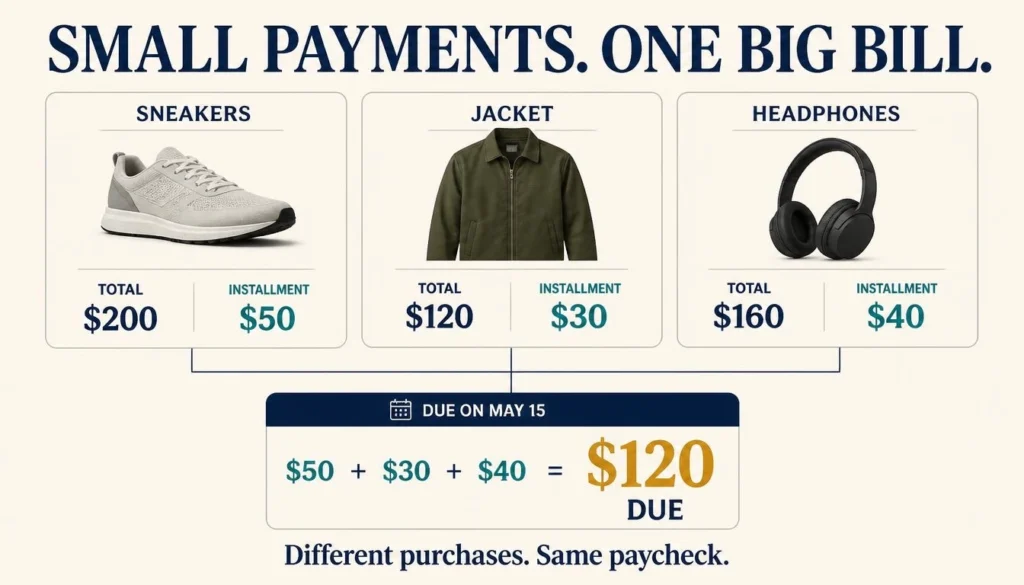
Let’s say you buy those $200 sneakers using BNPL.
Four payments of $50. Easy enough.
A few days later, you order a $120 jacket. Four payments of $30.
Then your headphones stop working, so you replace them for $160. Four payments of $40.
Each purchase seems manageable.
But now imagine that installments from all three purchases fall due during the same week.
Suddenly, you’re paying $120 toward things you bought days or weeks ago.
And that’s before rent, groceries, transportation, or anything unexpected.
The problem isn’t always one expensive purchase. Sometimes it’s several affordable-looking purchases happening together.
Consumer finance analyst Ted Rossman captured this problem with a simple observation:
“It’s not just $50 dollars here and $50 dollars there.”
Research suggests that overlapping installment plans are common.
A Consumer Financial Protection Bureau study published in 2025 found that approximately 63% of BNPL borrowers in its 2022 dataset had multiple loans outstanding at the same time at some point during the year.
That doesn’t mean everyone with several loans is struggling. But it shows how easily installment commitments can overlap.
There’s another complication.
Your payments may be spread across different apps and providers. One company charges you on Tuesday, another on Thursday, and a third the following week.
You might remember the purchases without remembering exactly when the money is leaving your account.
The simplest solution isn’t necessarily avoiding BNPL.
It’s looking at all your outstanding installments as one total obligation.
Because your paycheck doesn’t distinguish between a $50 Klarna payment and a $40 Afterpay payment.
It just gets smaller.
3. BNPL Can Turn a Passing Want Into an Immediate Purchase
Have you ever opened a shopping app just to browse?
You weren’t looking for anything in particular. Maybe you were waiting for dinner or relaxing after work.
Then something caught your eye.
A smartwatch. A pair of sunglasses. A kitchen gadget that looked surprisingly useful in the advertisement.
You weren’t planning to buy it.
But the checkout page offered four small payments, and suddenly the purchase didn’t seem like a big commitment.
This is where BNPL can influence a different part of our spending behavior.
The first problem was how we perceive prices.
This one is about how quickly we move from wanting something to buying it.
Ordinarily, an expensive purchase creates a moment of hesitation. You might check your balance, compare alternatives, or decide to wait until payday.
When financing is available almost instantly, some of that hesitation disappears.
Matt Schulz, Chief Consumer Finance Analyst at LendingTree, has warned about the relationship between easy access to installment financing and overspending:
“When they are easier to get, it’s a little easier to overspend.”
Of course, convenience isn’t automatically bad.
If you’ve been saving for a new laptop and find a suitable interest-free payment plan, a quick checkout doesn’t make the decision irresponsible.
But when you weren’t planning to buy anything in the first place, the ease of payment can become part of the temptation.
Here’s a small experiment worth trying.
The next time you’re tempted by an unplanned purchase, leave it in your cart for 24 hours.
Don’t decide whether you can afford the first installment. Decide whether you actually want the product.
You may discover that the urge to buy disappears much faster than the installments would have.
4. Using BNPL for Groceries Can Turn Today’s Necessities Into Tomorrow’s Bills
Buying a television in installments is one thing.
Buying groceries in installments is something else.
A television might last for years. Groceries disappear in days.
And next week, you’ll need more.
That’s what makes the growing use of Buy Now, Pay Later for everyday necessities particularly interesting.
LendingTree’s 2026 survey found that 29% of surveyed BNPL users had used it to buy groceries.
The Federal Reserve has also documented BNPL use for groceries and food delivery.
Why would someone finance something as ordinary as food?
Sometimes the explanation is straightforward.
Your paycheck arrives Friday, but the refrigerator needs filling on Tuesday. A short-term installment plan might help you get through the week.
For someone facing a temporary cash shortage, that flexibility can be valuable.
But imagine a different situation.
You buy $200 worth of groceries using BNPL because your budget is already stretched.
A week later, you need more food. The first grocery purchase hasn’t been fully paid for, so you finance the second.
Then comes another grocery trip.
Before long, you’re paying for food you’ve already eaten while trying to afford the food you need today.
The concern isn’t that groceries are being financed. It’s that groceries are a recurring expense, while the repayments from previous purchases are still outstanding.
That can create a difficult cycle when the household’s income consistently falls short of its needs.
And this is where we need to be careful about judging people.
Someone using BNPL for essentials may not be shopping impulsively. They may simply be trying to manage rising living costs with limited income.
The useful question isn’t, Why would anyone finance groceries?
It’s, Is this helping me bridge a temporary gap, or am I borrowing against next week’s grocery money every week?
Those are very different financial situations.
5. Interest-Free Doesn’t Always Mean Cost-Free
One of the most attractive features of BNPL is that many plans charge no interest.
That’s a real benefit.
But imagine this.
You’ve scheduled a $75 installment for Friday.
Unfortunately, your electricity bill is also due that morning, and both payments are coming out of the same checking account.
There isn’t enough money to cover everything.
Now a purchase that was supposed to be interest-free might trigger an overdraft charge from your bank, a late fee from your provider, or another repayment problem.
Suddenly, that convenient payment plan isn’t quite as inexpensive as it looked.
According to the Federal Reserve’s 2026 household report, 26% of BNPL users had paid late at least once during the previous year.
The report also found that 11% of BNPL users had experienced a bank overdraft or insufficient-funds fee triggered by a BNPL payment.
An insufficient-funds fee simply means your bank may charge you when a payment is attempted without enough money in the account.
Not every BNPL provider charges late fees, and not every missed payment results in additional charges. The consequences depend on the provider, your bank, and the terms of the agreement.
But the larger point remains.
A purchase doesn’t have to charge interest to become financially stressful.
There’s another situation worth considering: returns.
Suppose you order a jacket using BNPL, but it doesn’t fit.
You return it and assume the installment payments will stop immediately.
However, the retailer and payment provider may need time to process the return and adjust the loan.
Until the refund is confirmed, you shouldn’t assume the repayment schedule has changed.
This doesn’t mean BNPL returns are always problematic. It means you need to understand how your particular provider handles them.
Before using an installment plan, take a moment to check what happens if a payment fails, how refunds work, and whether any fees apply.
It’s not the most exciting part of online shopping.
But it’s considerably less frustrating than discovering those details after something goes wrong.
6. BNPL May Affect Your Credit Differently Than You Expect
Here’s something that surprises many shoppers.
Paying every BNPL installment on time doesn’t necessarily improve your credit score.
And missing payments doesn’t necessarily mean your credit will remain unaffected either.
Confusing? A little.
But the basic explanation is straightforward.
Your credit score is a number lenders use to help assess how you’ve handled borrowing in the past.
Traditional credit cards commonly report account information to credit bureaus, which maintain records used in credit scoring.
BNPL products don’t all work the same way.
Some short-term installment plans historically haven’t reported regular payments in the same way as credit cards. Other BNPL products may report information, and reporting practices have been changing.
That means two people using different BNPL services could have different credit-reporting experiences.
And even when a provider doesn’t report ordinary payments, unpaid debts that reach collections may still create credit problems.
Why does this matter for everyday spending?
Because BNPL can feel separate from your financial life.
You might carefully monitor your credit card balance while treating installment purchases as ordinary shopping transactions.
But the money still has to be repaid.
And depending on the product, the way you manage that obligation may affect your credit record.
Before choosing a plan, check whether the lender performs a credit inquiry, reports payments, or uses collections when loans go unpaid.
You don’t need to become a credit expert.
You just need to remember that a payment option that looks different from a credit card can still be a financial obligation with real consequences.
7. Your Bank Balance May Be Telling You Only Half the Story
Imagine it’s Monday morning.
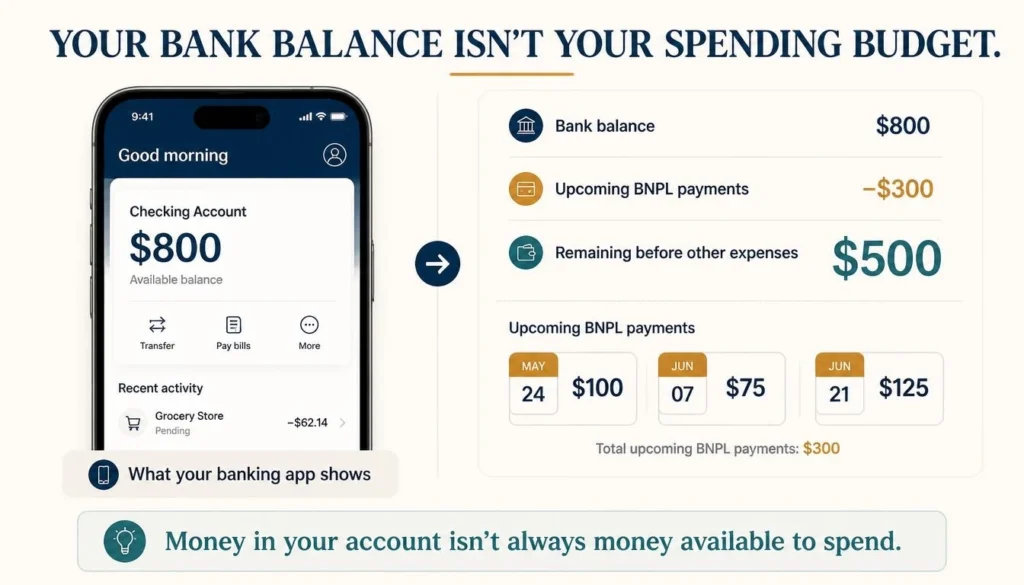
You open your banking app and see $800 in your checking account.
Not bad.
Your rent is paid, your next paycheck arrives in a week, and you feel reasonably comfortable.
Maybe you can order dinner tonight or finally buy that jacket you’ve been considering.
But there’s something you’ve forgotten.
Tomorrow, a $100 BNPL installment is due.
On Thursday, another $75.
And next Monday, $125.
That’s $300 in payments you’ve already promised to make.
Your banking app says you have $800.
But once those commitments are accounted for, only $500 remains—and that’s before any other upcoming expenses.
Your bank balance tells you how much money is in your account. It doesn’t tell you how much of that money you’ve already promised to someone else.
This is one of the easiest ways installment payments can distort your sense of affordability.
When you buy something today but pay for it over several weeks, the purchase and its financial impact become separated.
You enjoy the product immediately.
The payments arrive later.
And if you keep shopping in the meantime, you may begin making new spending decisions based on money that’s already committed.
The same problem can happen with credit cards, subscriptions, and other recurring expenses.
But with BNPL, opening multiple short-term plans can make those commitments especially easy to overlook.
A better habit is to look beyond your current balance.
Ask how much money will remain after the bills and installments due before your next paycheck.
That number is far more useful than the balance displayed at the top of your banking app.
And it may change how affordable your next purchase feels.
Is Buy Now, Pay Later Actually Bad for Your Finances?
After reading about these risks, you might be thinking that avoiding BNPL altogether is the safest choice.
For some people, that may be sensible.
But it would be unfair to suggest that installment payments are always harmful.
Consider this situation.
Your washing machine breaks unexpectedly, and replacing it costs $600.
You have enough savings to cover the expense, but paying everything upfront would leave your checking account uncomfortably low.
If you can use a genuinely interest-free payment plan, understand its terms, and comfortably cover every installment, spreading the cost may be a reasonable decision.
Now imagine buying a $600 designer handbag you hadn’t planned to purchase because the checkout page offers four payments of $150.
Same financing method.
Very different decision.
The real issue isn’t simply whether you’re using BNPL.
It’s whether the purchase makes sense for your financial situation.
Research supports this more balanced perspective.
In a February 2026 analysis, Zhu Wang of the Federal Reserve Bank of Richmond examined the growth of Buy Now, Pay Later and its implications for consumers.
The research found mixed evidence about BNPL’s effects on financial well-being. Although BNPL users often have higher balances on other unsecured credit products, the available evidence doesn’t establish that BNPL itself causes those balances to increase.
That’s an important distinction.
People already experiencing financial pressure may be more likely to use installment financing. We shouldn’t automatically assume that using BNPL created their financial difficulties.
And for someone with predictable income, a planned purchase, and a realistic repayment schedule, an interest-free plan can offer useful flexibility.
So rather than asking whether BNPL is good or bad, ask a more useful question:
Is this payment plan helping me manage a purchase I can afford, or helping me justify a purchase I otherwise wouldn’t make?
That one distinction can change how you shop.
How to Use Buy Now, Pay Later Without Overspending
You don’t need a complicated budget or a finance degree to use installment payments more carefully.
You just need to stop thinking about the first installment as the price of the purchase.
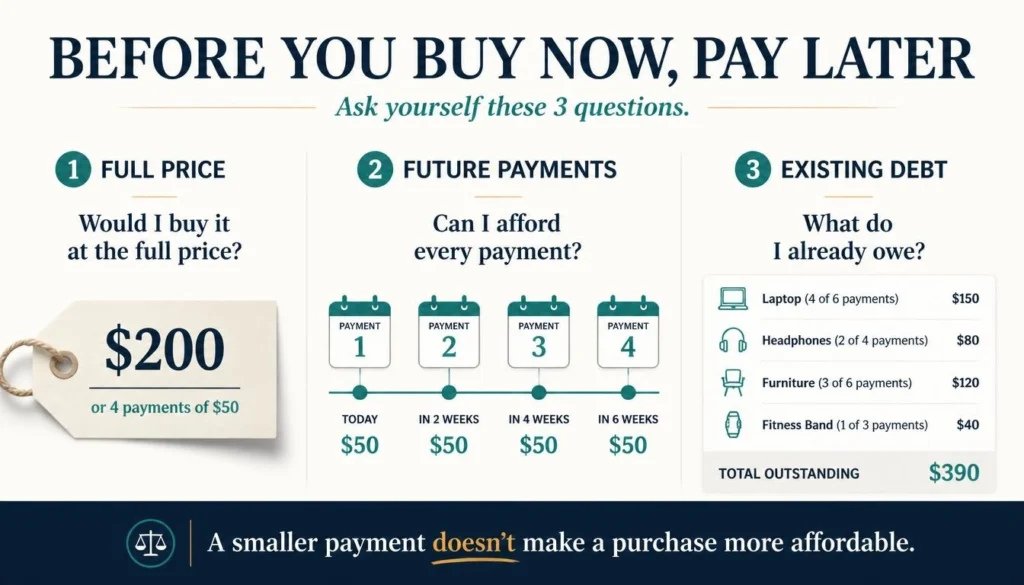
The next time you see a BNPL offer, try what we can call the Three-Question Affordability Test.
Would I Still Buy This at the Full Price?
Imagine the installment option disappears.
The product still costs the same amount, but now you see only the full price.
Would you still consider it worth buying?
You don’t necessarily have to pay upfront. This question simply helps separate the value of the purchase from the attractiveness of the payment plan.
If the product only seems appealing because the first installment is small, you may want to reconsider.
Can I Comfortably Make Every Payment?
Think beyond today.
Consider your next few paychecks, regular bills, and unexpected expenses.
If paying the final installment depends on nothing going wrong, the purchase may be stretching your budget further than it should.
An interest-free plan can be useful, but only when the repayment schedule fits your actual finances.
How Much Do I Already Owe?
Before opening another plan, check the ones you already have.
How much remains unpaid? When are the next installments due? How much of your upcoming income is already committed?
You can track this in a spreadsheet, a budgeting app, or even a note on your phone.
The method doesn’t matter nearly as much as knowing the total.
Once you can see all your outstanding payments together, those attractive little installment amounts become much easier to evaluate.
And sometimes, the smartest choice will be to wait.
The Bottom Line: Four Smaller Payments Don’t Make the Purchase Smaller
Remember those $200 sneakers from the beginning?
Four $50 payments made them seem easier to afford.
And maybe they genuinely are affordable for you.
Perhaps you’ve planned the purchase, checked your budget, and know exactly when every payment is due.
In that case, splitting the cost might be a convenient way to pay.
But what if you were ready to walk away until the store showed you that tempting $50 installment?
What if the payment plan, not the shoes themselves, changed your mind?
That’s the difference worth paying attention to.
Buy Now, Pay Later can make paying for something easier.
It can also make deciding to buy something easier.
Those are not always the same thing.
So the next time you see an installment offer, don’t focus only on how little you need to pay today.
Look at the full price. Think about the payments you’ve already committed to. Ask whether you’d still want the item without the financing offer.
Because the smartest financial decision isn’t always finding an easier way to pay.
Sometimes, it’s knowing when not to buy.
Frequently Asked Questions
Does Buy Now, Pay Later Make People Spend More?
BNPL can encourage additional spending by making purchases feel more affordable through smaller installments. Consumer surveys have found that some BNPL users report overspending and regretted purchases. However, these findings don’t prove that BNPL causes everyone to spend more.
Is Buy Now, Pay Later Better Than a Credit Card?
It depends on the terms and how you repay. An interest-free BNPL plan may be cheaper than carrying an interest-bearing credit card balance. But a credit card paid in full can also avoid interest and may offer different rewards, protections, and credit-building benefits.
Does Buy Now, Pay Later Hurt Your Credit Score?
It can, depending on the provider, product, and reporting practices. Some BNPL lenders report payments to credit bureaus, while others may not. Unpaid debts that reach collections may also affect your credit.
What Happens If You Miss a BNPL Payment?
Depending on your provider and agreement, you may face late fees, account restrictions, collection activity, or other consequences. Automatic payments can also trigger bank charges if your account doesn’t have enough money.
Can You Use Buy Now, Pay Later Without Going Into Debt?
BNPL is technically a form of debt because you’re borrowing money to complete a purchase. However, using it responsibly can help you avoid accumulating debt that becomes difficult to manage.
Is Buy Now, Pay Later Worth It for Groceries?
It may help bridge a temporary gap between income and essential expenses. But repeatedly financing groceries can create overlapping repayments, especially when new food purchases are needed before previous ones have been paid off.