The Big Picture: How Big Has the AI Boom Become?
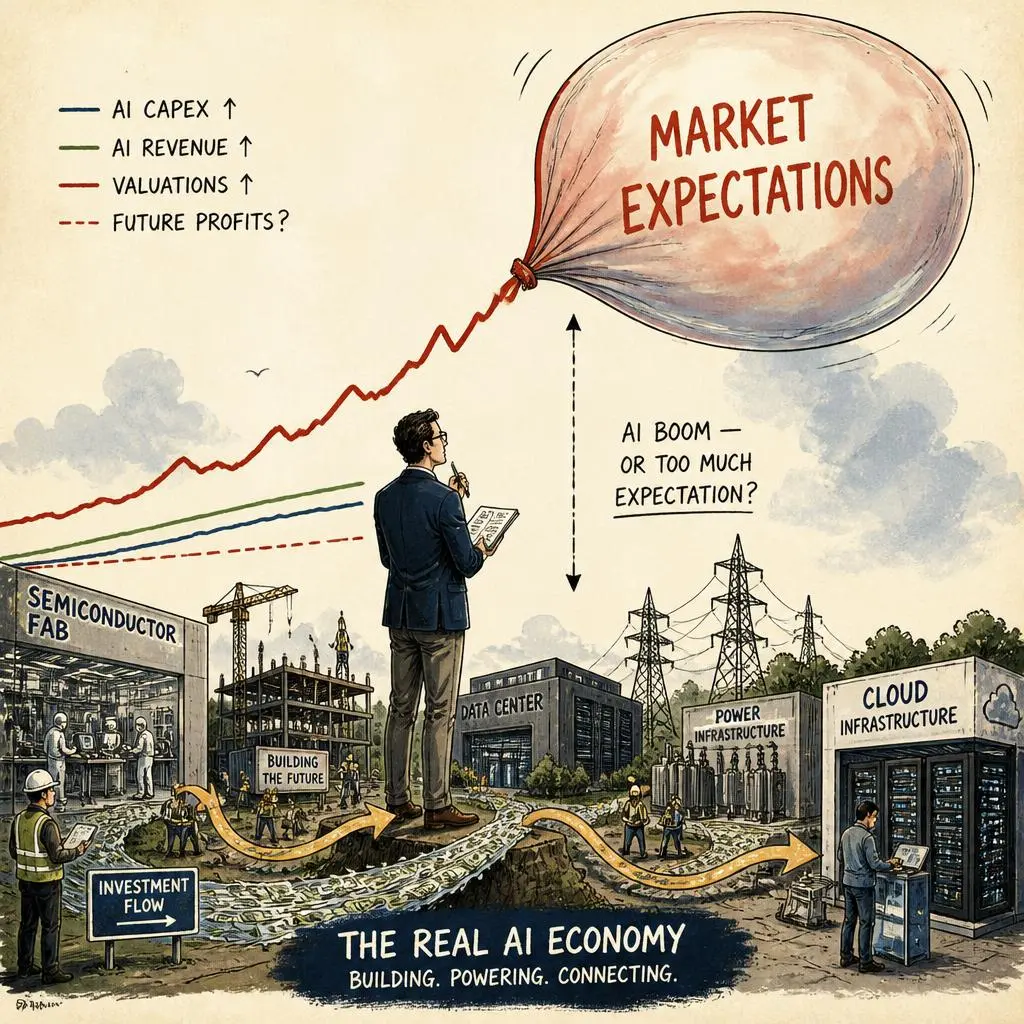
AI Stock Bubble: The AI investment boom has reached extraordinary scale. Morgan Stanley estimated in September 2026 that major cloud providers could spend more than $1.4 trillion on AI infrastructure in 2027, while the BIS says the five largest big-tech companies alone are set to spend more than $1 trillion on AI-related capital expenditure across 2025–2026. At the same time, AI-related valuations have risen sharply, making earnings, productivity, capital spending and financing increasingly important to investors.
AI is no longer something you only encounter in a chatbot. It is showing up in company budgets, data centers, semiconductor orders, electricity demand and, increasingly, your investment portfolio.
And that is where the story gets interesting.
Because the question isn’t really whether AI is real. It clearly is.
The uncomfortable question is whether investors have started pricing too much future success into AI-related stocks today.
That’s what a bubble question is really about.
And you don’t have to believe AI is fake to worry about one.
By the End of This Article, You’ll Know:
- How much AI growth is already priced into stocks?
- Are AI companies generating enough real economic value?
- Who is actually paying for the AI boom?
- What happens if AI spending slows or becomes much more efficient?
- How do interest rates affect AI stock valuations?
- Why can a great AI company still be a bad investment?
- What warning signs could indicate that the AI boom is becoming excessive?
- What does the AI boom mean for ordinary investors?
Let’s follow the money.
1. How Much AI Success Is Already Priced Into Stocks?
Imagine finding a company you believe could become one of the biggest businesses in the world.
You aren’t buying it for what it earns today. You’re buying it because you believe what it could earn five or ten years from now.
That is where the first financial theory enters the story: present value.
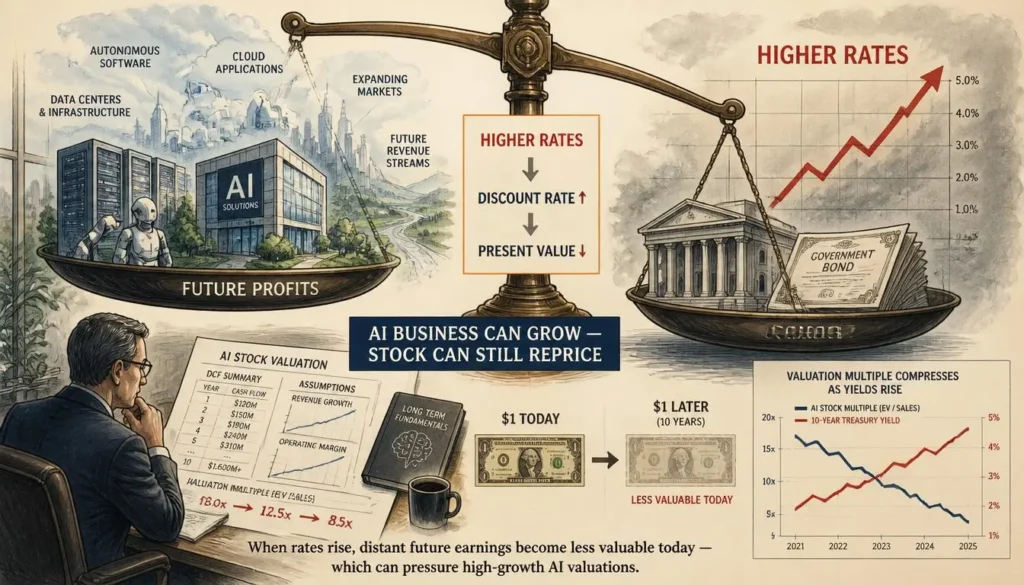
In everyday language, future money is usually worth less than money today. If someone promises you $1,000 today or $1,000 ten years from now, today’s money is more valuable because you can invest it in the meantime.
The same idea applies to stocks.
If an AI company is expected to make enormous profits years from now, investors have to decide what those future profits are worth today. Higher interest rates can make distant profits less valuable, which is one reason high-growth stocks can be particularly sensitive to rates.
That doesn’t mean the company is suddenly bad.
It means the price investors are willing to pay for its future can change.
And AI expectations are enormous. Fidelity’s February 2026 analysis said AI had pushed S&P 500 and technology-stock valuations above historical averages, although it judged them still below the extremes of the late-1990s dot-com bubble.
This is the first thing investors should watch:
How much future AI success is already included in today’s stock price?
A great future can already be a great deal, if you haven’t paid too much for it.
2. Are AI Companies Creating Enough Real Economic Value?
Here’s the part of the AI story that sounds almost too good to question: productivity.
Productivity simply means getting more useful output from the same amount of time, labor, or resources.
If an employee used to complete 10 tasks a day and AI helps them complete 15, something valuable has happened.
And recent research suggests that AI really can produce substantial gains at the task level.
A September 2026 NBER working paper studying more than 500,000 GitHub developers found that different generations of AI coding tools increased coding activity significantly, by 30% for autocomplete, 180% for interactive agents, and 240% for autonomous agents. But the gains were much smaller when researchers looked at actual projects and software releases.
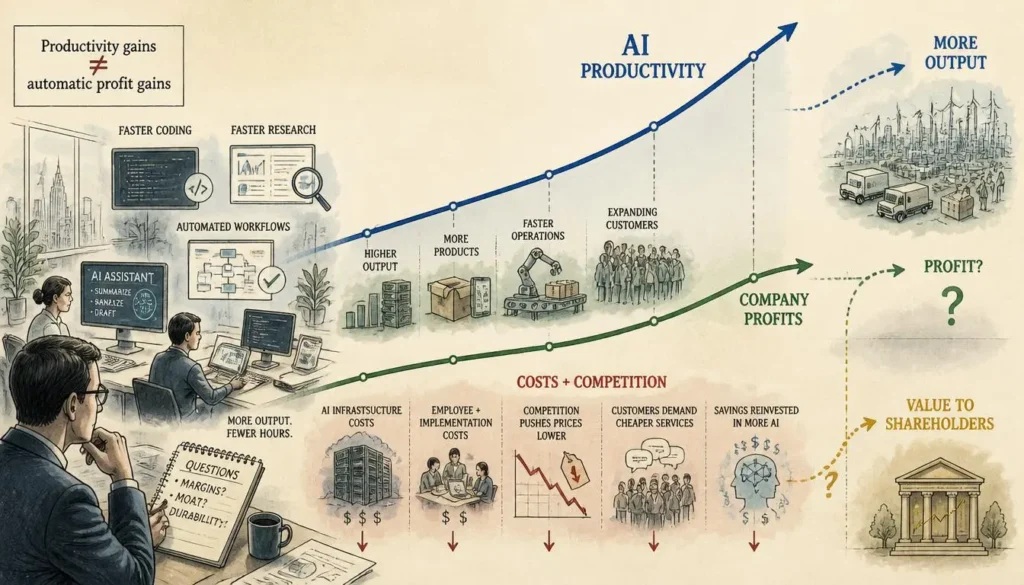
That’s a fascinating distinction.
AI can make one part of the job dramatically faster without making the entire business dramatically more profitable overnight.
For an investor, that difference matters.
A company needs more than faster workers. It needs customers, revenue, margins, and cash flow.
Another 2026 NBER study of nearly 750 corporate executives found positive AI-related productivity gains across firms, with particularly strong effects in high-skill services and finance, while also showing substantial differences in adoption across companies.
So the bullish AI story has real economic support.
But the next question is harder:
How much of that productivity eventually becomes profit, and how much is already assumed by the market?
3. Who Is Actually Paying for the AI Boom?
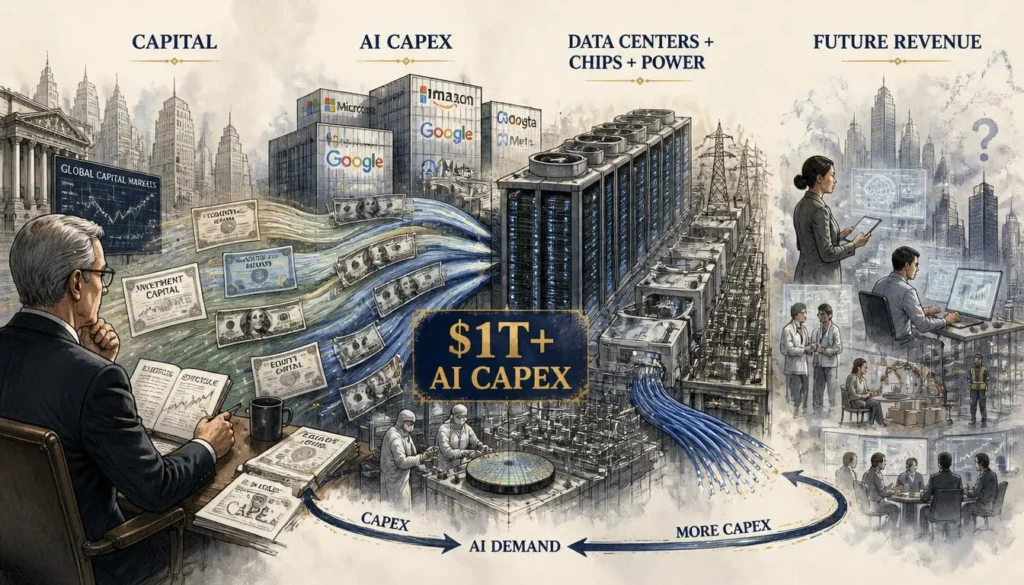
Now follow the money.
An AI application may sit at the top of the stack, but underneath it are cloud computing, specialized chips, data centers, networking equipment, electricity and enormous amounts of capital.
NVIDIA CEO Jensen Huang describes AI as “essential infrastructure, like electricity and the internet,” rather than simply another software product. He breaks the system into energy, chips, infrastructure, models and applications.
That helps explain why the spending is so enormous.
Morgan Stanley estimated on September 9, 2026, that major cloud providers could spend more than $1.4 trillion on AI infrastructure in 2027 alone.
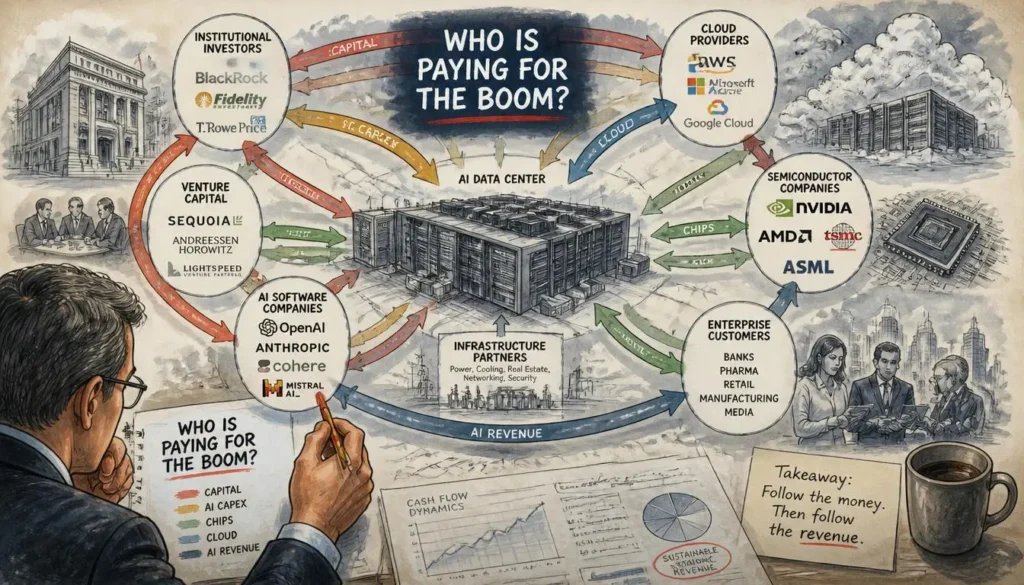
Now comes the interesting part.
Real Options Theory
A company can spend money today not because it expects an immediate payoff, but because the investment gives it valuable choices later.
Think of building a huge AI data center. It may not produce enough profit immediately to justify its cost. But if AI demand explodes over the next five years, that infrastructure could become extremely valuable.
So investors may be paying for future opportunities, not just current earnings.
The problem begins when too many companies make the same bet at once.
The BIS says the AI investment boom is increasingly being financed beyond operating cash flows, including through debt and private credit. It also describes increasingly interconnected “circular financing,” where chipmakers, hyperscalers, and AI companies invest in one another while purchasing from one another.
That does not prove that AI demand is artificial.
But it creates a question worth asking:
How much of the spending is ultimately supported by genuine end-user demand, and how much depends on everyone in the ecosystem continuing to spend?
That is where the story gets a little more complicated.
4. What Happens If AI Spending Slows, AI Gets Much Cheaper?
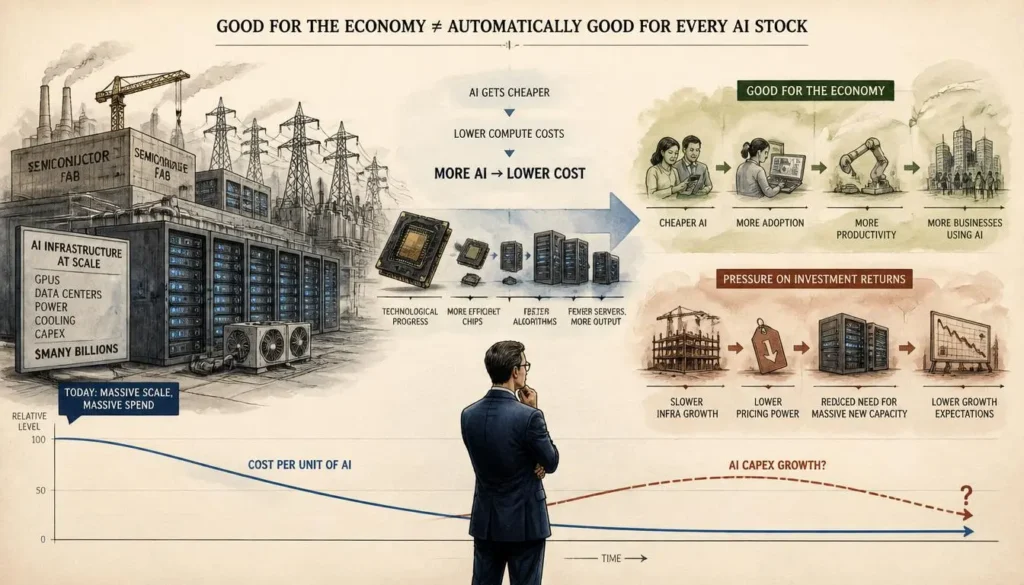
Here’s a twist that is easy to miss.
What if AI gets better and cheaper?
At first, that sounds entirely positive.
But for investors, it creates two possibilities.
Suppose a new AI model requires only half as much computing power to deliver the same result. Demand for individual units of computing could fall.
But cheaper AI could also encourage millions more people and businesses to use it, causing total demand to rise.
So:
Lower cost per AI task
could mean
less computing per task
but also
far more AI tasks overall.
That’s why efficiency isn’t automatically bearish for AI infrastructure.
The real question is how quickly adoption expands.
This is also where the technology-adoption curve matters. New technologies often move from early adopters to mainstream users over time. If AI adoption continues spreading across industries, today’s infrastructure spending could eventually look more reasonable.
But if adoption, monetization, or productivity disappoints, investors could begin questioning whether the capital buildout went too far.
The real test:
Is AI infrastructure being built ahead of demand, or in anticipation of demand that is actually arriving?
Nobody knows the full answer yet.
And that’s precisely why investors should watch the evidence rather than the excitement.
5. How Do Interest Rates Affect AI Stock Valuations?
AI doesn’t operate outside the financial system.
Remember the present-value idea from earlier? It becomes particularly important for companies whose valuations depend heavily on profits expected years into the future.
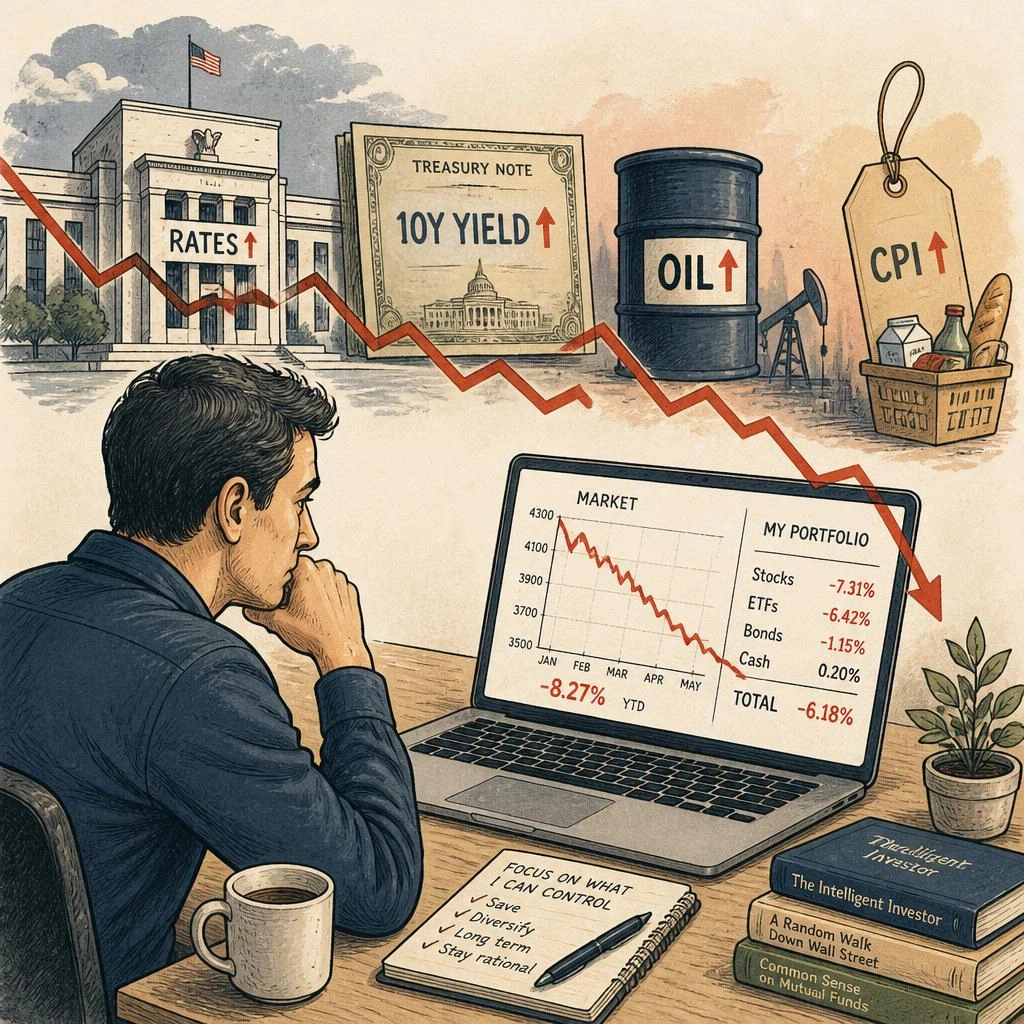
When interest rates rise, those future profits generally become less valuable in today’s terms.
And there is another problem: bonds.
If a government bond offers a much higher yield, investors have another place to put their money without taking the same level of equity risk.
That changes the calculation for an expensive AI stock.
Suppose an investor can earn a substantial yield from government bonds. Why should they pay an extremely high multiple for an AI company whose biggest profits may not arrive for years?
That doesn’t mean AI stocks must fall.
It means their expected future returns have to justify the risk.
This is why the BIS is watching the combination of elevated AI valuations, ambitious future earnings expectations, and rising capital expenditure.
For the ordinary investor, the takeaway is simple:
The stronger the stock’s dependence on distant future profits, the more important interest rates become.
6. Can a Great AI Company Still Be a Bad Investment?
This may be the most important distinction in the entire article.
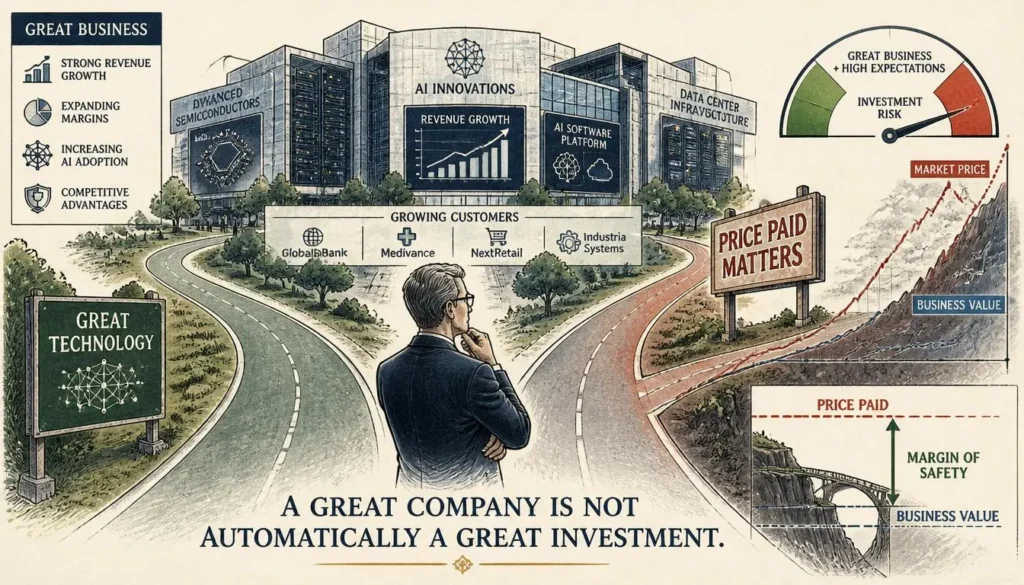
A great company is not automatically a great investment.
Imagine a business is genuinely worth $100 per share.
You pay $70.
That’s one investment.
Someone else pays $180 for the same business.
The company hasn’t changed.
The price has.
That’s valuation in everyday language.
And this is where AI creates a particularly difficult problem. Investors may be correct that a company will become enormously successful and still be wrong about how much they should pay for it today.
Howard Marks has made this distinction central to his discussion of the AI boom. In February 2026, he wrote that nobody could say definitively whether AI was a bubble, while emphasizing that the technology’s enormous potential did not automatically mean AI investments were fairly priced.
That is an important point.
You can believe:
AI will transform the economy.
And simultaneously believe:
Some AI stocks may be priced for an outcome that is too optimistic.
Sam Altman made a similar distinction in 2025, from a different angle, saying, “When bubbles happen, smart people get overexcited about a kernel of truth.”
In other words, the technology doesn’t have to be fake for the price to become excessive.
7. What Warning Signs Could Indicate an AI Bubble?
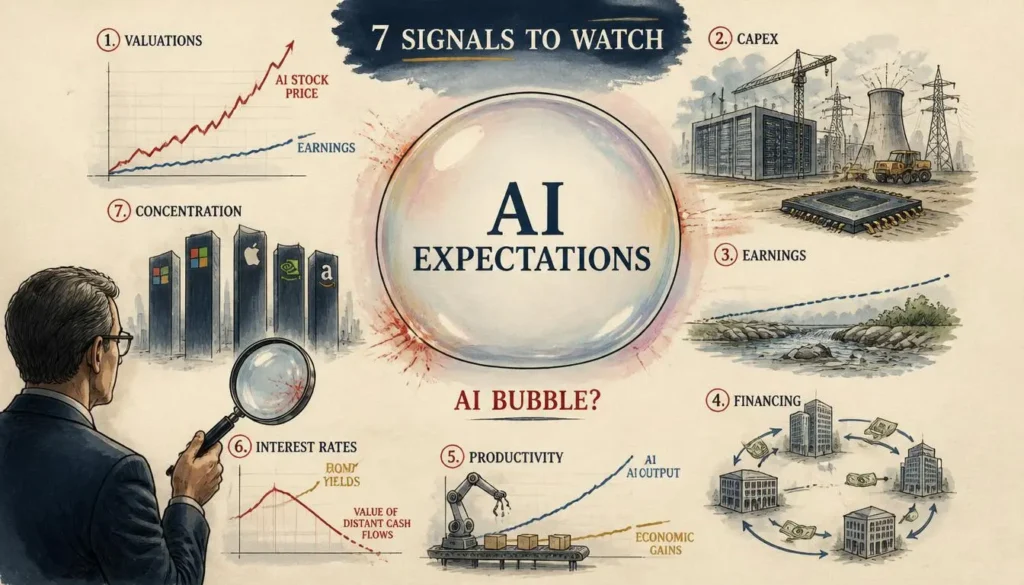
So how would you actually know whether the excitement is getting ahead of the economics?
Rather than trying to predict a bubble, watch the signals.
1. Valuations rise much faster than earnings
If share prices continue climbing while profits fail to keep pace, expectations may be doing more of the work.
2. AI spending grows faster than measurable returns
Huge capital expenditure is not automatically bad. The question is whether it eventually produces adequate revenue and cash flow.
3. Companies become increasingly dependent on distant future growth
The further today’s valuation moves away from current economics, the more sensitive it becomes to changes in expectations.
4. Circular financing becomes increasingly important
The BIS has specifically identified interconnected investment and purchasing relationships within the AI ecosystem as a potential source of financial fragility.
5. Weak businesses get rewarded simply for attaching themselves to AI
If merely using the word “AI” begins attracting enormous valuations without corresponding economics, that’s worth noticing.
6. Small disappointments produce very large price declines
When expectations are extreme, even good news may not be good enough.
7. Financing becomes harder
If investors and lenders become less willing to fund ambitious AI projects, it may reveal which parts of the ecosystem can support themselves economically.
A 2026 BIS working paper describes the current AI buildout as one of the largest technology-driven investment booms in U.S. history and warns that competition for market share can encourage firms to over-commit capital; debt and circular financing can amplify the consequences if returns disappoint.
That doesn’t mean a crash is inevitable.
It means the size of the bet deserves attention.
The Strange Part: AI Can Be Real and Still Create a Bubble
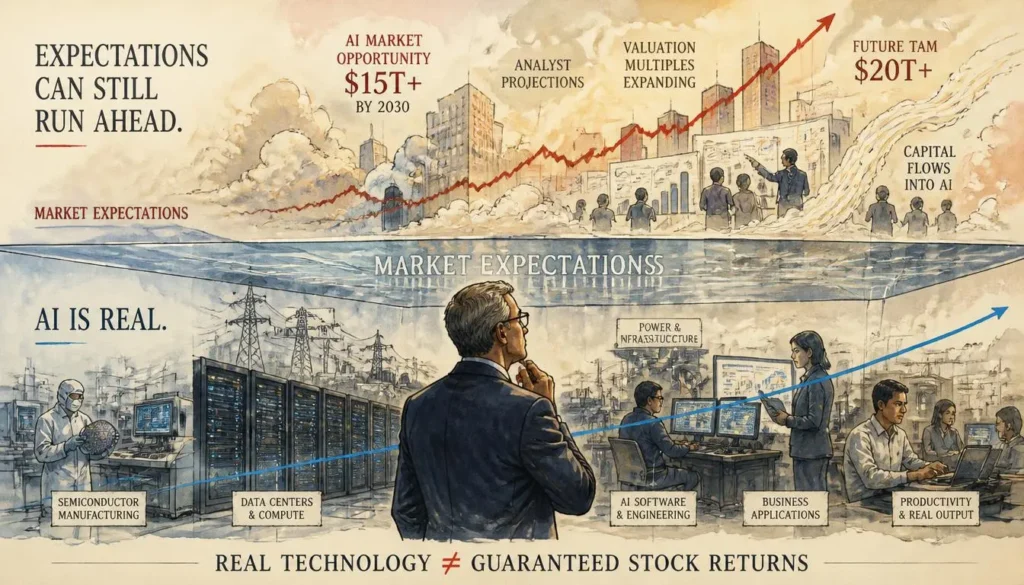
Here’s where the arguments start to collide.
Sam Altman has warned that investors can get overexcited about a technology with a genuine “kernel of truth.”
BlackRock CEO Larry Fink has taken the opposite view, saying in January 2026, “I sincerely believe there is no bubble in the AI space,” while emphasizing the scale of investment the technology requires.
Howard Marks lands somewhere more cautious: he argues that AI is extremely real and potentially transformative, but that nobody can know with certainty whether current investment prices constitute a bubble.
Those aren’t necessarily contradictory statements.
They are answering different questions.
Is AI real? Yes.
Can AI create enormous economic value? Very possibly.
Can some AI stocks become overpriced? Absolutely possible.
Can we know for certain today whether the entire AI market is a bubble? No.
That distinction may be the most important conclusion in the whole debate.
What Does the AI Boom Mean for Your Portfolio?
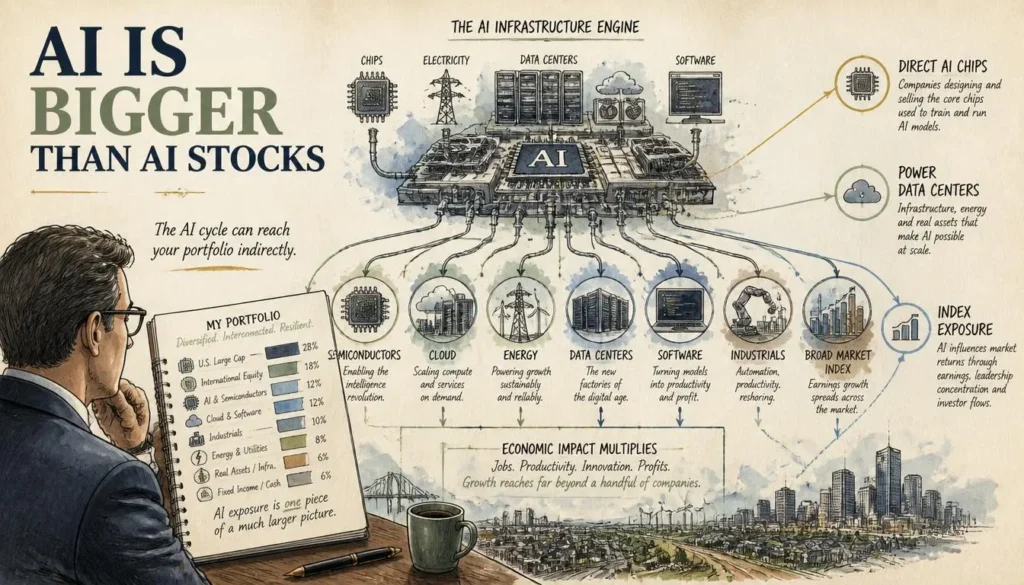
You might be thinking:
“I don’t own any AI stocks, so why should I care?”
Because you may own AI anyway.
You could have exposure through an index fund, retirement account or technology ETF. And even without direct ownership, AI can influence semiconductor companies, energy demand, data centers, cloud providers and the wider economy.
The BIS notes that AI-related investment is already affecting global growth and supply chains, while elevated equity concentration means a sharp repricing could affect markets beyond the companies at the center of AI development.
There is another personal dimension.
AI can affect you as an investor and a worker.
Research from the NBER finds that AI adoption is already associated with productivity gains across firms, while the size of those gains varies considerably by sector and company.
So the question isn’t simply:
“Do I own Nvidia?”
It is:
“How dependent are my investments, income, and financial plans on the economic changes AI may create?”
What Should Investors Watch Next?
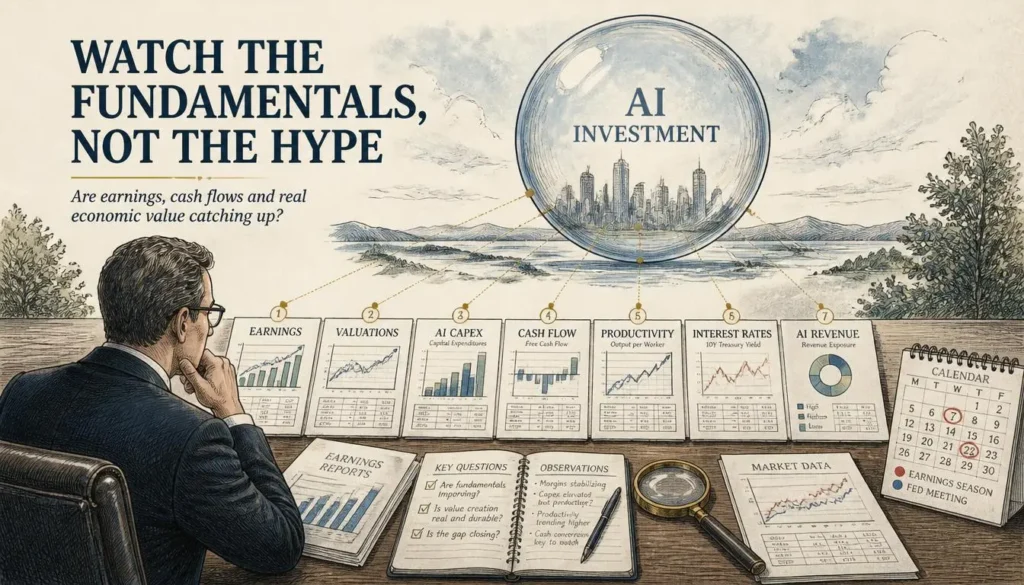
You don’t need to predict the future. You need to watch whether the story is becoming more or less economically convincing.
Look at AI revenue growth. Is usage turning into sales?
Watch earnings and free cash flow. Are profits catching up with the scale of investment?
Track capital expenditure. Is spending growing because demand is growing, or because companies are racing to avoid being left behind?
Watch valuations. How much future AI success is already reflected in stock prices?
Keep an eye on interest rates and bond yields, because higher discount rates can make distant profits less valuable.
And watch financing. If companies increasingly need debt or private credit to fund the AI buildout, the sustainability question becomes more important. The BIS has specifically identified this shift as a growing area of financial-stability concern.
The Bigger Picture
The most interesting thing about the AI boom is that both sides of the argument can be right.
AI can genuinely transform productivity. Companies can earn enormous amounts of money from it. Entire industries can be rebuilt around it.
And some AI stocks can still become overpriced.
That’s because markets do not price technology directly. They price expectations about future profits, productivity, competition, financing, and risk.
The real question, then, is not:
“Is AI a bubble?”
It is:
“Are today’s prices and investments supported by the economic value AI can realistically create?”
That is a question nobody can answer perfectly yet.
But it is a much better question for investors than simply asking whether AI is the “next big thing.”
Because the technology can be revolutionary.
And the price can still be wrong.
Frequently Asked Questions
Is the AI stock boom becoming a bubble?
There is no single indicator that proves the entire AI market is a bubble. Current evidence shows genuine AI investment and productivity gains alongside elevated valuations, enormous capital spending, and growing concerns about the sustainability of some financing structures.
Why are AI stocks so expensive?
AI stocks can command high valuations because investors expect rapid future growth, strong profits and large productivity gains. The risk is that today’s prices may already assume years of exceptional growth, leaving less room for disappointing results.
What happens if AI spending slows down?
A slowdown could affect chipmakers, cloud providers, data centers, networking companies, and other infrastructure businesses. The impact would depend on the reason: weaker AI demand would be more concerning than spending falling because AI has become substantially more efficient.
Does AI actually increase productivity?
Research increasingly finds measurable productivity gains from AI, but the size varies by task and company. A 2026 NBER study found large gains in coding activity, but those gains became much smaller when researchers looked at actual software releases rather than coding activity alone.
How do interest rates affect AI stocks?
Higher interest rates can pressure AI stocks because investors often value them partly on profits expected far in the future. Higher discount rates reduce the present value of those future profits and can also make bonds more competitive with expensive growth stocks.
How can investors tell if an AI stock is overvalued?
Compare the company’s current price with realistic expectations for revenue, earnings, cash flow, and long-term growth. A fast-growing company can still be overvalued if its share price assumes unusually strong performance for many years.
What are the warning signs of an AI bubble?
Watch for valuations rising faster than earnings, capital spending exceeding sustainable returns, increasingly circular financing, weak companies receiving AI-driven valuations, excessive dependence on distant future growth, and unusually large price reactions to disappointing news.
Is AI similar to the dot-com bubble?
There are similarities in technological excitement and high expectations, but the current AI leaders generally have much more substantial revenue and profits than many dot-com-era companies. A more useful comparison is to examine valuations, earnings, capital spending, and financing rather than headlines alone.