
At a Glance
The Fed raise interest rates to fight inflation because more expensive borrowing can slow spending, reduce demand, and ease pressure on prices. When people borrow less and businesses postpone investments, the economy may cool enough for inflation to slow.
But there’s a painful trade-off. Higher interest rates can make mortgages, car loans, and credit cards more expensive. They can also slow hiring and economic growth.
The Fed isn’t trying to make everyday life more expensive. It’s trying to prevent prices from rising too quickly for too long even though the solution can create financial difficulties along the way.
By the End of This Article, You’ll Know:
- Why the Fed raises interest rates when groceries, rent, and bills are already expensive.
- How higher borrowing costs can actually help reduce inflation.
- Why mortgages and credit cards become more expensive.
- Why prices don’t necessarily fall when inflation slows.
- How Fed decisions affect your savings, job, and stock investments.
- When interest rates might fall and what you can do to protect your finances.
Everything Is Already Expensive. So Why Is the Fed Making It Worse?
It’s Friday evening in Ohio.
Sarah and Michael are sitting at their kitchen table, surrounded by grocery receipts, utility bills, and a laptop showing mortgage estimates.
They’re not living extravagantly.
They have two steady jobs, drive an older car, and have been saving for their first home.
But lately, their money doesn’t seem to stretch as far.
Their weekly grocery bill has climbed. Their car insurance costs more. And the credit-card balance they planned to pay off months ago is barely shrinking.
Then Michael opens a news article.
“Federal Reserve Raises Interest Rates to Fight Inflation.”
He reads the headline twice.
“Wait a minute,” he says. “Everything is already expensive. Why would they make loans and mortgages even more expensive?”
Sarah laughs, but not because it’s funny.
“Maybe someone should explain how making things more expensive is supposed to make them cheaper.”
It’s a question millions of Americans have wondered about.
And surprisingly, the answer isn’t that the Federal Reserve wants everything to become cheaper tomorrow.
It’s trying to prevent prices from continuing to rise too quickly.
To understand why, we need to follow Sarah and Michael through the next few months and see how one decision in Washington can affect almost every part of their financial lives.
Sarah and Michael are fictional characters. Their experiences and financial examples are illustrative.
THE 7: Why the Fed Raises Interest Rates and What It Means for Your Money
1. Why Does the Fed Raise Interest Rates When Everything Is Already Expensive?
Let’s start with something Sarah and Michael already understand.
Their favorite neighborhood restaurant has become increasingly popular.
A few years ago, they could walk in on a Friday evening and easily find a table.
Now there’s a long waiting list.
The restaurant has the same number of tables, but far more customers.
With demand exceeding what it can comfortably serve, the restaurant may find it easier to raise menu prices.
Something similar can happen across an economy.
When households and businesses want to buy more goods and services than the economy can readily supply, prices can rise.
Of course, that’s not the only reason inflation happens.
Oil shortages, transportation disruptions, labor constraints, and rising production costs can also make goods more expensive.
But when strong demand contributes to inflation, the Federal Reserve has a way to slow it down.
What Does the Federal Reserve Actually Control?
The Federal Reserve, often called the Fed, is America’s central bank.
One of its main tools is the federal funds rate, a short-term interest rate that influences borrowing costs throughout the economy.
When the Fed raises its target range for that rate, many other interest rates may rise as financial conditions adjust.
Banks may charge more for certain loans.
Businesses may find expansion more expensive.
And consumers may think twice before borrowing money.
The Fed doesn’t directly decide what a gallon of milk costs or how much rent your landlord charges.
Instead, it influences the amount of spending and borrowing taking place in the economy.
Even the Fed Knows This Can Hurt
During his August 26, 2022, Jackson Hole speech, Federal Reserve Chair Jerome Powell acknowledged that higher interest rates and slower growth would bring pain to households and businesses.
That’s a striking admission.
The people responsible for controlling inflation understand that their policies can make life harder in the short term.
So why do it?
Because they believe allowing inflation to remain high could create even greater long-term damage.
Think of it this way: the Fed isn’t trying to make your groceries more expensive. It’s trying to stop the prices of groceries and other essentials from continuing to rise so quickly.
But how can expensive loans accomplish that?
That’s where Sarah and Michael’s car comes into the story.
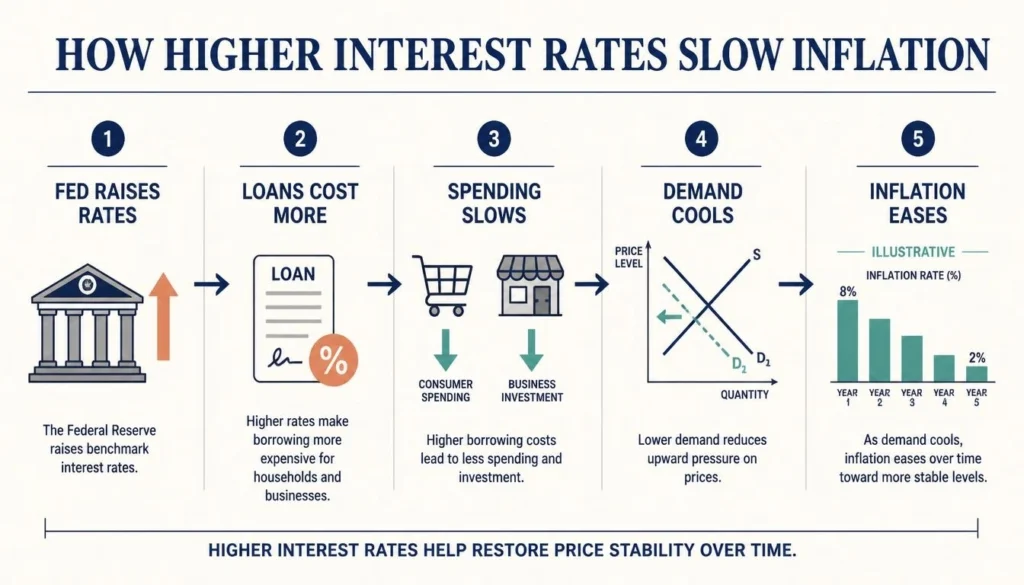
2. How Can Making Loans More Expensive Actually Reduce Inflation?
Sarah and Michael have been thinking about replacing their old car.
It still runs, but repairs are becoming more frequent.
They visit a dealership and find a car they like.
The price seems manageable.
Then the salesperson shows them the financing options.
At a higher interest rate, the monthly payment is more than they expected.
Michael looks at Sarah.
“Maybe the old car can survive another year.”
They decide to postpone the purchase.
Now imagine thousands of households making similar decisions.
Some delay buying cars.
Others postpone home renovations.
Some decide not to finance new furniture or appliances.
Businesses also reconsider their plans.
A retailer may delay opening another location.
A manufacturer may postpone buying new machinery.
As these decisions spread, demand for certain goods and services can slow.
Why Does Lower Demand Matter?
Imagine the car dealership was previously selling vehicles almost as quickly as they arrived.
Customers had little negotiating power.
But now fewer buyers are visiting.
Cars sit on the lot longer.
The dealership may become more willing to offer discounts or avoid raising prices.
The same principle can operate across other industries.
When demand becomes less intense, businesses may face less pressure—or have less ability to increase prices.
The basic chain reaction
Fed raises rates → Borrowing becomes more expensive → Some spending and investment slow → Demand cools → Inflationary pressure may ease.
It doesn’t happen everywhere at once, and some prices may continue rising because of supply problems.
But this is one of the main ways monetary policy works.
Why Not Just Let Inflation Continue?
Imagine Sarah receives a 4% salary increase.
She’s happy until she realizes that the prices of the things her family buys have increased by 8%.
Her paycheck is bigger, but it buys less.
That’s the danger of persistent inflation.
In his August 2022 speech, Jerome Powell warned:
“But a failure to restore price stability would mean far greater pain.”
He was arguing that allowing high inflation to persist could ultimately be more damaging than taking difficult steps to control it.
For Sarah and Michael, the trade-off is uncomfortable.
They can face higher borrowing costs now—or risk an economy where prices continue eroding their purchasing power.
Neither outcome feels particularly appealing.
The important distinction is that higher interest rates can reduce inflationary pressure. They cannot directly fix shortages of oil, food, housing, or other goods.
And unfortunately, Sarah and Michael are about to experience the borrowing side of that trade-off firsthand.
3. Why Do Higher Interest Rates Make Mortgages and Credit Cards So Expensive?
A few weeks later, Sarah and Michael find a house they love.
It has a small backyard, enough space for a future family, and a manageable commute to work.
They start imagining where their furniture will go.
Then they calculate the mortgage payment.
Suddenly, the dream feels much further away.
How Much Difference Can Interest Rates Make?
Suppose they need a $300,000 mortgage with a 30-year repayment period.
Here’s what happens at two hypothetical interest rates:
| Mortgage rate | Monthly principal and interest |
| 4% | $1,432 |
| 7% | $1,996 |
| Difference | $564 more per month |
That’s approximately $6,768 extra every year.
The house hasn’t become bigger.
They aren’t borrowing more money.
They’re simply paying more to finance the same purchase.
These figures are rounded illustrations and exclude property taxes, insurance, and other housing expenses.
Does the Fed Set Mortgage Rates?
Not directly.
This is a common misunderstanding.
The Fed influences short-term interest rates, while 30-year mortgage rates depend on longer-term bond yields, inflation expectations, and other financial-market factors.
Mortgage rates can even fall while the Fed is raising its policy rate, depending on what investors expect to happen next.
Still, tighter monetary policy often contributes to more expensive borrowing conditions.
What About Credit Cards?
Sarah has a credit card with a variable interest rate.
When the benchmark affecting her card changes, the interest charged on her outstanding balance may change too.
That can make it harder to reduce the debt if she continues carrying a balance.
For borrowers with variable-rate debt, higher rates can feel particularly painful.
People with existing fixed-rate mortgages are in a different position: their agreed interest rate generally stays unchanged.
The Uncomfortable Reality
Sarah and Michael weren’t spending recklessly.
They were saving for a home and trying to manage their expenses.
Yet they still feel the effects of tighter monetary policy.
That’s one of the hardest things about the Fed’s approach.
It influences the entire economy, not just the people or businesses contributing most to inflation.
Higher rates can discourage borrowing and spending, but the financial burden isn’t distributed equally.
And even when inflation finally begins slowing, another frustrating surprise awaits.
Their grocery bill doesn’t suddenly go back to normal.
4. If Inflation Is Falling, Why Are Groceries and Rent Still Expensive?
One morning, Sarah hears something encouraging on the radio.
“Inflation has fallen significantly.”
Finally, some good news.
That evening, she visits the supermarket.
But the prices don’t look much better.
Her usual grocery basket is still expensive.
She checks the receipt twice.
“How can inflation be falling if everything still costs so much?”
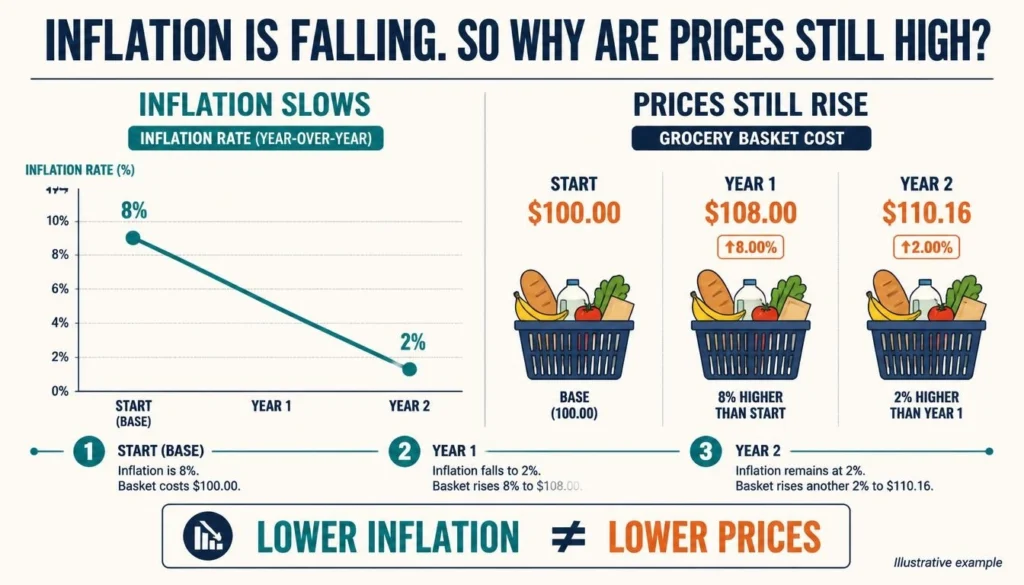
This is probably the most important misunderstanding about inflation.
Falling Inflation Isn’t the Same as Falling Prices
Imagine Sarah’s weekly groceries originally cost $100.
After a year of 8% inflation, the same basket costs $108.
The following year, inflation slows to 2%.
What happens?
The basket doesn’t return to $100.
Instead:
$108 × 1.02 = $110.16
| Period | Inflation rate | Grocery cost |
| Starting point | — | $100.00 |
| Year 1 | 8% | $108.00 |
| Year 2 | 2% | $110.16 |
Inflation has dropped dramatically.
But the grocery basket has become more expensive.
The difference is that prices are rising more slowly.
Economists call this disinflation.
What Would Make Prices Actually Fall?
When the overall price level declines, economists call that deflation.
Individual prices can fall without the whole economy experiencing deflation.
Gasoline might become cheaper.
Used-car prices might decline.
Certain groceries might cost less.
But broad, persistent deflation can create economic problems, especially when it accompanies weak spending, falling wages, and rising debt burdens.
That’s one reason the Fed generally aims for low, stable inflation rather than continuously falling prices.
The Federal Reserve Bank of St. Louis explained this distinction in its March 2024 article, The Inflation Rate Is Falling, but Prices Are Not.
So How Does Life Become Affordable Again?
For Sarah and Michael, the answer isn’t necessarily that every price returns to where it was several years ago.
It’s that their income eventually needs to catch up with their living expenses.
Imagine their household income grows 5% while the prices of what they buy rise 2%.
Their purchasing power may improve.
That doesn’t erase the earlier financial pressure.
But it can gradually make their budget more manageable.
The lesson: Lower inflation slows the rate at which prices rise. Lasting affordability also depends on wages, housing costs, employment, and household debt.
And speaking of household finances, Sarah’s parents are having a very different experience with interest rates.
5. Why Do Higher Interest Rates Help Some People but Hurt Others?
Sarah’s parents, Linda and Robert, are retired.
They have little debt and keep part of their savings in bank deposits.
During a family dinner, Robert mentions that their savings account is finally paying a more attractive interest rate.
Sarah nearly laughs.
“That’s great for you. Meanwhile, we’re struggling to afford a mortgage.”
Robert smiles sympathetically.
“Same interest rates. Different sides of the equation.”
And he’s right.
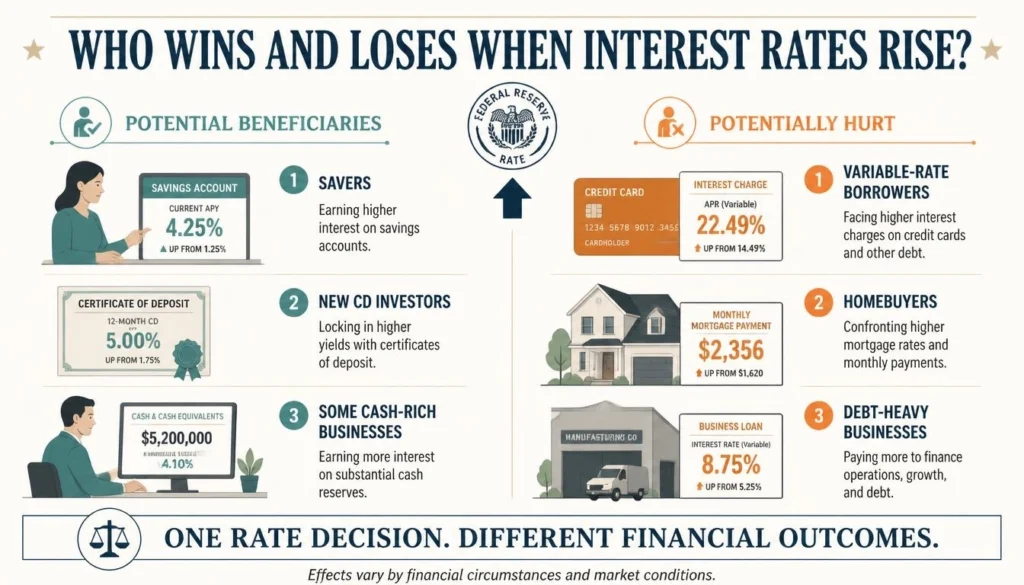
Higher Rates Can Reward Savers
Suppose Linda and Robert have $20,000 in savings.
At 1% annual interest, they earn approximately $200 before taxes.
At 4%, they earn approximately $800.
That’s an additional $600.
Banks don’t always pass on rate increases fully, and actual yields depend on the account. But higher market interest rates can create better opportunities for savers.
Borrowers, meanwhile, may face higher financing costs.
But What About Workers?
Michael works for a construction company.
His employer has been considering buying additional equipment and hiring several new workers.
But financing costs have increased, and some customers are delaying construction projects.
The owner decides to postpone expansion.
Michael keeps his job.
But the company doesn’t hire the additional workers it had planned to employ.
If enough businesses make similar decisions, hiring can slow across the economy.
And if spending weakens substantially, layoffs may follow.
Why Doesn’t the Fed Just Focus on Inflation?
Because controlling inflation isn’t its only responsibility.
The Federal Reserve has two central economic objectives:
Price stability: Keeping inflation low and stable.
Maximum employment: Supporting the highest sustainable level of employment.
These objectives are known as the Fed’s dual mandate.
And sometimes they pull in different directions.
Higher interest rates may help reduce inflation, but they can also weaken employment and growth.
At a December 14, 2022 press conference, Jerome Powell acknowledged that there was no completely painless way to restore price stability.
That is the dilemma.
The Fed must weigh the damage caused by persistent inflation against the economic risks of slowing demand.
What About the Stock Market?
There’s another group affected by interest-rate changes: investors.
Imagine two businesses.
The first has plenty of cash and very little debt.
The second relies heavily on borrowing to finance expansion.
When financing costs rise, the second business may face greater pressure on its future profits.
Higher interest rates can also make investors less willing to pay high prices today for earnings expected far into the future.
That’s one reason some growth stocks can be particularly sensitive to changes in interest rates.
However, stocks don’t move according to Fed decisions alone. Company earnings, economic growth, and market expectations also matter.
So even if Sarah and Michael don’t actively trade stocks, their retirement savings or index funds may be affected by monetary policy.
The lesson: Interest-rate changes create different outcomes for savers, borrowers, businesses, workers, and investors. There’s no single experience shared by everyone.
And making matters more complicated, the Fed can’t immediately see the full consequences of its decisions.
6. Why Does It Take So Long for Fed Rate Hikes to Work?
Months pass.
Sarah and Michael have postponed buying a car.
They’ve put their home purchase on hold.
Michael’s employer has delayed expansion.
Yet the news continues discussing inflation.
Sarah wonders why the Fed’s actions aren’t producing faster results.
Michael points to the thermostat on their wall.
“Remember when we lowered the temperature last summer? The house didn’t cool down instantly.”
That’s a useful way to understand monetary policy.
The Economy Responds Gradually
When the Fed changes interest rates, the effects spread through the economy over time.
Some borrowers have fixed-rate loans that won’t change.
Others encounter higher rates only when they refinance or apply for new credit.
Businesses may already have investments underway.
Consumers may take months to change their spending plans.
The result is a delayed and uneven response.
Why Is That Dangerous?
Imagine driving a car where the brakes take several seconds to respond.
You press the pedal.
Nothing obvious happens.
You press harder.
Then the car slows more than you intended.
Central bankers face a similar problem.
If they continue tightening policy while earlier rate increases are still affecting the economy, they could slow growth too much.
But if they stop too early, inflation may remain elevated.
This is why monetary policy involves forecasts, judgment, and uncertainty.
Can the Fed Cause a Recession?
Yes, tighter monetary policy can contribute to a recession if spending and investment weaken enough.
But a recession isn’t the Fed’s objective.
Policymakers generally hope to reduce inflation while avoiding unnecessary damage to employment and economic growth.
Economists sometimes describe this as a soft landing.
Think of an airplane descending smoothly instead of making a hard landing.
In economic terms, it means inflation slows without a severe downturn.
Achieving that outcome isn’t guaranteed.
The lesson: The Fed must act before it knows exactly how its earlier decisions will affect the economy. That’s why fighting inflation is so difficult.
Which brings us to the question Sarah and Michael have been waiting to ask.
When will borrowing finally become cheaper?
7. When Will the Fed Cut Interest Rates and What Should You Do With Your Money?
After months of adjusting their spending, Sarah and Michael hear that inflation has moved closer to the Fed’s target.
They’re hopeful.
Maybe mortgage rates will improve.
Maybe buying a home will become realistic again.
But the Fed doesn’t automatically lower interest rates after one encouraging inflation report.
What Does the Fed Look for Before Cutting Rates?
Policymakers consider several questions.
Is inflation moving sustainably toward the target?
Is the job market remaining healthy?
Is economic growth slowing too much?
Are current financial conditions becoming unnecessarily restrictive?
The answers help determine whether interest rates should remain high, rise further, or begin to fall.
Will Lower Fed Rates Make Everything Cheaper?
Not necessarily.
Lower policy rates may eventually reduce some borrowing costs.
But mortgage rates can respond differently, and falling interest rates don’t automatically reverse earlier increases in grocery or housing prices.
In fact, if lower mortgage rates encourage more people to buy homes while housing supply remains limited, home prices could face renewed upward pressure.
The relationship isn’t as simple as lower rates equals cheaper houses.
Why Does the Fed Aim for 2% Inflation?
The Federal Reserve targets 2% inflation over the longer run, measured using the Personal Consumption Expenditures (PCE) price index.
The PCE index tracks price changes across a broad range of consumer goods and services.
The Fed believes low and stable inflation helps households and businesses plan their spending, borrowing, saving, and investment decisions.
The goal isn’t to make every price stop moving.
It’s to make the overall rate of price increases more predictable.
Five Practical Things You Can Do When Interest Rates Are High
You can’t control the Fed’s decisions.
But you can make financial choices that reduce your vulnerability to changing rates.
| Your situation | What to consider |
| Carrying credit-card debt | Prioritize reducing high-interest balances where possible |
| Planning to buy a home | Focus on an affordable monthly payment, not just the house price |
| Keeping emergency savings | Compare yields on insured savings accounts and CDs |
| Taking out a loan | Compare fixed and variable rates, fees, and total repayment costs |
| Investing in stocks | Consider earnings, debt levels, valuations, and long-term goals rather than Fed headlines alone |
For Sarah and Michael, this means focusing on what they can control.
They begin paying down their expensive credit-card balance.
They keep saving for a down payment.
They decide not to buy a house unless the monthly payment fits comfortably within their budget.
And instead of trying to predict the next Fed meeting, they make a plan that can work under different interest-rate conditions.
The lesson: You don’t need to predict the Fed’s next move to make smarter financial decisions. Understanding how rates affect your money is already a valuable advantage.
The Bottom Line: Why the Fed Sometimes Makes Things Worse Before They Get Better
A year later, Sarah and Michael are back at their kitchen table.
Their grocery bill hasn’t returned to what it was years ago.
The house they wanted is still expensive.
But in our hypothetical story, inflation has slowed, their wages have improved, and they’ve made progress paying down their credit-card debt.
For the first time in a while, their monthly budget feels a little less overwhelming.
The Fed didn’t make everything cheap again.
It was trying to prevent prices from continuing to rise too quickly.
And that is the uncomfortable truth about fighting inflation.
Higher interest rates can discourage spending, reduce demand, and help slow inflation.
But they can also make borrowing harder, delay business investment, and weaken hiring.
There is no guarantee the process will be painless or that policymakers will get every decision right.
The Fed doesn’t raise interest rates to make Americans struggle. It raises them because persistent inflation can make the struggle even worse over time.
Understanding that trade-off won’t make your mortgage payment smaller tomorrow.
But it can help you make better decisions about debt, savings, homeownership, and investing, no matter what the Fed does next.
Frequently Asked Questions
Does raising interest rates actually lower prices?
Higher interest rates can reduce inflation by slowing borrowing, spending, and demand. But lower inflation usually means prices are increasing more slowly, not necessarily falling. Some individual prices may decline while the overall price level continues to rise.
Why does the Fed want 2% inflation instead of 0%?
The Fed believes low, stable inflation supports economic planning and reduces the risks associated with persistent deflation. Its longer-run 2% target is measured using the PCE price index.
Does the Federal Reserve control mortgage rates?
No. The Fed directly influences short-term policy rates. Mortgage rates depend heavily on longer-term bond yields, inflation expectations, and other market conditions. Fed policy can influence mortgage rates indirectly, but not in a fixed one-to-one relationship.
Are high interest rates good for savings accounts?
They can be. Higher market rates often create opportunities to earn better yields on savings accounts and CDs. However, individual banks determine their offered rates, and the benefit depends on the account and competitive conditions.
Can raising interest rates cause a recession?
Yes. If higher borrowing costs reduce spending and investment too sharply, economic growth can weaken and unemployment may rise. However, rate hikes don’t automatically cause recessions, and the Fed generally aims to control inflation while avoiding unnecessary economic damage.
Why doesn’t the Fed just print more money to help people?
Creating additional money doesn’t automatically increase the economy’s supply of goods and services. If it stimulates spending without a matching increase in production, it can add to inflationary pressure. The Fed also doesn’t simply distribute newly created money directly to households as part of ordinary monetary policy.
Will interest-rate cuts make groceries and housing cheaper?
Not automatically. Lower rates may reduce some borrowing costs, but they don’t necessarily reverse past price increases. Grocery prices depend on production, transportation, energy, and other factors. Housing prices also depend heavily on local supply and demand.