
At a Glance
Yes, $1 million can be enough to retire in America, but it depends on your spending, Social Security benefits, retirement age, and investment strategy.
Using the traditional 4% retirement withdrawal guideline, $1 million could provide approximately $40,000 in first-year withdrawals, or $3,333 per month before taxes. Social Security can supplement that amount, but inflation, healthcare costs, and stock-market losses may affect how long your savings last.
The most important number isn’t necessarily how much you’ve saved. It’s how much of those savings you’ll need to spend every year.
By the End of This Article, You’ll Know:
- How much monthly retirement income $1 million can provide.
- Whether Social Security makes $1 million enough for retirement.
- What different retirement lifestyles might cost.
- How inflation, healthcare, and location affect retirement savings.
- Why a market crash early in retirement can be dangerous.
- How to calculate whether your own retirement savings are sufficient.
They Finally Saved $1 Million. Then Came One Uncomfortable Question.
David stared at his laptop.
$1,000,000.
He refreshed the page.
Still there.
After more than 30 years of saving, investing, and occasionally arguing about whether they really needed another vacation, David and his wife Emily had finally reached their retirement goal.
David was 64. Emily was 62.
They’d spent much of their working lives imagining this moment.
No more early morning alarms. No more scheduling holidays around work. Maybe they’d finally take that long road trip across America.
David called Emily into the kitchen.
“We did it. We’re millionaires!”
Emily smiled.
Then she asked something David hadn’t really thought about.
“That’s wonderful. But how much can we actually spend every month?”
David opened his calculator.
One million dollars divided by 25 years.
$40,000 a year.
About $3,333 a month.
He looked at Emily.
“That doesn’t sound like millionaire money.”
Emily laughed.
“It doesn’t even sound like our current household budget.”
And suddenly, their million-dollar milestone raised a question neither had fully answered.
Is $1 million really enough to retire comfortably in America?
Let’s find out by following their numbers, not just their account balance.
David and Emily are fictional characters. All household figures are illustrative, and their retirement plan is not a personalized financial recommendation.
1. Is $1 Million Really Enough to Retire in America?
Here’s something surprising.
Two couples can retire with exactly $1 million and have completely different financial futures.
Imagine one couple owns their home outright, has no expensive debt, receives Social Security, and enjoys a relatively simple lifestyle.
Now imagine another couple has a mortgage, expensive medical needs, and dreams of traveling internationally every few months.
Both have $1 million.
But one might be financially comfortable while the other struggles.
Why?
Because retirement isn’t about how wealthy your savings account looks. It’s about how much your lifestyle costs.
David and Emily are beginning to realize that.
They’ve reached their savings goal, but that doesn’t mean their expenses have disappeared.
They still need groceries, electricity, insurance, transportation, and healthcare.
And Emily has no intention of spending retirement sitting at home.
“I didn’t work for 35 years just to stop going on vacations,” she tells David.
David has a different concern.
“And I don’t want us worrying about money when we’re 85.”
Both concerns are reasonable.
As Shams Talib, head of Fidelity Workplace Consulting, explained in Fidelity’s July 2026 retirement research:
“Financial planning for retirement is about more than reaching a savings target, especially as retirement itself continues to evolve.”
That’s the problem with treating $1 million as a magical retirement number.
It tells you how much you’ve accumulated.
It doesn’t tell you whether you can afford to stop working.
So, David and Emily decide to start with the most basic question.
How much money can their investments actually provide?
2. How Much Monthly Income Can $1 Million Provide?
David initially divided their savings by 25 years.
But what if they live for 30 years?
Or 35?
And what happens if their investments earn money or lose it?
Retirement savings don’t usually sit untouched in a checking account. They’re often invested in stocks, bonds, and other assets.
That means the balance can rise or fall even while money is being withdrawn.
This is why retirement researchers study something called a withdrawal rate.
It simply means the percentage of your savings you take out to pay your living expenses.
The Famous 4% Rule, Explained Simply
The traditional 4% rule suggests starting retirement by withdrawing around 4% of your investment portfolio in the first year.
After that, the original dollar withdrawal is generally increased with inflation.
Here’s what different starting withdrawal rates look like for $1 million:
| Starting withdrawal rate | First-year income | Monthly equivalent |
| 3% | $30,000 | $2,500 |
| 3.5% | $35,000 | $2,917 |
| 4% | $40,000 | $3,333 |
| 5% | $50,000 | $4,167 |
These are portfolio withdrawals, not guaranteed investment earnings. They are also before any applicable taxes.
The higher your withdrawal rate, the more money you have to spend initially but the greater the risk that your savings may not last.
Is the 4% Rule Still Reliable?
Financial planner William Bengen pioneered the research behind the rule in 1994.
But even Bengen has cautioned against treating it as a universal formula.
“I didn’t mention any rule or suggest that all retirees use the 4.15% number.”
His point is simple: retirement outcomes depend on circumstances and assumptions.
Morningstar’s State of Retirement Income for 2026 research identifies a 3.9% starting withdrawal rate under its base-case assumptions for a 30-year retirement.
For David and Emily, that would mean:
$1,000,000 × 3.9% = $39,000 a year.
Or $3,250 a month before taxes.
Emily looks at the number.
“That’s better than nothing. But we can’t live the retirement we want on $3,250 a month.”
David nods.
Then Emily remembers something.
“Wait. What about Social Security?”
Social Security Changes the Calculation
Social Security is a major source of retirement income for many Americans.
According to the Social Security Administration’s June 2026 statistics, the average monthly retired-worker benefit was approximately $2,084.
But that’s a national average, not a prediction of what David or Emily will receive.
Their actual benefits depend on their earnings histories and claiming ages.
For our example, suppose their combined benefits will eventually total $3,500 a month, once both have claimed.
Now the picture changes.
| Income source | Monthly amount |
| Portfolio withdrawal at 3.9% | $3,250 |
| Combined Social Security | $3,500 |
| Total | $6,750 |
That’s $81,000 annually before taxes.
David leans back in his chair.
“Now that sounds more promising.”
But there’s one important complication.
David is 64, and Emily is 62. They can’t simply assume they’ll both receive their planned benefits immediately.
Claiming Social Security early can permanently reduce monthly benefits. Waiting longer, up to age 70, can increase them.
So, they divide their plan into two stages:
Stage 1: Before both Social Security benefits begin. Their portfolio may need to cover a larger portion of their expenses.
Stage 2: After both benefits begin. Their required portfolio withdrawals may decrease substantially.
This distinction matters. A retirement that looks affordable at age 67 may be much more expensive to fund at age 62.
David and Emily decide not to treat Social Security as money they’ll receive until they’ve confirmed their individual benefit estimates and claiming dates.
Their next question: How much will their retirement lifestyle actually cost?
3. What Does a $1 Million Retirement Look Like in Real Life?
Emily opens a spreadsheet.
“Let’s stop guessing and calculate what we actually spend.”
David agrees.
But he adds one condition.
“We need to separate what we must spend from what we’d like to spend.”
It’s a useful distinction.
Housing, food, utilities, and healthcare are essential expenses.
Travel, restaurants, and hobbies are more flexible.
Three Possible Retirement Lifestyles
Consider these illustrative monthly household budgets:
| Retirement lifestyle | Monthly spending | Annual spending |
| Modest | $4,000 | $48,000 |
| Comfortable | $6,000 | $72,000 |
| Expensive | $9,000 | $108,000 |
These are examples, not national averages. Actual spending varies significantly by household and location.
For David and Emily, a comfortable retirement means keeping their home, taking occasional vacations, visiting family, and enjoying life without constantly checking every expense
So they build their own budget.
David and Emily’s Retirement Budget
| Monthly expense | Amount |
| Housing, taxes, and maintenance | $1,500 |
| Groceries and household essentials | $800 |
| Healthcare and insurance | $850 |
| Transportation | $500 |
| Utilities, phone, and internet | $350 |
| Travel, dining, and entertainment | $900 |
| Miscellaneous and contingency | $600 |
| Total monthly spending | $5,500 |
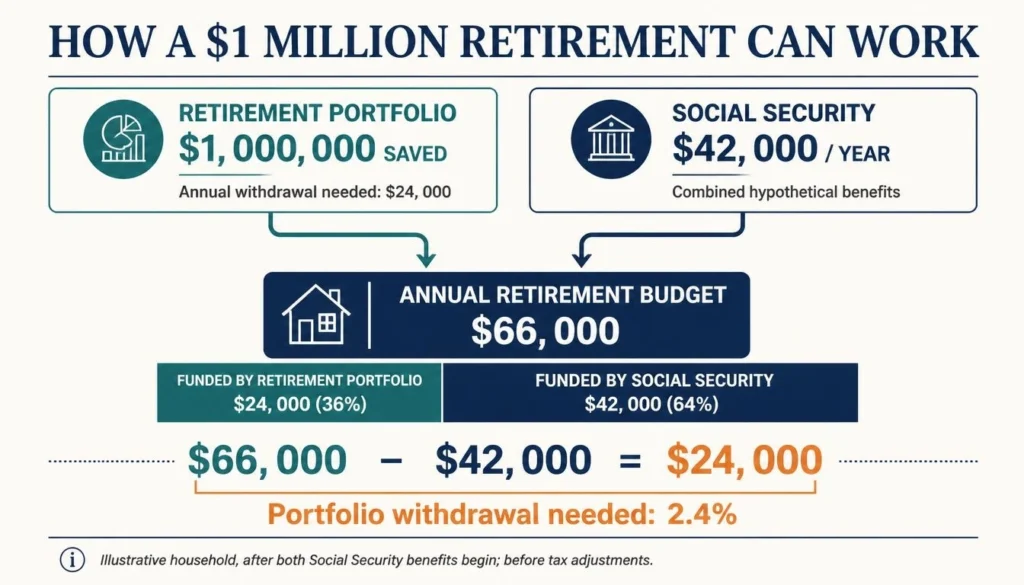
Their estimated annual spending is $66,000.
Emily points to the travel budget.
“I’m keeping that.”
David smiles.
“Fine. But if markets fall, the road trip might become a weekend getaway.”
They’ve just discovered an important retirement strategy without using any financial jargon.
Some expenses are necessary. Others can be adjusted.
Now Calculate Their Retirement Income Gap
Once both receive their hypothetical combined Social Security benefits:
Annual spending: $66,000
Annual Social Security: $42,000
Amount needed from investments:
$66,000 − $42,000 = $24,000 per year.
That’s only 2.4% of their original $1 million portfolio.
Much less than the 3.9% starting withdrawal discussed earlier.
But this is a simplified spending calculation. It doesn’t yet include any extra withdrawals needed for taxes, major unexpected expenses, or the years before both Social Security benefits begin.
Still, David notices something.
“We might not actually need to withdraw $39,000 every year.”
Exactly.
A withdrawal guideline tells you what a portfolio might support under certain assumptions.
It doesn’t mean you must withdraw that amount.
The less you need to withdraw, the more flexibility you may have.
For the first time, David and Emily feel like they have a workable plan.
Then Emily looks at their budget again.
“There’s one problem. These are today’s prices.”
4. How Much Will Inflation and Healthcare Cost Over 30 Years?
Imagine buying groceries for $100 today.
A few years later, the same groceries cost $120.
You’re not buying more.
Your money simply doesn’t stretch as far.
That’s inflation.
And when retirement lasts decades, even relatively modest inflation can make a major difference.
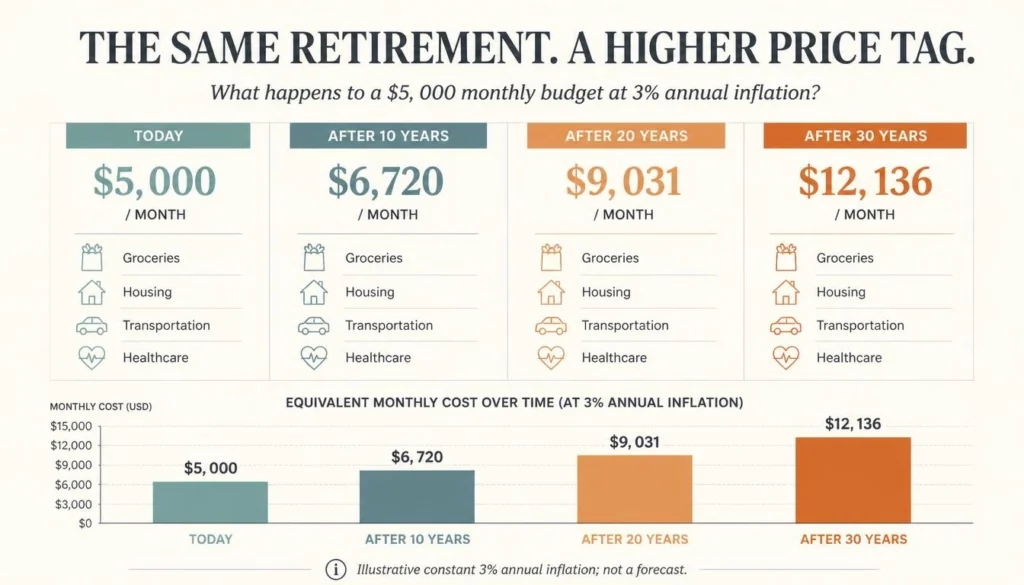
What Happens to a $5,000 Monthly Budget?
Suppose living costs increase by an average of 3% every year.
| Time | Cost of the same lifestyle |
| Today | $5,000/month |
| After 10 years | $6,720/month |
| After 20 years | $9,031/month |
| After 30 years | $12,136/month |
This is a hypothetical illustration, not an inflation forecast.
After 20 years, the same lifestyle could cost around 81% more.
That’s why simply dividing $1 million by 30 years doesn’t produce a reliable retirement plan.
William Bengen captured this risk in a May 2026 Morningstar interview, describing inflation as:
“The greatest enemy of retirees”
Inflation matters because retirees may need to increase their withdrawals just to maintain their standard of living.
The traditional 4% framework attempts to account for this by adjusting withdrawals for inflation.
But that doesn’t eliminate investment risk.
Healthcare Could Be an Even Bigger Surprise
Emily is 62.
That means she may need health insurance before she becomes eligible for Medicare at 65.
And even after qualifying for Medicare, she and David may still face premiums, deductibles, prescription costs, and other out-of-pocket expenses.
According to Fidelity’s 2026 Retiree Health Care Cost Estimate, a 65-year-old retiring in 2026 could spend approximately:
$185,500 on healthcare throughout retirement.
That’s an estimate for one person under Fidelity’s assumptions, not a bill everyone will face.
It also excludes long-term care.
Importantly, this lifetime estimate shouldn’t simply be added on top of a retirement budget that already includes healthcare expenses. It’s a separate planning benchmark that can help retirees assess whether their assumptions are realistic.
David and Emily already budgeted $850 a month for healthcare and insurance.
Now they decide to review whether that amount is realistic for both of them, especially during Emily’s pre-Medicare years.
They also discuss maintaining a reserve for unexpected expenses.
Because nobody can predict every medical bill.
The Retirement Lesson
Inflation and healthcare don’t automatically make $1 million insufficient.
But they make flexibility and realistic assumptions essential.
David and Emily can adjust travel spending.
They can’t simply decide to stop needing medical care.
And that distinction matters when planning for a long retirement.
5. Does Where You Retire Change Everything?
A few days later, David brings up another idea.
“What if we moved somewhere cheaper?”
Emily looks up.
“Are you trying to move us away from the grandchildren?”
“No. I’m trying to see whether we could save money.”
It’s a fair question.
Because $1 million doesn’t have the same purchasing power everywhere in America.
The Cost of Retirement Depends on Location
Housing is often one of the largest household expenses.
But location also affects transportation, property taxes, insurance, healthcare access, and everyday prices.
The Bureau of Economic Analysis measures regional price differences using an index called Regional Price Parities.
Think of it as a way to compare how expensive different places are overall.
In its 2024 data, California’s overall price index was 110.7, compared with 86.9 for Arkansas, where the national average is 100.
That doesn’t mean every item costs the same percentage more in California.
But it illustrates how substantially overall price levels can differ.
What About States Without Income Tax?
Florida and Texas often attract retirees partly because they don’t impose a broad state individual income tax.
But that doesn’t mean they’re automatically cheaper.
Higher property taxes, insurance costs, or housing expenses can offset tax advantages.
And costs can vary enormously within the same state.
For David and Emily, moving would also mean leaving family, friends, and familiar healthcare providers.
Emily makes her position clear.
“I’m not moving across the country to save money if we end up spending it all traveling back to see everyone.”
David laughs.
“Fair point.”
They decide to compare their actual housing costs and local alternatives before considering a major relocation.
The cheapest place to retire isn’t necessarily the best place to retire.
What matters is finding a location where your money can support the lifestyle and relationships you value.
And sometimes, staying in a familiar, affordable home is the best financial decision.
6. What Happens If the Stock Market Crashes Right After You Retire?
David and Emily have almost completed their retirement plan.
Their estimated spending looks manageable.
Their expected Social Security income will eventually cover a substantial portion of their expenses.
They’ve considered inflation, healthcare, and housing.
But David still has one concern.
“What if we retire, and the stock market crashes immediately?”
That’s a legitimate risk.
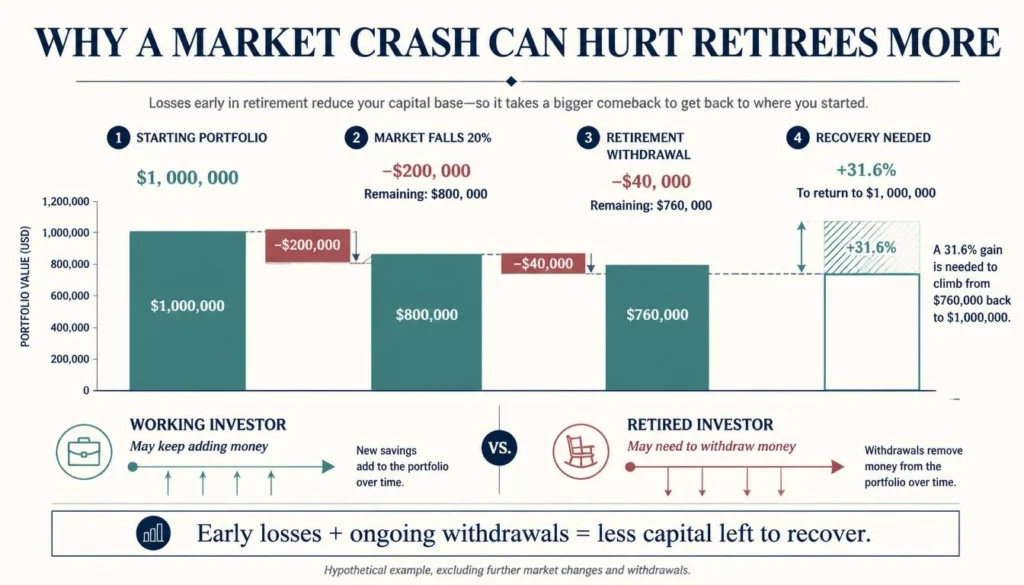
Imagine Their $1 Million Portfolio Falls 20%
They begin retirement with $1 million.
Then markets decline.
Their portfolio loses 20% and falls to:
$800,000.
Suppose they withdraw $40,000 after the decline to cover living expenses.
Their remaining balance becomes:
$760,000.
To recover from $760,000 to $1 million, their portfolio would need to grow by approximately 31.6%.
And that’s before considering any additional withdrawals.
Why the Timing of Losses Matters
Here’s the important difference between investing while working and investing during retirement.
When you’re working, you may be able to keep contributing money after a market decline.
When you’re retired, you may be withdrawing money instead.
That means you might have to sell investments at depressed prices to pay everyday bills.
Financial planners call this sequence-of-returns risk.
In simple language:
A stock-market crash early in retirement can be especially damaging because you’re taking money out while your investments are down.
Two retirees could experience similar long-term average investment returns but end up with different outcomes because their gains and losses occurred in a different order.
Warren Buffett’s Warning
In Berkshire Hathaway’s 2023 shareholder letter, Warren Buffett emphasized an investment principle:
“Never risk permanent loss of capital.”
Buffett was discussing Berkshire’s investment discipline rather than recommending a retirement portfolio.
Still, the broader lesson is relevant.
Retirees need to think about protecting their ability to fund future spending not simply maximizing investment returns.
David and Emily Make a Decision
They don’t want to abandon stocks completely.
Their retirement could last 30 years, and growth investments may help their savings keep pace with inflation.
But they also don’t want to depend entirely on selling stocks during a market downturn.
So, they decide to review a diversified investment mix and keep an appropriate amount of accessible money for near-term expenses.
They also agree that during a severe market decline, discretionary spending may need to change.
Emily looks at David.
“So, the vacation might have to wait?”
“Maybe.”
“But we’re still going somewhere.”
“Somewhere,” he agrees.
The point isn’t that they can eliminate investment risk.
They can’t.
It’s that they can build a retirement plan that doesn’t depend on markets performing perfectly every year.
7. How Can You Make $1 Million Last 25–30 Years?
After weeks of calculations, David and Emily sit down at the kitchen table one final time.
Their million-dollar account balance is the same starting point.
But now they have something more valuable than a savings target.
They have a clearer understanding of what their retirement will require.
Their Retirement Plan, Finally Explained
| Financial detail | David and Emily’s plan |
| Starting retirement portfolio | $1,000,000 |
| Estimated annual living expenses | $66,000 |
| Hypothetical annual Social Security, once both claim | $42,000 |
| Annual spending gap | $24,000 |
| Starting portfolio withdrawal needed for that gap | 2.4% |
This is their projected situation after both Social Security benefits begin, before additional tax adjustments and unexpected expenses.
And it reveals something important.
David and Emily don’t necessarily need to withdraw 4% of their portfolio to fund their lifestyle.
Under these assumptions, their annual spending gap is smaller.
That gives them more room to manage financial uncertainty.
But Can They Retire Right Now?
Not necessarily.
And this is where their plan becomes realistic.
David is 64, and Emily is 62.
If they both stop working immediately, they may have several years when their combined Social Security benefits are lower than the $42,000 annual amount assumed above—or haven’t started at all.
During those years, they might need substantially larger portfolio withdrawals.
Emily may also need pre-Medicare health coverage.
So, they decide their retirement date must depend on three things:
- When each person will claim Social Security. They need actual benefit estimates, not averages.
- How they’ll fund the years before both benefits begin. Their portfolio may need to carry a larger burden temporarily.
- Whether their spending plan can withstand poor markets, higher expenses, and a long retirement.
They can test different retirement dates rather than assume reaching $1 million means they should immediately stop working.
What If Markets Perform Poorly?
Retirement expert Christine Benz of Morningstar has emphasized the value of flexible withdrawals.
In a January 2025 interview, she said retirees may need to:
“Tap on the brakes in terms of their portfolio withdrawals.”
That means making sensible adjustments when circumstances change.
David and Emily decide to review their retirement finances every year.
If their portfolio performs well, they may have more room for discretionary spending.
If markets struggle, they can temporarily reduce travel and other nonessential expenses.
If healthcare costs rise, they can adjust their budget.
And if they discover that retiring immediately requires too much financial risk, working a little longer remains an option.
Their Final Decision
David looks at their spreadsheet.
“So, can we retire with a million dollars?”
Emily studies the numbers.
“Once both Social Security benefits begin, our planned spending only requires about $24,000 a year from investments, before taxes and other adjustments.”
“That sounds manageable.”
“It does. But we still need to plan for the years before that.”
David nods.
For the first time, their retirement conversation isn’t about reaching an impressive number.
It’s about making a practical decision.
Their conditional verdict: $1 million appears capable of supporting their planned lifestyle once both Social Security benefits are in place, provided their assumptions hold and their portfolio remains sufficiently resilient. But retiring immediately requires a separate analysis of the income gap before those benefits begin.
That’s a more useful answer than a simple yes or no.
And it’s the same approach readers can use for their own retirement plans.
The Bottom Line: Is $1 Million Enough to Retire?
Remember the morning David and Emily first reached $1 million?
They thought the hardest part was over.
Then they discovered that being a millionaire doesn’t automatically mean having unlimited retirement income.
But they also learned something reassuring.
Their million dollars doesn’t need to pay for everything on its own.
Social Security may cover part of their expenses.
A manageable lifestyle can reduce the amount they need to withdraw.
And a flexible investment and spending strategy may help them navigate unexpected challenges.
For some Americans, $1 million is enough to retire comfortably.
For others, especially those retiring early, carrying substantial debt, or facing high living costs, it may not be sufficient.
The difference isn’t simply how much money they have.
It’s how much they need, how long they need it, and how carefully they plan.
A million dollars isn’t a guarantee of retirement security. But with the right circumstances and a realistic plan, it can be the foundation of a financially comfortable retirement.
And perhaps that’s the most important lesson David and Emily learned.
The goal was never just to become millionaires.
It was to build a life where money could give them freedom not become another reason to worry.
Frequently Asked Questions
Can you retire at 60 with $1 million?
Yes, some people can retire at 60 with $1 million, but early retirement requires careful planning. Your savings may need to last 30–35 years or longer, and you’ll need to consider healthcare before Medicare eligibility and income before Social Security begins.
How long will $1 million last in retirement?
It depends on your annual withdrawals, investment performance, inflation, taxes, and lifespan. A $1 million portfolio may last decades under a sustainable withdrawal strategy, but no withdrawal rate guarantees that your savings will last for life.
Is $1 million enough to retire with Social Security?
For many households, it may be. Social Security can reduce the amount you need to withdraw from investments. A couple with manageable expenses and sufficient Social Security benefits may find $1 million adequate, while a higher-spending household may need more.
How much monthly income can $1 million provide?
Using a 4% starting withdrawal rate, $1 million provides approximately $3,333 per month in the first year before taxes. At 3.9%, it provides $3,250 monthly. These are starting portfolio withdrawals, not guaranteed lifetime income.
What is the 4% retirement rule?
The 4% rule is a retirement withdrawal guideline based on historical investment research. It generally involves withdrawing 4% of your portfolio in the first year and adjusting the original withdrawal amount for inflation afterward. It isn’t a guarantee and may not fit every retirement.
How much should a couple save for retirement?
There’s no single savings target suitable for every couple. Estimate annual retirement spending, subtract Social Security and other reliable income, then calculate how much your investments need to provide. Account for taxes, inflation, healthcare, and retirement duration.
What happens if you run out of retirement savings?
You may need to rely more heavily on Social Security, pensions, available assistance programs, or family support. You might also need to reduce spending, change housing arrangements, or return to work if possible. Planning early and regularly reviewing withdrawals can reduce the risk.