
At a Glance: Is the Stock Market Heading for a Crash?
No one can reliably predict when the next stock market crash will happen. But expensive stock valuations, concentrated investments in artificial intelligence, rising borrowing costs, and excessive speculation can make markets more vulnerable to sudden declines.
In October 2026, the International Monetary Fund (IMF) warned that global financial markets remained resilient despite elevated risks. Its concerns included disappointing AI investment returns, rising government bond yields, and potential cyber disruptions.
The important lesson? A market can be performing well and still carry significant risks. Recognizing those risks is more useful than trying to predict the exact date of a crash.
Imagine waking up one morning, opening your investment app, and discovering that your portfolio has lost 15% of its value.
Your first thought might be: What happened?
You check the news. The companies you invested in haven’t gone bankrupt. People are still buying their products. Some are even reporting record profits.
So why are their stock prices falling?
Here’s something many new investors don’t realize: the stock market doesn’t simply reflect how businesses are performing today. It also reflects what investors believe those businesses will earn tomorrow.
And when those expectations change, stock prices can fall surprisingly fast.
Think about the internet boom. Investors correctly believed the internet would transform the world. Yet many internet stocks collapsed because their prices had risen far beyond what their businesses could justify.
Today, investors are asking similar questions about artificial intelligence, expensive stocks, and the enormous amounts of money flowing into financial markets.
Does that mean another crash is coming?
Not necessarily. But understanding why markets fall could help you avoid costly mistakes.
By the End of This Article, You’ll Know:
- Is the stock market really at risk of crashing?
- Why can profitable companies lose stock-market value?
- Could the AI boom trigger a wider market correction?
- How do interest rates and bond yields influence stock prices?
- What are the seven warning signs of a possible market crash?
- What can the crashes of 2000, 2008, and 2020 teach investors?
- Should you sell, hold, or buy when the market starts falling?
THE 7: Understanding Stock Market Crashes Before They Happen
1. Is a Stock Market Crash Really Coming?
Let’s begin with the question everyone wants answered.
Will the stock market crash?
It could. But anyone confidently predicting exactly when deserves some skepticism.
Markets have always faced uncertainty. Wars, recessions, banking problems, disappointing corporate profits, and unexpected global events can all change how investors value stocks.
Yet markets don’t crash every time something goes wrong.
In October 2026, the IMF identified three potential sources of financial-market stress: disappointing AI-related earnings or investment returns, sharply rising government bond yields, and major cyber incidents.
At the IMF’s October financial stability briefing, officials summarized the situation:
“But resilience is not safety. Financial stability risks remain elevated.”
Think of it like driving a car on a smooth highway.
The engine is running perfectly. Traffic is moving. Everything feels comfortable.
But that doesn’t mean you should stop paying attention to the road.
The stock market works similarly. Rising prices don’t automatically mean danger, but they don’t eliminate risk either.
And there’s a reason investors remain optimistic.
The IMF also noted that solid economic growth and strong corporate earnings have helped support financial markets. These are genuine strengths, not merely speculation.
So the real question isn’t whether the market has risen too much.
It’s whether future business profits can justify the prices investors are paying today.
That brings us to one of the biggest reasons stock markets sometimes fall.
2. Why Can Stock Prices Crash Even When Companies Are Profitable?
Imagine a successful coffee shop earning $100,000 in annual profit.
The owner offers to sell it for $1 million.
You’re paying ten times its annual profit.
Now imagine investors become excited about the coffee shop’s future. Someone offers $5 million for exactly the same business.
Its customers haven’t changed. Its profit is still $100,000.
Only the price has changed.
Would you pay $5 million?
Maybe, if you expect profits to grow enormously. But what if that growth never arrives?
That’s the basic problem with expensive stocks.
Investors often use the price-to-earnings ratio (P/E ratio) to understand how much they’re paying for a company’s profits.
A P/E ratio of 30 means investors are paying $30 for every $1 of annual earnings per share.
A high P/E ratio isn’t automatically bad. Fast-growing businesses may justify higher valuations.
But high expectations leave less room for disappointment.
Let’s use a simple example.
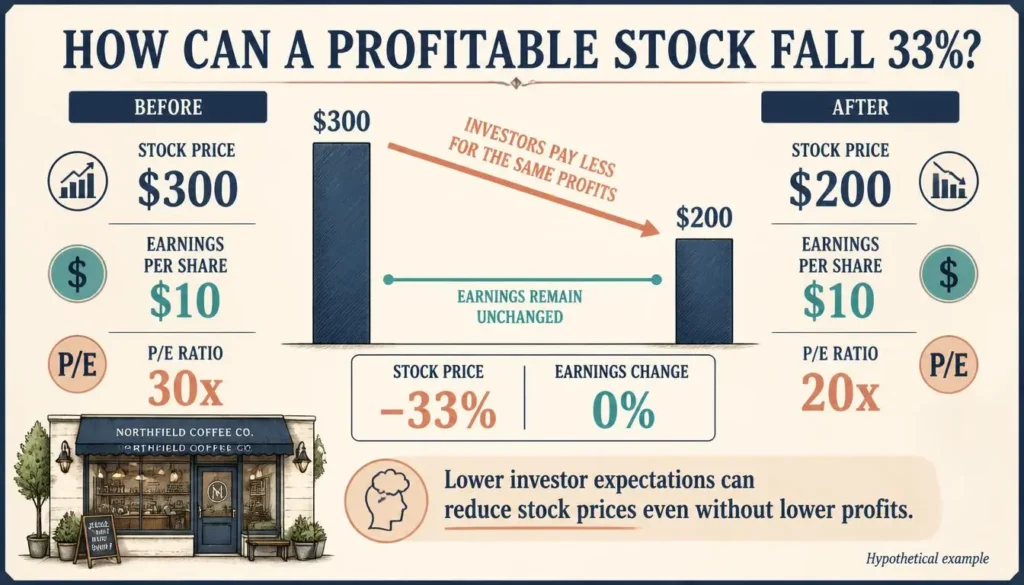
Suppose a company earns $10 per share and its stock trades at $300.
Its P/E ratio is 30.
Now imagine investors become less optimistic and decide they’re willing to pay only 20 times earnings.
The share price falls to $200.
That’s a 33% decline even though the company’s earnings haven’t fallen at all.
This is why stock prices can collapse even when businesses remain profitable.
The concern isn’t imaginary.
In its July 2026 Financial Stability Report, the Bank of England found that several measures of stock valuations were stretched compared with historical levels. Some remained stretched even after excluding major AI-related companies.
Legendary investor Warren Buffett explained the underlying problem in Berkshire Hathaway’s 1986 shareholder letter:
“Unfortunately, however, stocks can’t outperform businesses indefinitely.”
In other words, share prices can race ahead of company performance for a while, but business results ultimately matter.
The lesson: A great company can still be a disappointing investment if you pay too much for it.
And today, nowhere is that debate more visible than in artificial intelligence.
3. Could the AI Boom Trigger Another Stock Market Crash?
Let’s revisit the internet boom of the late 1990s.
Investors believed the internet would change how people shop, communicate, work, and do business.
They were absolutely right.
But many investors still lost enormous amounts of money.
Why?
Because being right about a technology doesn’t automatically mean you’re paying the right price for its stocks.
Today, artificial intelligence is creating similar excitement.
Companies are spending enormous amounts on AI chips, data centers, electricity, software, and computing infrastructure.
Some are already generating substantial profits from that demand.
But investors are also betting on profits that may take years to arrive.
What happens if AI adoption grows more slowly than expected?
Or if the cost of providing AI services remains much higher than companies anticipated?
Investors might lower their expectations, causing stock prices to fall.
There’s another important issue: the influence of a relatively small group of enormous technology companies.
The Bank of England estimated that AI-related companies accounted for approximately half of the S&P 500’s market capitalization in June 2026, based on its classification of AI-exposed businesses.
The S&P 500 includes around 500 leading US companies, but its stocks aren’t equally weighted. Bigger companies have a greater influence on the index.
Imagine a school where five students account for half the class’s total marks.
Even if everyone else performs reasonably well, poor results from those five students could significantly lower the class average.
A stock index can behave similarly.
If major AI-related companies decline together, the broader market may fall even when many other businesses remain healthy.
The IMF’s October 2026 research also examined the financial relationships supporting AI investment. In 14 transactions reviewed since 2023, it identified approximately $300 billion in equity investments and $650 billion in debt linked to $1.4 trillion in future revenue commitments.
These figures don’t prove that AI investment is unsustainable. They illustrate how closely connected parts of the AI financing system have become.
But we shouldn’t ignore the optimistic argument.
AI infrastructure spending creates real revenue for chipmakers, cloud providers, construction companies, and electricity suppliers. Successful AI adoption could also improve productivity across the economy.
The question isn’t whether AI will change the world. It’s whether the profits it eventually generates will justify today’s stock prices.
And even when business expectations are reasonable, another factor can influence how much investors are willing to pay: interest rates.
4. Why Can Rising Interest Rates Make Stock Prices Fall?
Imagine you have $10,000 to invest.
You could buy stocks, which might deliver attractive returns but could also lose value.
Or you could buy a relatively safe government bond that offers a more predictable return if held to maturity and the issuer meets its obligations.
Suppose the bond initially offers 3% annually.
Stocks might look attractive because they offer the possibility of earning considerably more.
Now imagine the bond’s yield rises to 6%.
Suddenly, the lower-risk investment looks more competitive.
Would you still be willing to pay the same high price for a risky stock?
Maybe not.
That’s one reason rising bond yields can put pressure on stock prices.
Higher interest rates also affect businesses directly.
Consider a company planning to borrow money to build a new factory.
If borrowing costs rise, that factory becomes more expensive to finance. Higher interest expenses can reduce future profits.
Now multiply that effect across thousands of businesses.
Borrowing costs can influence corporate investment, consumer spending, economic growth, and ultimately stock valuations.
The IMF’s October 2026 research identified a sharp rise in government bond yields as a potential source of wider financial-market stress.
But here’s an important detail.
Rising bond yields don’t always mean falling stocks.
Sometimes yields rise because investors expect stronger economic growth. In that situation, improving corporate earnings may help support share prices.
The key question isn’t simply whether interest rates are rising.
It’s why they’re rising and whether businesses can continue delivering the profits investors expect.
So how can an ordinary investor recognize when several risks are building together?
5. What Are the 7 Warning Signs of a Possible Stock Market Crash?
Think of these warning signs like the dashboard lights in your car.
One warning light doesn’t necessarily mean the engine is about to fail. But several appearing together deserve attention.
Warning Sign 1: Stock Prices Rise Much Faster Than Profits
If share prices keep climbing while company earnings barely improve, investors may be paying increasingly high prices for future growth.
What to watch: P/E ratios, earnings growth, and whether profit forecasts appear realistic.
Warning Sign 2: Only a Few Stocks Are Driving the Market Higher
A stock index can reach record highs even when many of its constituent companies are struggling.
This happens when a small group of very large businesses dominates the index.
What to watch: Whether gains are spread across different industries and companies or concentrated in a handful of market leaders.
Warning Sign 3: Investors Start Believing Prices Can Only Rise
When everyone seems convinced that a particular stock or industry is guaranteed to succeed, people may stop questioning valuations.
This doesn’t prove a bubble exists, but it can encourage excessive speculation.
What to watch: unrealistic return promises, speculative trading, and investment decisions driven by fear of missing out.
Warning Sign 4: Borrowing to Invest Becomes Excessive
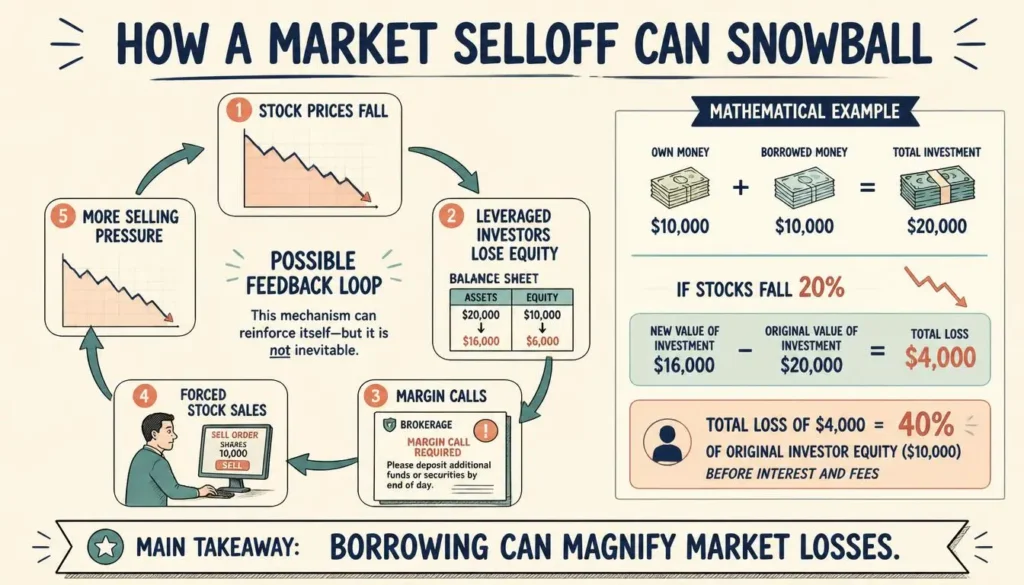
Borrowing money to buy stocks is called leverage.
It can increase profits—but it also magnifies losses.
Suppose you invest $10,000 of your own money and borrow another $10,000.
You now own $20,000 worth of shares.
If those shares fall 20%, you lose $4,000.
That’s a 40% loss on your original $10,000, before borrowing costs.
The Bank of England reported in July 2026 that global hedge-fund equity prime-brokerage balances had risen approximately 40% over the preceding year.
In simple terms, this indicates substantially more borrowing and financing activity in parts of the professional investment market.
That can become dangerous if falling prices force investors to sell assets to repay lenders.
Warning Sign 5: Bond Yields and Borrowing Costs Rise Sharply
Higher financing costs can pressure company profits and reduce how much investors are willing to pay for future earnings.
What to watch: Government bond yields, inflation, and signs that businesses are struggling with debt repayments.
Warning Sign 6: The Economy Starts Weakening
Slowing consumer spending, rising unemployment, and deteriorating corporate profits can signal that businesses face a tougher environment.
However, markets often react before economic data clearly confirms a slowdown.
What to watch: Employment trends, business activity, consumer spending, and earnings forecasts.
Warning Sign 7: Panic Selling Begins to Feed on Itself
When prices fall sharply, some investors sell because they’re frightened.
Others may be forced to sell because they borrowed money to invest.
That additional selling can push prices down further, creating a cycle of fear.
What to watch: Sudden volatility, forced liquidations, and sharp declines spreading across unrelated sectors.
The Bank of England has warned that concentrated positions and leveraged investment strategies can amplify market declines.
But remember: these are warning signs, not a countdown clock.
A market showing several warning signs may continue rising. A market showing few warning signs can still suffer an unexpected shock.
That’s why history is useful—not because it predicts the next crash, but because it reveals how differently financial crises can unfold.
6. What Can Previous Stock Market Crashes Teach Us?
Here’s something that surprises many investors:
Not every stock market crash begins with the same problem.
Consider three major examples.
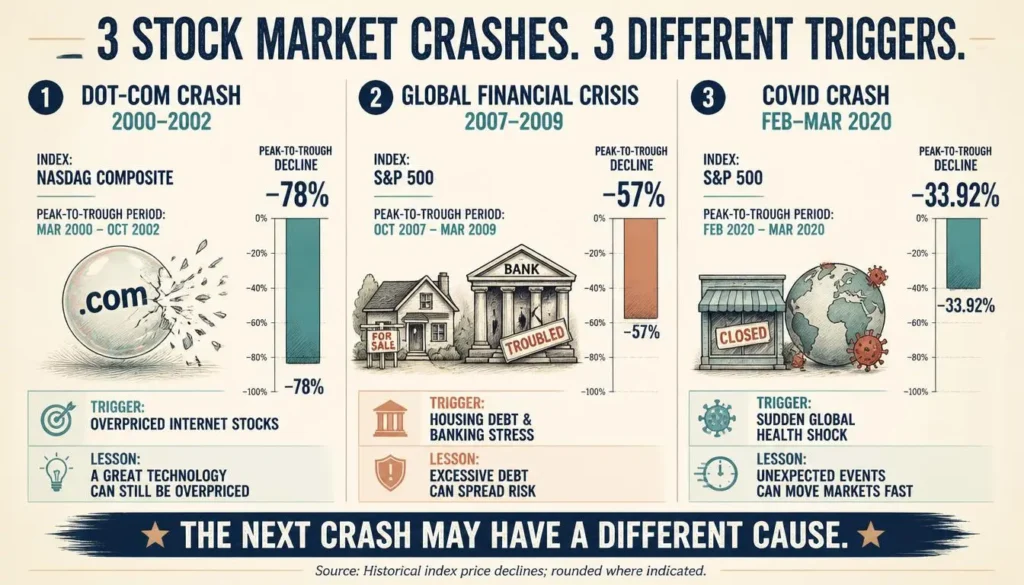
The Dot-Com Crash: 2000–2002
During the late 1990s, investors poured money into internet-related companies.
Many businesses had little revenue or no clear path to profitability, yet their stock prices soared.
When expectations changed, technology shares suffered enormous losses.
The Nasdaq Composite fell approximately 78% from its March 2000 peak to its October 2002 low.
The internet didn’t disappear. In fact, it went on to transform the global economy.
But many companies failed, and investors who paid excessive prices suffered severe losses.
The lesson: A revolutionary technology can succeed while many investments associated with it fail.
The Global Financial Crisis: 2007–2009
The 2008 financial crisis had a very different cause.
Problems involving housing loans, excessive borrowing, and complex financial products spread through banks and the broader economy.
As confidence collapsed, lending became more difficult and businesses faced severe pressure.
The S&P 500 declined approximately 57% from its October 2007 peak to its March 2009 low.
The lesson: Financial problems can spread from one industry to the wider economy, especially when businesses and investors are heavily indebted.
The COVID-19 Crash: 2020
In February 2020, the world was beginning to understand the scale of the COVID-19 pandemic.
Within weeks, businesses closed, travel stopped, and investors faced enormous uncertainty.
The S&P 500 fell 33.92% between February 19 and March 23, 2020, according to Bloomberg market data cited in an April 2020 investment report.
That decline occurred in just 23 trading days.
But the market’s subsequent recovery was also remarkably fast.
Investors who sold in panic and waited for all economic uncertainty to disappear risked missing a substantial rebound.
The lesson: Even when you understand why stocks are falling, predicting when they’ll recover is extremely difficult.
Look at what these three crashes have in common.
They all caused major losses, but their triggers were different.
One involved unrealistic technology valuations. Another involved financial-system weaknesses. The third came from an unexpected global health emergency.
That’s why preparing for uncertainty is generally more useful than trying to predict the next crisis.
7. Should You Sell, Hold, or Buy When the Stock Market Starts Falling?
Let’s return to our opening example.
You wake up and discover your investment portfolio has fallen 15%.
Should you sell everything before it falls further?
Should you buy more because stocks are cheaper?
Or should you do nothing?
The answer depends on something more important than the latest market headline:
Why did you invest that money in the first place?
Imagine two investors.
The first needs their money next year to buy a home.
The second is investing for retirement 25 years from now.
Both own stocks. Both experience the same market decline.
But the consequences are completely different.
The first investor may not have enough time to recover before needing the money.
The second may have more flexibility to withstand short-term volatility, assuming their investments are appropriate for their circumstances.
This is why investment decisions should begin with your financial goals, time horizon, and ability to tolerate losses.
The US Securities and Exchange Commission’s investor education guidance emphasizes that appropriate asset allocation depends on these very factors.
Warren Buffett also offered a memorable reminder about investor psychology in Berkshire Hathaway’s 1986 shareholder letter:
“Be fearful when others are greedy and to be greedy only when others are fearful.”
His point wasn’t that investors should automatically buy every falling stock.
It was that investment decisions should be guided by value and judgment rather than following the crowd.
Before Making Your Next Investment Decision, Ask Yourself Three Questions
1. Am I paying a reasonable price for the business?
A falling share price doesn’t automatically mean a stock is cheap. If the company’s future profits have deteriorated, its lower valuation may be justified.
2. Can I afford to hold this investment through a major decline?
If a market downturn would force you to sell investments needed for essential expenses, you may be taking more risk than your circumstances allow.
3. Am I investing based on evidence or emotion?
Fear can make investors sell after large losses.
Excitement can make them buy overpriced stocks.
Neither is a substitute for understanding what you own.
Diversification can also help manage risk. Spreading investments across appropriate companies, sectors, and asset classes reduces dependence on any single outcome, although it cannot eliminate market losses.
And be cautious with borrowing. A temporary market decline can become a permanent financial setback when debt forces you to sell.
You don’t need to predict every market movement. You need a plan that can survive being wrong.
The Bottom Line: Should You Be Worried About a Stock Market Crash?
The possibility of a stock market crash will always attract attention.
And that’s understandable. Nobody enjoys watching their savings lose value.
But perhaps we’re asking the wrong question.
Instead of constantly wondering, “When will the next crash happen?” ask yourself:
“If the market falls tomorrow, am I financially prepared?”
Expensive stocks, concentrated market gains, unrealistic expectations, rising borrowing costs, and excessive leverage can increase financial vulnerability.
But none guarantees a crash.
Strong corporate earnings and economic growth can support markets, sometimes for much longer than cautious investors expect.
The goal isn’t to become someone who predicts every market decline.
It’s to understand what you’re investing in, recognize the risks, and make decisions without being controlled by fear.
Because successful investing isn’t only about making money when markets rise. It’s also about protecting your financial future when they fall.
Frequently Asked Questions
Is a stock market crash coming soon?
No one can reliably predict when the next stock market crash will occur. Expensive valuations, rising borrowing costs, excessive leverage, and economic weakness can increase market vulnerability, but these indicators cannot determine the timing of a crash.
What are the first signs of a stock market crash?
Potential warning signs include unusually high stock valuations, weakening earnings expectations, narrow market leadership, excessive borrowing, rising bond yields, deteriorating economic conditions, and sudden increases in selling pressure. No single indicator reliably predicts a crash.
What is the difference between a stock market correction and a crash?
A stock market correction generally means a decline of at least 10% from a recent peak. A bear market typically means a decline of at least 20%. A crash refers to an unusually rapid and severe decline, although there is no universally accepted percentage threshold.
Can the stock market crash even when the economy is doing well?
Yes. Stock prices depend on expectations about future earnings, interest rates, and risk. If investors decide shares are overpriced or future profits may disappoint, stock prices can fall even while the economy remains relatively healthy.
Should I sell all my stocks before a market crash?
Selling everything based on a prediction can be risky because markets may continue rising or recover before you reinvest. Investment decisions should reflect your financial goals, time horizon, liquidity needs, diversification, and risk tolerance.
Is buying stocks during a crash a good investment strategy?
Market declines can create opportunities, but not every falling stock is a bargain. Investors should evaluate company fundamentals, financial strength, valuations, and their ability to withstand further losses before investing.
How long does it take for the stock market to recover after a crash?
Recovery times vary significantly. Some markets recover within months, while others take years to regain previous highs. The severity of the decline, economic conditions, corporate earnings, and policy responses all influence recovery.