
The Big Picture
Oil prices above $100 a barrel can put pressure on petrol prices, food costs, business profits, and the global economy. As the Iran crisis disrupts energy shipments and raises shipping and insurance costs, the impact could reach households and investors far beyond the Middle East. But the damage depends on how long the disruption lasts, how governments respond, and whether the world can find alternative supplies.
Imagine filling your car or motorcycle with petrol and wondering why it costs more, even though the conflict is happening thousands of kilometers away.
Or imagine a restaurant owner paying more to transport ingredients, a farmer spending more on diesel, or an airline facing a bigger fuel bill. None of them needs to buy crude oil directly to feel its effects.
That is what makes an oil crisis so powerful. Oil is not just another commodity. It is an input into the cost of moving people, producing goods, and running businesses. When its price rises sharply, the pressure can spread through the economy.
As of October 9, 2026, Brent crude, the international oil benchmark, traded around $104.72 a barrel, according to The Wall Street Journal. The latest increase came amid concerns about Middle Eastern supply and disruptions to energy shipments, although other factors were also influencing prices.
But here is the question that matters more than the headline price: What happens if oil stays expensive?
Let’s follow the money, from the oil tanker to the petrol pump, from the petrol pump to the price of food, and eventually to businesses, stock markets and the wider economy.
By the end of this article, you’ll know:
- Why is oil above $100 during the Iran crisis?
- How can expensive oil make everyday life more costly?
- Could an oil shock cause inflation or even a recession?
- Who benefits, and who loses, when oil prices rise?
- How does expensive oil affect stock markets and investors?
- What does the crisis mean for Pakistan?
- Could oil prices fall even if the conflict continues?
1. Why Are Oil Prices Rising During the Iran Crisis?
To understand the price of oil, imagine that the world depends on a handful of major roads to deliver an essential product. If one of those roads becomes dangerous or difficult to use, deliveries can slow down, transport becomes more expensive, and buyers start worrying about shortages.
The global oil market faces a similar problem.
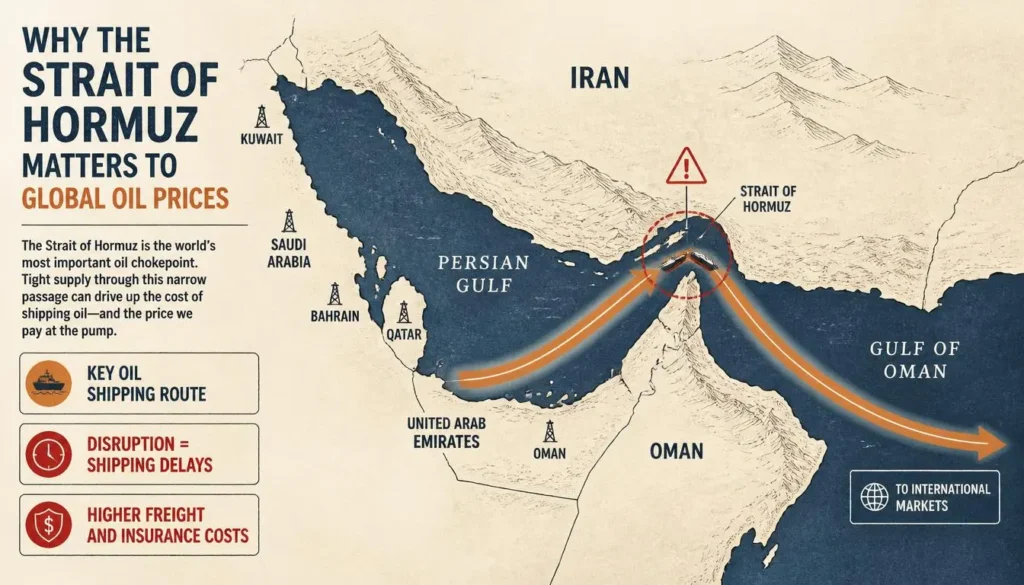
One of the world’s most important energy routes is the Strait of Hormuz, a narrow waterway between Iran and Oman. Oil and other energy products pass through it on their way to international markets. When conflict threatens ships or disrupts traffic through the strait, buyers worry that less oil may reach them on time.
That fear can push prices higher, even before a shortage becomes visible at petrol stations.
The concern is not limited to how much oil producers extract. It is also about whether tankers can carry it safely, how much insurance costs, and whether alternative routes can compensate for disrupted shipments.
Reuters reported on October 8 that crude movements through the Strait of Hormuz had fallen to around 10.1 million barrels a day, roughly 74% of pre-war levels, amid shipping attacks and disruption. Alternative routes can help, but they cannot necessarily replace all the affected flows.
There is an important distinction here: a threat to supply is not the same as a permanent loss of supply. Oil can be redirected, inventories can be used, and producers may increase output where possible. But these responses take time and may not fully offset the disruption.
That is why oil prices can move dramatically on news about a conflict, even when the world has not completely run out of oil.
And when getting oil to market becomes more difficult, the cost does not stop with the oil companies. It begins travelling through the economy.
2. How Do Higher Oil Prices Make Everyday Life More Expensive?
The first place many people notice an oil shock is at the petrol pump. But fuel is only the beginning.
Consider a simple example.
A farmer uses diesel-powered machinery to prepare a field and harvest crops. A truck then carries the produce to a wholesale market. Another vehicle delivers it to a local shop. If fuel and transport costs rise, each stage may become more expensive.
The shopkeeper now faces a choice: absorb the extra cost and earn less, or raise prices and pass some of the cost to customers.
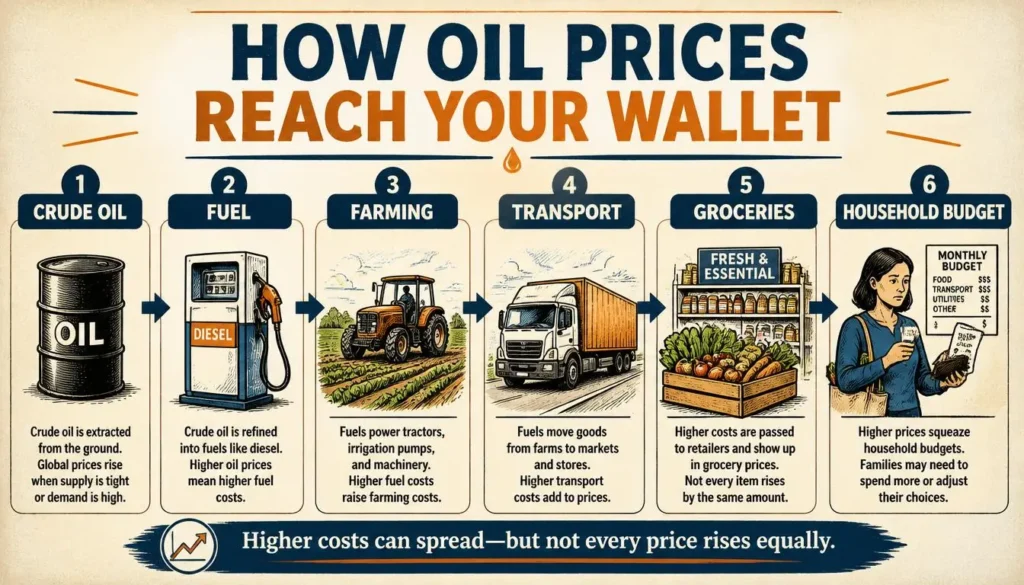
That is one way a global oil shock can reach your grocery bill.
The same pressure can affect airline tickets, delivery services, public transport, manufacturing and businesses that rely on energy-intensive production. Some companies may also face higher costs for packaging, materials or other products linked to oil and gas.
But there is a catch: higher oil prices do not make every product more expensive immediately, or by the same amount.
A business may have long-term fuel contracts, hold existing inventory, use less fuel, or decide to absorb some of the increase rather than risk losing customers. Government taxes, subsidies, exchange rates and local pricing policies also influence what consumers pay.
So, if crude oil rises by 10%, you should not expect petrol, food and every other product to rise by 10%.
The more useful question is whether the increase is temporary or lasts long enough to work its way through the economy.
A short-lived spike may be manageable. A prolonged period of expensive oil can gradually squeeze household budgets, especially when wages do not rise at the same pace.
And that leads to a bigger concern: what happens when higher costs spread beyond a few products and start affecting the overall cost of living?
3. Can an Oil Price Shock Cause Inflation, or Even a Recession?
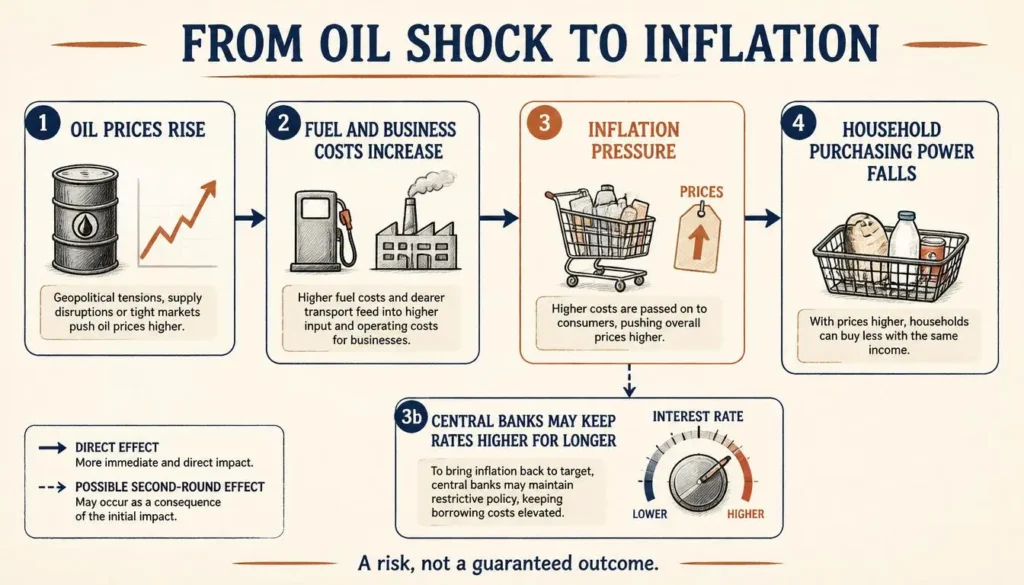
Imagine your monthly income stays the same, but you spend more on fuel, transport and groceries. You now have less money left for eating out, shopping, entertainment or saving.
You have not necessarily become poorer on paper. But your money buys less.
That is the everyday experience behind inflation: a broad increase in prices that reduces the purchasing power of money.
An oil shock can contribute to inflation because fuel and energy are used throughout the economy. Businesses facing higher costs may pass some of them on to customers. If higher prices persist, households can find themselves paying more for ordinary necessities.
Central banks then face a difficult decision.
Normally, they try to control inflation by influencing borrowing costs. But raising interest rates cannot reopen a shipping route or produce more oil. It can, however, make borrowing more expensive and reduce spending elsewhere in the economy.
This creates a difficult balancing act: inflation may remain stubborn while economic growth weakens.
Could that lead to a recession?
It is possible, but oil above $100 does not automatically mean a recession is coming. The outcome depends on how high prices go, how long they remain elevated, how much spare supply is available, and how resilient households and businesses are.
Think of an oil shock as an additional weight placed on an economy. If growth is strong and the disruption is brief, the economy may absorb it. If households are already struggling, borrowing is expensive, and supply disruptions persist, that extra weight can become more damaging.
The International Energy Agency has warned about oil-security risks as hostilities have escalated and commercial inventories have been drawn down. Its September 2026 oil-market report also described continuing disruption to energy flows and a recovery in Middle Eastern production that could extend into 2027.
The key point is not that a recession is inevitable. It is that a prolonged oil shock can make the fight against inflation harder while leaving consumers with less room to spend.
And while households face that squeeze, businesses experience the same crisis in very different ways.
4. Who Wins, and Who Loses, When Oil Prices Rise?
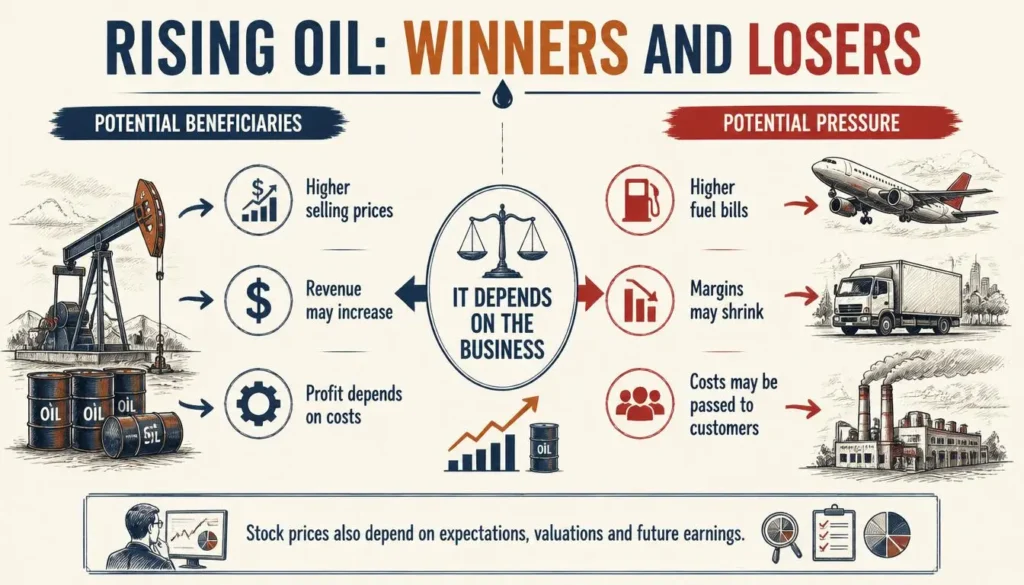
It may seem obvious that expensive oil is good news for oil companies. Sometimes it is. But the full picture is more complicated.
Consider two businesses.
The first produces oil and can sell it at a higher price without facing a similar increase in its own production costs. Its revenue and potentially its profits may improve.
The second is an airline. It needs fuel to operate its planes, so higher oil prices can increase one of its biggest expenses. It may raise ticket prices, cut other costs or accept lower profits. If customers become more price-sensitive and travel less, passing on the full increase may be difficult.
The same pressure can affect trucking companies, logistics businesses, manufacturers and other fuel-intensive industries.
Oil-importing countries can also be hurt because they must spend more to buy the energy they need. Oil exporters may receive more revenue, although disruptions to their own production or shipments can offset some of that benefit.
Even oil producers are not guaranteed winners. Higher prices may coincide with damaged infrastructure, interrupted exports, rising operating costs or uncertainty about future demand.
So the real divide is not simply between companies that sell oil and everyone else. It is between businesses that can benefit from higher prices and those that struggle to absorb them.
Higher oil prices can create winners and losers, but they do not guarantee investment profits.
A company’s share price reflects what investors expect to happen, not just what is happening today. If investors have already anticipated higher oil prices, the share price may have risen before the latest headline. If they fear the disruption will damage production or reduce demand, the market may react differently.
That brings us to the question investors often ask next: what does an oil crisis mean for the stock market as a whole?
5. How Can the Oil Crisis Affect Stock Markets and Investors?
When oil prices surge, investors are not just asking whether fuel will become more expensive. They are trying to work out how the crisis could change company earnings, inflation, interest rates, and economic growth.
Consider a delivery company.
If its fuel bill rises but it cannot increase delivery charges without losing customers, its profit margin, the portion of revenue left after costs, may shrink.
Now consider an oil producer. It could benefit from higher selling prices, provided it can maintain production and deliver its output.
These different pressures help explain why the same event can hurt some shares while supporting others.
There is another layer to the story: interest rates.
If expensive oil keeps inflation elevated, central banks may have less room to cut rates. Higher borrowing costs can weigh on businesses that need financing and on consumers who rely on loans. They can also affect how investors value future company profits.
But none of this means the entire stock market must fall.
Markets respond to expectations. If investors believe the disruption will be brief, prices may recover even while the conflict continues. If the crisis is worse than expected, or begins to threaten economic growth, the reaction may be more severe.
For everyday investors, the practical lesson is simple: do not assume that every energy stock is a winner or every other stock is a loser.
Look at a company’s actual exposure. Does it produce oil or consume large amounts of fuel? Can it pass higher costs to customers? Is its business already under pressure? How much of the risk is reflected in its share price?
An oil crisis is a reason to reassess risks, not a reliable shortcut to predicting which share will rise next.
And for countries that import much of their energy, the consequences can go beyond individual businesses. They can affect the country’s finances and currency, too.
6. What Does the Oil Crisis Mean for Pakistan?
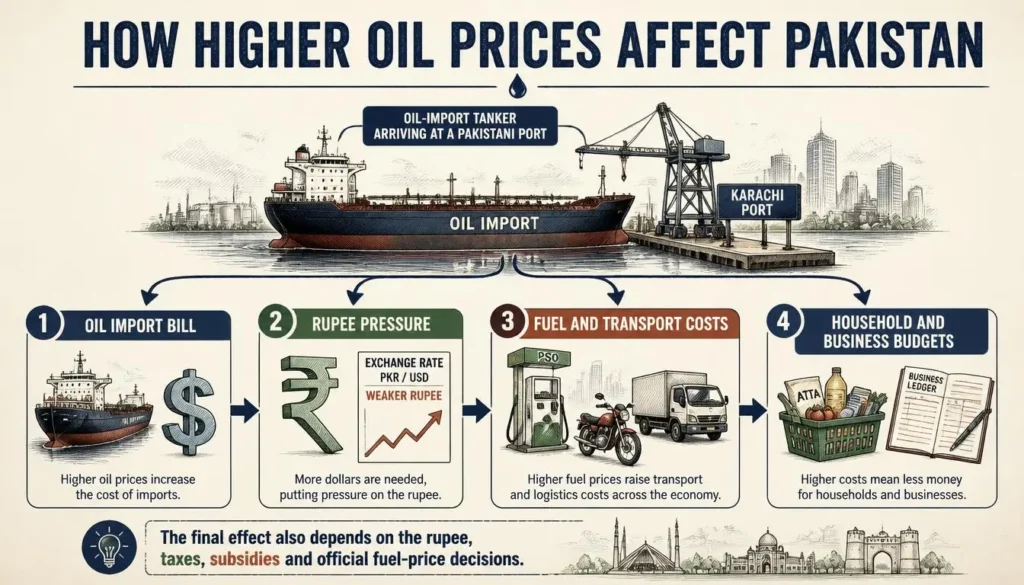
For Pakistan, expensive oil presents a particularly important challenge because the country relies heavily on imported energy.
When international oil prices rise, the country may need to spend more foreign currency to purchase the energy it uses. That can put pressure on the import bill and, depending on other inflows and economic conditions, the country’s external finances.
The impact can reach ordinary households through several routes.
First, petrol and diesel costs. Higher international prices can place upward pressure on domestic fuel prices, although the final price also depends on the exchange rate, taxes, levies, government decisions and other pricing components.
Second, transport and food. If diesel becomes more expensive, it can raise costs for trucks, buses, agricultural machinery and other parts of the supply chain. Businesses may absorb some of these costs, but prolonged pressure can eventually reach consumers.
Third, the rupee. If the oil import bill increases, demand for foreign currency may rise. Whether this weakens the rupee depends on the wider balance of payments, foreign exchange inflows, policy and other factors. It is a risk, not an automatic outcome.
Fourth, government finances. Authorities may face pressure to cushion households from higher energy costs. But subsidies require funding, and supporting one group can leave less room for other spending.
For a sense of how the crisis is being managed, Pakistan’s fuel-price announcements and relief measures need to be read with their dates attached. The Associated Press reported in early October on assistance for low-income fuel users. Such measures can ease the burden on eligible households, but they do not remove the underlying cost of imported energy.
That distinction matters. If the international price of oil remains high, the economic cost still has to be borne somewhere, by consumers through prices, businesses through lower margins, the government through support, or some combination of the three.
This is why the same oil shock can feel different in different countries. A country that produces much of its own oil may receive more revenue when prices rise. A country that imports much of its energy may face a larger bill.
For Pakistan, the question is not simply whether oil stays above $100. It is how long it stays there, what happens to the rupee, and how much of the increase reaches local prices.
But there is one final twist: even if the conflict continues, oil prices do not necessarily have to keep rising.
7. Could Oil Prices Fall Even If the Iran Crisis Continues?
It sounds counterintuitive. If the conflict is still happening, shouldn’t oil prices keep going up?
Not necessarily.
Oil prices depend on more than the existence of a crisis. They depend on how much oil is available, how easily it can reach buyers, how much people and businesses need, and what traders expect to happen next.
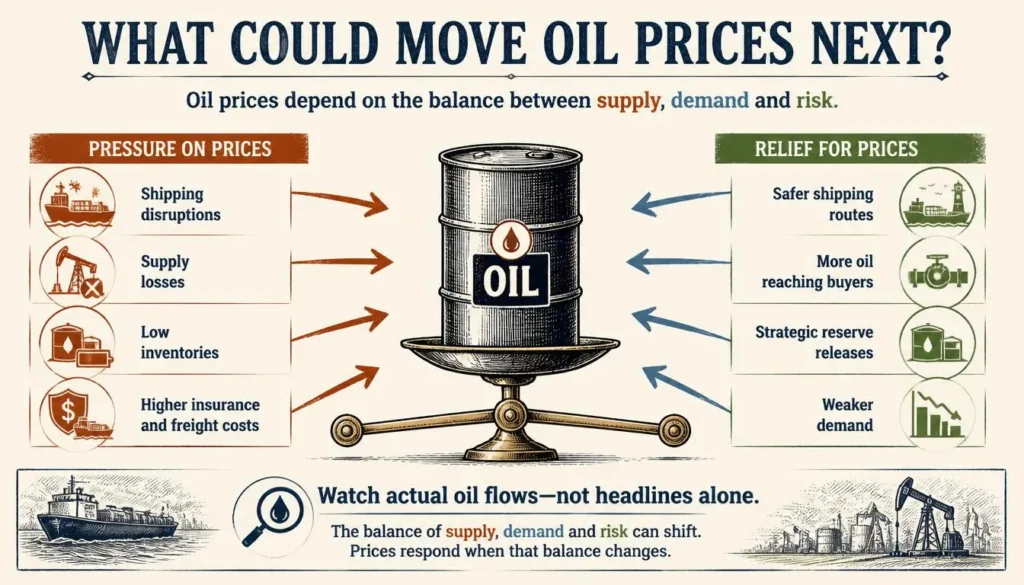
There are several ways prices could ease even while tensions remain.
Supply routes could improve. If tanker movements become safer or more reliable, more oil may reach buyers and some of the extra shipping and insurance costs could decline.
Other producers could help fill the gap. Additional output or the use of strategic stockpiles can provide temporary relief. But reserves are finite, and releasing oil from storage does not create new long-term production capacity.
Demand could weaken. If high prices slow travel, industrial activity or consumer spending, buyers may need less oil. That can reduce price pressure, although weaker demand may also signal a struggling economy.
Markets could become less worried. Oil prices reflect expectations as well as current supply. If traders believe the worst disruption has passed, prices can fall before every shipment and production facility has returned to normal.
The reverse is also possible. Prices could rise further if shipping disruptions intensify, exports remain constrained or inventories fall more sharply than expected.
So what should readers watch?
- Oil prices: Is Brent consistently rising, falling or moving sharply in both directions?
- Shipping through the Strait of Hormuz: Are tanker movements and oil flows recovering?
- Inventories and supply: Are stockpiles cushioning the disruption, and can producers increase output?
- Freight and insurance costs: Is it becoming cheaper and safer to move oil?
- Demand and economic growth: Are businesses and consumers continuing to use energy at the same pace?
- Local fuel prices and exchange rates: How is the international shock translating into the cost of living in your country?
No single indicator tells the whole story. Together, however, they can help distinguish a temporary price spike from a longer-lasting energy shock.
The important lesson is that the price of oil depends not only on what is happening today, but also on what the world expects to happen tomorrow.
What Should Consumers and Investors Do When Oil Prices Surge?
An oil crisis is a reminder that events far beyond our control can affect everyday budgets and investment portfolios. But understanding the chain reaction can help us respond more thoughtfully.
For households, the sensible response is to review essential expenses, avoid assuming that current fuel prices will remain unchanged, and be cautious about making large financial commitments on the expectation that costs will quickly fall.
For investors, it is worth reviewing which businesses may be vulnerable to sustained energy costs and which might benefit, and checking whether those risks are already reflected in share prices. A dramatic headline alone is not a complete investment thesis.
For readers in Pakistan, it is particularly useful to watch international crude prices alongside the rupee, domestic fuel-price announcements and government relief measures. These factors help explain why the local impact may differ from the movement in Brent crude.
Above all, separate what is known from what is predicted. Oil prices can rise sharply without causing a recession, and they can fall without a conflict having fully ended.
The Final Thought
The real cost of an oil crisis isn’t measured only at the petrol pump. It’s measured in what households can no longer afford, what businesses can no longer absorb, and how much uncertainty the global economy can withstand.
The question is not simply whether oil stays above $100. It is whether the disruption lasts long enough to change how people spend, how businesses operate and how investors value the future.
Frequently Asked Questions
Why are oil prices rising because of the Iran crisis?
Oil prices can rise when conflict threatens production or disrupts shipments through important routes such as the Strait of Hormuz. Buyers worry that less oil may reach the market on time. Shipping, insurance and freight costs can also increase, pushing prices higher even before a lasting physical shortage develops.
Why is the Strait of Hormuz so important for oil prices?
The Strait of Hormuz is a major route for oil and other energy shipments from the Gulf to international markets. When tanker movements are threatened or restricted, it becomes harder and potentially more expensive to deliver energy to buyers. Disruptions can therefore affect global oil prices, shipping costs and supply expectations.
How do higher oil prices affect inflation?
Higher oil prices can increase fuel, transport and production costs. Businesses may pass some of these costs to consumers, contributing to inflation. The effect depends on how long prices remain high, how much companies absorb, government policies, exchange rates and the broader economy. Expensive oil does not automatically cause a recession.
Will oil prices above $100 make petrol and food more expensive?
They can put upward pressure on both, but the effect is not automatic or one-for-one. Retail fuel prices also depend on exchange rates, taxes and government pricing decisions. Food prices may respond to higher transport, farming and production costs, often with a delay. Short-lived oil spikes may have a smaller impact than prolonged increases.
Which stocks benefit when oil prices rise?
Some oil and gas producers may benefit if they can sell output at higher prices without facing equivalent cost increases. But results vary with production levels, operating costs, taxes, debt and market expectations. Higher oil prices can hurt airlines, transport companies and fuel-intensive businesses. No stock or sector is guaranteed to gain.
Why do high oil prices hurt airlines and transport companies?
Fuel is a major operating expense for many airlines and transport businesses. When fuel becomes more expensive, profits can shrink unless companies raise prices, improve efficiency or reduce other costs. Raising fares or delivery charges may not fully solve the problem if customers cut back on travel or purchases.
How do rising oil prices affect Pakistan’s economy?
Pakistan relies heavily on imported energy, so higher international oil prices can increase its import bill and put pressure on foreign currency demand. They can also raise domestic transport and production costs. The actual impact depends on the rupee, fuel-price policy, taxes, subsidies, global supply conditions and how long oil remains expensive.
Can oil prices fall while a war is still happening?
Yes. Oil prices can fall if supply routes improve, other producers increase output, inventories provide relief, demand weakens or traders become less concerned about future shortages. Prices reflect expectations as well as current events. A decline in oil prices does not necessarily mean the conflict has ended or all supply disruptions have been resolved.
What happens to stock markets when oil prices surge?
Stock-market reactions vary by sector and by what investors expected beforehand. Oil producers may benefit, while airlines and other fuel-intensive businesses can face higher costs. If expensive oil keeps inflation elevated, interest-rate expectations may also change. Higher oil prices do not automatically mean the entire stock market will fall.
What should investors watch to understand where oil prices are heading?
Investors can monitor Brent crude, shipping through the Strait of Hormuz, global oil inventories, production levels, freight and insurance costs, and signs of changing demand. Central-bank expectations and currency movements can also matter. No indicator predicts prices perfectly, so it is more useful to consider several signals together than to rely on one headline.