
At a Glance
Treasury yields rise when investors demand higher returns for lending money to the US government. This can happen because of inflation, expectations about Federal Reserve interest rates, stronger economic growth, increased government borrowing, or changes in investor demand.
When Treasury yields rise, existing fixed-rate bond prices generally fall. Higher yields can also put pressure on stock valuations, influence mortgage rates, increase business borrowing costs, and create new opportunities for savers.
But here’s what matters most: Rising Treasury yields aren’t always bad news. The reason behind the increase can be more important than the increase itself.
Imagine you’ve spent years saving $10,000.
You worked overtime, skipped unnecessary purchases, and resisted the temptation to spend that money. Now you’re ready to make it grow.
You could invest in stocks. You could keep it in savings. Or you could lend it to the US government by purchasing Treasury securities.
Suppose a Treasury investment offers a 3% annual yield. On $10,000, that’s approximately $300 a year before taxes.
Then something changes.
Comparable Treasury investments start offering 5%. Suddenly, that same $10,000 could generate approximately $500 a year.
An extra $200 might not sound life-changing. But think about what just happened.
A relatively low-risk investment has become more attractive. Stock investors may reconsider how much risk they’re willing to take. Banks may adjust borrowing rates. Businesses may rethink expansion plans.
And if you’re planning to buy a house, the impact could be much bigger than $200.
How can a change in the return on government debt affect so many parts of your financial life?
The answer is surprisingly simple once you connect the dots.
By the End of This Article, You’ll Know:
- What Treasury yields are, without complicated financial jargon.
- Why Treasury bond prices fall when yields rise.
- The main reasons US Treasury yields increase.
- Why higher Treasury yields can make stock prices fall.
- How Treasury yields affect mortgage rates and monthly payments.
- When rising yields are good news, and when they’re a warning sign.
- What higher yields mean for your savings, investments, and financial decisions.
THE 7: How Rising Treasury Yields Affect Your Money
1. What Are Treasury Yields, and Why Should You Care?
Let’s start with something familiar.
When you need money to buy a house, you might borrow from a bank. When a business needs money to expand, it might take out a loan.
The US government borrows money too.
But instead of applying for a traditional bank loan, it sells securities called US Treasuries.
When you buy a newly issued Treasury security, you’re effectively lending money to the federal government.
In exchange, the government promises to repay you according to the security’s terms. Depending on the type of Treasury, you may receive regular interest payments or earn a return from buying it below its maturity value.
Now imagine buying a $1,000 Treasury note with a fixed annual interest payment of $40.
That $40 represents a 4% annual coupon rate on its face value.
Simple enough, right?
But here’s where things get interesting.
Treasury securities can be bought and sold after they’re issued. Their market prices change, even though the promised payments on a conventional fixed-rate Treasury note stay the same.
The Treasury yield reflects the return available to someone buying that security at its current market price.
In other words:
The coupon tells you what the bond promises to pay. The yield helps tell you what return you’re getting for the price you pay.
Why Is the 10-Year Treasury Yield So Important?
You’ve probably seen headlines mentioning the 10-year US Treasury yield.
It’s one of the world’s most closely watched interest-rate benchmarks.
Why?
Because lenders and investors use Treasury yields as reference points when deciding what returns to demand from other investments and loans.
Think of the 10-year Treasury yield as a financial measuring stick.
When that measuring stick moves, the prices of many other financial products can move too.
That’s why Treasury yields matter even if you’ve never bought a government bond.
But before understanding their impact, we need to solve one of finance’s most confusing puzzles.
2. Why Do Treasury Bond Prices Fall When Yields Rise?
Imagine you bought a Treasury note paying $40 annually.
You paid $1,000 for it, and at the time, a 4% coupon seemed attractive.
A year later, newly issued comparable Treasury securities offer a 6% yield.
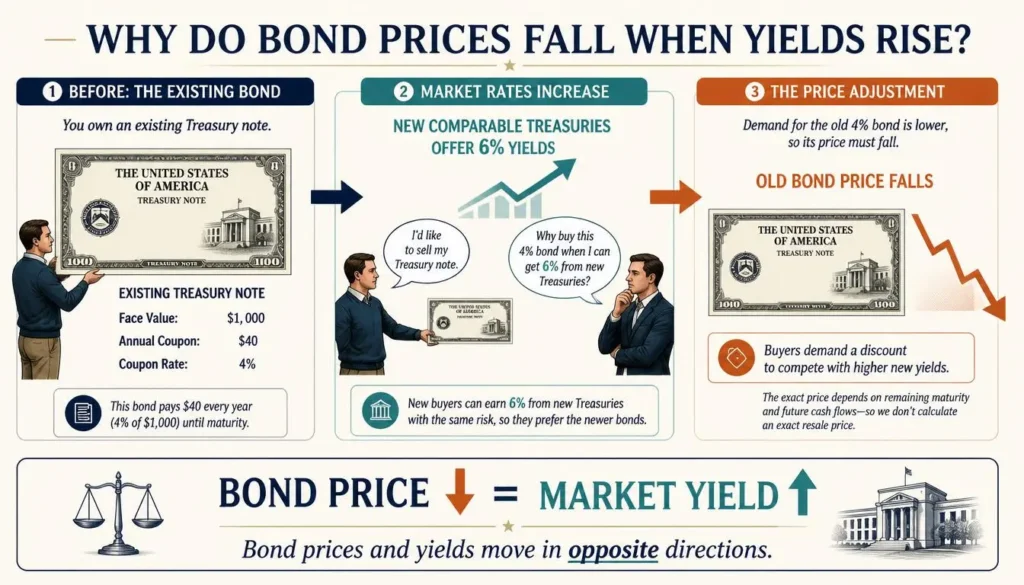
Now you want to sell your older note.
Here’s the problem.
Why would another investor pay you $1,000 for an investment paying $40 a year when newer securities offer a higher return?
They probably wouldn’t.
To attract a buyer, you’d likely need to lower your asking price.
That’s the basic reason bond prices fall when market yields rise.
For a simplified illustration, imagine a security paying $40 annually whose market price falls to $800.
Its annual payment would then equal 5% of that purchase price rather than 4%.
This is only a simplified current-yield example. A Treasury’s actual yield to maturity also depends on its remaining payments, maturity value, and time until repayment.
The important relationship is the same:
Bond prices go down → Yields go up.
Bond prices go up → Yields go down.
The US Securities and Exchange Commission explains this inverse relationship in its investor education materials.
Does That Mean Treasury Bonds Are Risky?
US Treasuries are generally considered to have very low credit risk because they’re backed by the US government’s full faith and credit.
But low credit risk doesn’t mean their market prices never fall.
If you need to sell a conventional fixed-rate Treasury before maturity, you could receive less than you paid.
If you hold it until maturity, its promised payments remain unchanged by interim market movements, assuming the government fulfills its obligations.
And here’s another important detail: longer-term fixed-rate bonds generally experience larger price changes when yields move.
Now we understand how yields rise.
But what actually causes investors to demand higher returns?
3. Why Are US Treasury Yields Rising?
Imagine you’re lending money to a friend.
If you believe prices will rise sharply over the next few years, you might want extra compensation. Otherwise, the money you receive later could buy less than it does today.
If your friend suddenly needs to borrow much more money, you might also reconsider the terms.
Treasury investors think about similar questions, although the government bond market is far more complex.
Four major forces help explain why Treasury yields rise.
Reason 1: Inflation Makes Future Money Less Valuable
Suppose you lend $1,000 today and receive it back in ten years.
If prices increase significantly during those ten years, that $1,000 won’t buy as much.
Investors know this.
When they expect higher inflation, they may demand higher Treasury yields to compensate for the loss of purchasing power.
Higher expected inflation can mean higher required yields.
Reason 2: The Federal Reserve Changes Interest-Rate Expectations
You’ve probably heard that the Federal Reserve raises or lowers interest rates.
But here’s something many people misunderstand.
The Federal Reserve doesn’t directly set the 10-year Treasury yield.
It influences short-term interest rates through monetary policy. Longer-term Treasury yields are determined in financial markets.
Those yields reflect expectations about future interest rates, inflation, economic growth, and the extra compensation investors require for holding longer-term securities.
So even when the Fed leaves its current policy rate unchanged, Treasury yields can still move.
Reason 3: The US Government Needs to Borrow Money
Imagine a business seeking investors for a new project.
If plenty of investors are interested, the business may be able to borrow on attractive terms.
But if it needs substantially more funding and investor demand doesn’t keep pace, it may have to offer better returns.
Government borrowing operates through a different market, but the supply-and-demand principle still matters.
When the Treasury issues more debt, investors must be willing to buy it.
Depending on demand, the amount and composition of new issuance can influence yields.
More government borrowing doesn’t automatically mean higher yields, but it can contribute to upward pressure.
Reason 4: A Stronger Economy Can Push Yields Higher
This one surprises many people.
Sometimes Treasury yields rise because the economy is performing well.
If businesses are growing, employment is strong, and consumers are spending, investors may expect higher future interest rates or stronger returns from other investments.
That can push Treasury yields upward.
So a rising yield can signal economic strength, or concern about inflation and borrowing costs.
That’s why asking “Why are yields rising?” is more useful than simply asking “Are yields rising?”
Now comes the part that often makes stock investors nervous.
4. Why Do Rising Treasury Yields Affect Stock Prices?
Let’s return to your $10,000.
Imagine Treasury securities offer a 3% yield.
You might be willing to accept the additional risks of investing in stocks because you’re hoping for a much higher return.
But what happens if Treasury yields increase to 5%?
Suddenly, you have a more attractive alternative.
Stocks can still offer greater returns, but they also come with greater uncertainty.
So you might ask:
If I can earn 5% from a Treasury security, how much more should I expect from a risky stock?
Millions of investors asking variations of that question can influence stock valuations.
Warren Buffett captured the relationship with a memorable analogy at Berkshire Hathaway’s 2013 annual meeting:
“Interest rates are to asset prices, you know, sort of like gravity is to the apple.”
– Warren Buffett, May 4, 2013.
Buffett’s point was that interest rates influence how much investors are willing to pay for assets.
How Can a Company’s Stock Fall Even When Its Business Is Doing Fine?
Imagine a company earning $10 per share annually.
Investors are initially willing to pay $300 per share.
That gives the stock a price-to-earnings ratio of 30.
Now Treasury yields rise, and investors demand better potential returns from stocks.
Suppose they’re no longer willing to pay 30 times earnings. Instead, they’ll pay only 25 times earnings.
The company’s annual earnings haven’t changed.
But its stock price could fall from $300 to $250.
That’s a decline of approximately 17%, even though the company is still earning the same amount.
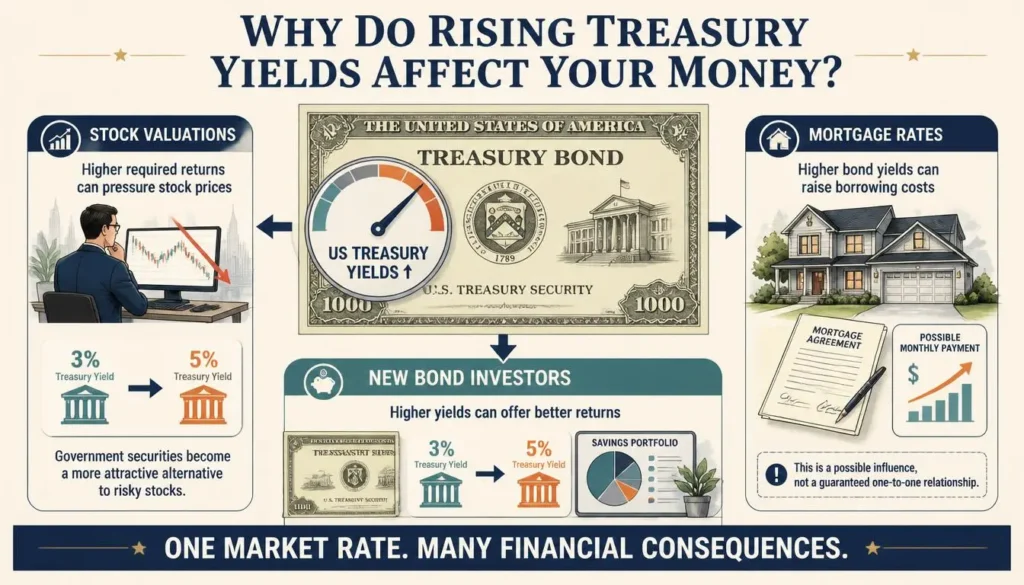
This is a hypothetical illustration of valuation compression, not a prediction or a rule that Treasury yields cause a specific change in P/E ratios.
Why Are Technology and Growth Stocks Often Sensitive?
Think about two businesses.
One already generates substantial profits.
The other expects much of its success to arrive ten or fifteen years from now.
When investors demand higher returns, profits expected far in the future generally lose more of their present value.
That’s one reason highly valued growth stocks can be especially sensitive to rising interest rates.
But there’s an important catch.
Rising Treasury yields don’t guarantee falling stock prices.
If yields rise because the economy is growing strongly, companies may generate higher earnings, supporting their share prices.
The real question is whether stronger earnings can offset the pressure from higher required returns.
And for many Americans, the effect of higher yields doesn’t stop at their investment accounts.
It can show up in the cost of buying a home.
5. How Do Treasury Yields Affect Mortgage Rates and Your Monthly Payments?
Imagine you’ve finally found a house you love.
You’ve saved for the down payment. You’ve calculated your monthly budget. Everything seems affordable.
Then you check mortgage rates.
They’re higher than you expected.
Suddenly, the same house costs significantly more each month.
This is one of the most relatable ways Treasury yields influence everyday life.
US mortgage rates are closely connected to conditions in longer-term bond markets.
The 10-year Treasury yield is an important reference point, but mortgage rates also reflect mortgage-backed securities markets, lender costs, credit risk, and other factors.
Former Federal Reserve Chair Jerome Powell made an important distinction at his July 30, 2025 press conference: the Fed sets an overnight policy rate, not mortgage rates directly.
What Difference Can Two Percentage Points Make?
Let’s say you’re borrowing $300,000 with a 30-year fixed-rate mortgage.
| Interest rate | Monthly principal and interest |
| 5% | Approximately $1,610 |
| 7% | Approximately $1,996 |
| Difference | About $386 more per month |
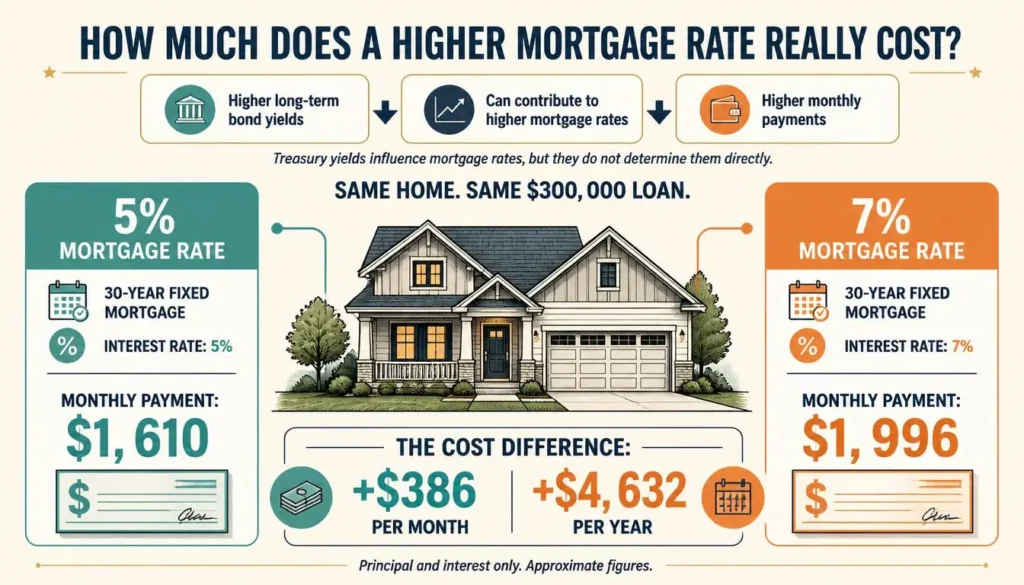
That’s roughly $4,632 more per year for the same loan amount.
Over 30 years, assuming the loan remains unchanged and is fully repaid on schedule, the difference in total payments is approximately $139,000.
And that’s before property taxes, homeowners’ insurance, and other housing expenses.
This is a hypothetical mortgage comparison, not a claim that a particular Treasury yield change automatically causes a two-percentage-point increase in mortgage rates.
Still, it shows why interest-rate movements matter so much.
A family that could comfortably afford a house at one mortgage rate might struggle at another.
Higher financing costs can also affect businesses.
A restaurant planning to open another location may delay expansion. A construction company may find new projects less profitable. A manufacturer may reconsider borrowing to buy equipment.
And when enough households and businesses delay spending, economic growth can slow.
So even if you never buy a Treasury bond, the Treasury market can influence how much you pay to borrow.
But that raises an interesting question.
If rising yields make borrowing more expensive, why do some investors celebrate them?
6. Are Rising Treasury Yields Good or Bad for Your Money?
Meet Sarah and Michael.
Sarah bought a long-term fixed-rate Treasury bond several years ago.
Michael has been keeping money in cash, waiting for a suitable investment opportunity.
Now Treasury yields rise.
Sarah checks her investment account and discovers that the market price of her existing bond has declined.
Michael, meanwhile, can buy newly issued Treasury securities offering more attractive yields.
Same market movement. Two very different experiences.
That’s the important lesson.
Higher Treasury yields create winners, losers, and trade-offs, not one universal outcome.
For new Treasury buyers, higher yields may mean better prospective returns.
For existing bondholders, higher yields generally reduce the market value of their fixed-rate securities.
For borrowers, higher interest rates can make mortgages and business loans more expensive.
For stock investors, the effect depends on valuations, corporate earnings, and the reasons yields are rising.
But What About Inflation?
Imagine earning a 5% return while prices increase by 4%.
Your investment balance is growing, but your purchasing power is increasing much more slowly.
The approximate inflation-adjusted return is only about 1% before taxes.
Now imagine earning the same 5% while inflation is just 2%.
Your purchasing power grows much faster.
That’s why a higher quoted yield doesn’t always mean a better real return.
Investors need to consider both the money they’re earning and what that money will buy.
Two Very Different Reasons for Higher Yields
Scenario A: The economy is growing strongly.
Businesses are expanding, employment is healthy, and investors expect stronger economic activity.
Treasury yields rise partly because growth expectations improve.
Higher borrowing costs may create challenges, but stronger business earnings could help offset them.
Scenario B: Inflation fears are increasing.
Investors become concerned that prices will keep rising, and they demand greater compensation for holding longer-term debt.
Treasury yields rise, but businesses and households may face higher costs without corresponding income growth.
Both scenarios involve higher yields.
Yet their implications for the economy and stock market can be very different.
So, what should you do when the next headline announces another jump in Treasury yields?
7. What Should You Do When Treasury Yields Rise?
Imagine three people reading the same news.
One is saving for a house.
Another is investing for retirement.
The third owns long-term bonds.
Should all three react in the same way?
Not at all.
The smartest response depends on what you’re trying to achieve with your money.
If You’re Saving for a House
Pay attention to mortgage affordability and how soon you’ll need your savings.
Higher Treasury yields may coincide with higher mortgage rates, but the relationship isn’t exact.
If your home purchase is approaching, protecting your down payment and understanding your borrowing costs may matter more than chasing a slightly higher investment return.
If You’re Investing in Stocks
Don’t assume rising yields mean you should immediately sell.
Instead, ask whether your investments are reasonably valued, whether the businesses can handle higher borrowing costs, and whether your portfolio is sufficiently diversified.
A strong company can still be an expensive stock.
And an expensive stock can become vulnerable when investors demand higher returns.
If You Own Bonds or Bond Funds
Pay attention to duration.
Duration measures how sensitive a bond’s price is to changes in yields.
A bond with longer duration generally experiences larger price movements when yields change.
Also remember that owning an individual Treasury until maturity is different from owning a bond fund. A bond fund’s value can fluctuate, and it generally doesn’t promise each investor repayment of a fixed principal amount on a particular maturity date.
If You’re Investing for Retirement
Your time horizon matters.
Someone retiring in two years may need a different mix of investments from someone retiring in thirty years.
Rather than changing your entire strategy because of one Treasury-yield headline, consider whether your investments still match your goals and ability to handle losses.
Benjamin Graham emphasized the importance of a margin of safety in The Intelligent Investor, particularly in Chapter 20.
The principle is relevant here: financial decisions should allow room for uncertainty rather than depend on a perfect forecast.
You don’t need to predict exactly where Treasury yields will go next to make thoughtful decisions.
Three Questions to Ask Before Reacting
- Why are yields rising? Is it inflation, economic growth, Federal Reserve expectations, or government borrowing concerns?
- How does it affect me? Am I borrowing money, buying stocks, holding bonds, or saving for a near-term goal?
- Does it change my financial plan? Or am I simply reacting to another alarming headline?
Understanding these three questions can be more useful than trying to guess tomorrow’s Treasury yield.
The Bottom Line: Treasury Yields Matter More Than You Think
Remember the $10,000 you saved at the beginning of this article?
At first, a Treasury yield rising from 3% to 5% seemed like a straightforward opportunity to earn more money.
But now you can see the bigger picture.
That same movement can influence the prices investors pay for stocks, the interest households pay on mortgages, the financing costs businesses face, and the returns available to savers.
It can be good news for some people and challenging news for others.
And the reason yields are rising can tell you something important about inflation, economic growth, and investor expectations.
So the next time you see a headline saying “US Treasury Yields Are Rising,” don’t just scroll past it.
Ask yourself why they’re rising, and what that means for your own money.
Because you don’t need to own Treasury bonds to be affected by Treasury yields.
You just need to save, borrow, invest, or plan for your financial future.
Frequently Asked Questions
Why are Treasury yields rising?
Treasury yields can rise because investors expect higher inflation, stronger economic growth, higher future Federal Reserve interest rates, or greater compensation for holding long-term government debt. Increased Treasury issuance and changes in investor demand can also influence yields.
What happens when Treasury yields go up?
When Treasury yields rise, prices of existing fixed-rate Treasury securities generally fall. Higher yields can also influence stock valuations, mortgage rates, corporate borrowing costs, and investment returns available to new bond buyers.
Why do Treasury bond prices fall when yields rise?
Older fixed-rate bonds become less attractive when comparable new securities offer higher returns. Their market prices generally fall to make their yields more competitive. The reverse happens when market yields decline.
Do rising Treasury yields cause the stock market to crash?
No. Higher yields can put pressure on stock valuations, particularly for highly valued growth companies, but they don’t automatically cause a crash. Corporate earnings, economic growth, inflation, and investor expectations also influence stock prices.
Why do higher Treasury yields affect mortgage rates?
Treasury yields serve as important benchmarks for longer-term borrowing costs. Mortgage rates are also influenced by mortgage-backed securities markets, lender pricing, and borrower characteristics, so they don’t move exactly in line with Treasury yields.
Are higher Treasury yields good for savers?
They can be beneficial for investors purchasing new Treasury securities because higher yields offer more attractive prospective returns. However, inflation, taxes, investment maturity, and liquidity needs all affect whether those returns are suitable.
Should I buy Treasury bonds when yields are high?
Higher yields can make Treasury securities more attractive, but the right decision depends on your investment horizon, cash needs, inflation expectations, and ability to hold the security until maturity. Higher yields alone aren’t a sufficient reason to invest.